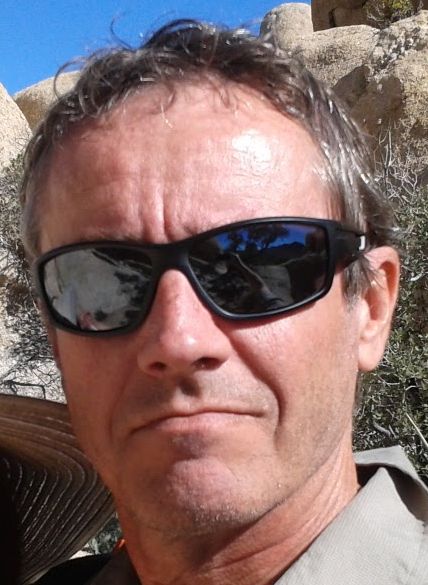
During the Heisei era, Omni Productions gave voice to the Godzilla series in the English-speaking world. For many years, however, Omni Productions remained a mystery for just about anyone who didn’t work in the Hong Kong dubbing industry. Through various recent interviews with the voice actors who were there, we can finally piece together a vivid history of the dubbing studio that spoke for Godzilla in the ’90s and beyond. Martin Pachy was not just an Omni Productions voice actor; he was one of the company’s most prolific scriptwriters, and, in this May 2026 interview with Brett Homenick, he breaks down the process of writing a dubbing script in the pre-digital age, in addition to sharing his recollections of the assorted personalities behind Omni Productions.
Brett Homenick: What can you tell us about your early years, particularly when and where you were born and grew up?
Martin Pachy: I grew up in Essex, UK, living in a small town with local shops and a countryside feel. My parents, brother, sister, and I lived in a bungalow with a good-sized garden, overlooking the golf course and Thames Estuary, so I spent a lot of my time playing outside.
I went to a local comprehensive school where I studied to O-level and then went to sixth-form college at 16 but dropped out after a year due to ill health.
I started work at a freight forwarding company in nearby Brentwood at 17. My father was in the same line of business and was working for a different company in London. I stayed in the freight forwarding business for around eight years until I went traveling.
BH: At that time, what were some of your hobbies and pursuits?
MP: Like most kids, we’d play football either in the garden or down on the local recreation ground, which was a 10-minute bike ride away. I learned to read at a very young age, and I used to read a lot.
BH: When did you become interested in Hong Kong or Asia in general?
MP: Both my mother and father had gone out to Australia when they were young adults, so I’d always had photos and mementos of their travels around me growing up. Also, I loved to look through atlases, just reading out the place names. So, although not specifically Asia, I already had an interest in travel and seeing the world at a very young age.
BH: What ultimately brought you to Hong Kong?
MP: In 1982, I had to decide whether to continue at my employer and agree to a transfer or go traveling. I chose the latter. After a season working in the Alps for a tour company, I set out in September 1983 with round-the-world tickets, traveling to Australia via Greece, India, and Southeast Asia. I ended up cashing in the rest of the tickets and heading back from Australia to Singapore, then by yacht to Phuket, and then to Hong Kong and home via China and the Trans-Mongolian Railway.
I only spent a few days in Hong Kong, mainly to get my China visa. But, a year or so after returning to the UK, a friend I’d traveled with in India called me from Hong Kong to say he’d got some work for me. Since I was at a bit of a dead end in the UK, I borrowed some money for a ticket and flew out.
BH: When did you arrive there?
MP: I arrived in late summer of 1986.
Unfortunately, the work didn’t pan out, and I had to find something that would pay the HK$10 a night bed at the Central Guest House on Canton Road. I started teaching English at HK$20 per hour, which at least paid for bed and board.
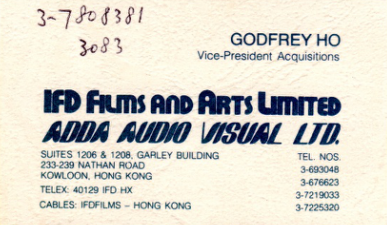
BH: I understand you worked with the notorious low-budget filmmaker Godfrey Ho. How did you get involved with his operation?
MP: I managed to get into dubbing some films in French for Rik and Ina Thomas and was told that IFD were starting up an English dubbing team, so I went along to the Garley Building on Nathan Road — no, I didn’t see Thomas Tang! — and met a girl call May and a guy called Steven — I think it was Steven — who started to give me dubbing work.
I found out IFD were also looking for European extras for Godfrey’s what I call “cut and shut” — a motor trade expression — films where he inserted ninja scenes into cheapo Taiwanese films he’d bought and then re-released them under a different name. He notoriously did this with footage filmed with Richard Harrison, much to the latter’s dismay. They needed us for the eye close-ups in fight scenes to show that the “baddie” being killed was European and not Chinese.
I did a couple of films with Godfrey up in Kam Shan Country Park, and one I remember well in an abandoned factory on the old Tai Po Road, which was especially fun because we did a big fight scene.
BH: What are some of your memories of working with Godfrey Ho?
MP: To me, Godfrey was — is! — an absolute gent. Of course, I only saw one side of him; I didn’t know him well, and others may have a different opinion. He was always very courteous, smiling, gentle, and a pleasure to work for.
The productions we worked on weren’t masterpieces, of course, but there was a demand for that type of film at the time, and he knew how to fulfil it. His budgets were tiny, and we didn’t have time to dwell on lip sync or voice tone. In any case, it wasn’t for native English-speaking audiences.
I remember working on a war film in a microscopic studio in the basement of a building on Waterloo Road one evening in a howling typhoon. The basement was leaking, there was all hell breaking loose outside, and there were four of us to dub a feature film that included dozens of characters and mass attacks by hundreds of troops. We did it in four hours flat. Job done.
But I still maintain that Godfrey was an artist at heart. Pragmatic but still an artist.
At the end of a take, his signature phrase was always, “Eighty percent! But good enough for me!”
BH: How did you join Omni Productions?
MP: In the guest house I was staying at, I was told about a guy who was looking for French speakers to dub Chinese government films at Clear Water Bay Studios. The films were being sent to the Chinese embassies in African countries as part of a cultural festival, I believe. As I was bilingual, I managed to get on the dubbing team.
The guy turned out to be Rik Thomas. On the first day at the studio, Ina and Rik basically taught me and the other new recruits to dub.
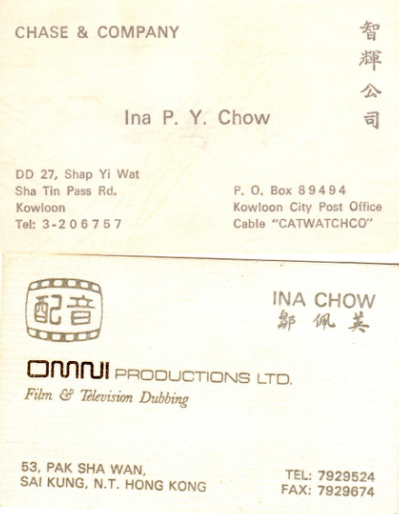
BH: There seems to be a lot of uncertainty about the history of Omni Productions. Would you happen to know when Omni Productions was founded?
MP: I first started dubbing for Rik and Ina in 1986. At that time, their company was called Chase & Co. I believe the change to Omni happened in around 1988, but I am by no means sure.
BH: Prior to Omni Productions, Ted Thomas was the king of Hong Kong dubbing. Did you ever meet or work with Ted?
MP: I never met Ted, although Rik did talk about him. I met and worked with some of the old guard, such as Warren Rooke and Chris Hilton, both very good dubbers.
BH: Rik Thomas is a larger-than-life figure among dubbing aficionados, and dubbing fans are always interested in learning more about him. What do you remember about him?
MP: Rik was a bit of an enigma for me at first. He sometimes talked about his earlier life back in Rhodesia, where I believe he was a policeman.
He had family, including a brother, back in the UK, but he was regarded as a bit of the black sheep, I think.
He said he’d been in Vietnam with the UK special forces, where apparently he worked with the Green Berets. He seemed to have had a very eclectic existence, but I am convinced everything he told us was true.
He had a reputation of being pretty strict, which is true, but he was the boss, after all. He had no time for niceties; he got straight to the point. If a dubber turned up smelling of BO, he’d tell them straight to their faces to go and wash. I never saw anyone take offense.
However, once you’d proved that you were worthy of trust, he was a true and steadfast friend who took an interest in you and your views and would talk/argue for hours about politics, history, cars, motorbikes, and almost anything over a few beers.
BH: What could you tell us about his wife, Ina Chow, who assisted Rik with the running of the company?
MP: Ina was a lovely person. She worked incredibly hard, directing the dubbing and scriptwriting, until others, including me, started taking the load, and putting up with the mayhem in the studio. She had the patience of a saint. She was the glue that kept the whole operation together. I don’t know anyone who could say a bad word against her. A wonderful person.
BH: I’ve heard there was a rivalry between Annie Mather and Rik Thomas. Could you shed any light on this?
MP: There was rivalry, but it was just professional; they had a lot of respect for each other, as far as I’m aware.
I don’t know if they dubbed together in earlier times or how Annie started her dubbing business, Lip Sync. She used to do some higher-market films, and I know she did work for Cathay Pacific dubbing in-flight films. Her partner was Sally Nichols, with whom I later worked on some telenovelas [Spanish soap operas] for Coral TV.
Rik didn’t like “his” dubbers — at least his A-team dubbers — working for Annie. He’d sometimes be short of dubbers when dates overlapped with Annie. But it was a difficult thing to defend, given that they were not on a fixed salary.
For example, Simon [Broad] worked on the “Judge Bao” [Justice Pao (1993-94)] series without telling Rik. I did a couple of bit parts on it, too. Word about Simon got to Rik — Annie used the same studios as Rik, and a technician at one of the studios let the cat out of the bag — and he didn’t use Simon again, as far as I remember.
But I don’t think they were direct competitors generally for the same contracts; they each had their own network of clients, although of course it must have happened on some occasions.
BH: How did you start writing scripts at Omni?
MP: As I said, I started out dubbing with the French group. Very quickly, I was asked if I wanted to write the dubbing scripts for those government films in French, since the people who were doing it at the time had day jobs, unlike me, apart from a few hours teaching English. Ina showed me how to punctuate the scripts to denote the different pause lengths and reactions, etc.
I then got drafted into the English-dubbing team and, subsequently, started writing English scripts. Since the scripts seemed to please, and no one else wanted to do the job, anyway — Ina no longer had much time — I was asked to become the main scriptwriter. I ended up scriptwriter for many of Omni’s films and TV series.
BH: Could you walk us through the process of writing a dubbing script?
MP: It depended on the format. At the beginning, for the French films, we’d take the English dubbing script done by Ina and try to fit the same length of dialogue in French without even seeing the picture.
Afterwards, if the films were on 35mm, I’d go into the lab and sit down at the Steenbeck with a pen and a pad of A4 paper and go back and forth on the reels to write the script. I’d have the Chinese subtitles either on the film or printed on paper, or both, as a guideline. Then I’d go home and type it up on the typewriter. This was all before computers became the norm.
Later, I started getting the films on VHS tape. I’d sit in front of the TV at home, hitting REW and PLAY on the remote control and writing the script on the pad, before typing up the handwritten script. I can’t recall how many times I had to stick the rubber cover of the REW button back with glue.
When I came back to Europe for the first time, in 1990, I did a couple of scripts for Omni. I received the VHS and subtitles by courier, [wrote] the script, and then faxe[d] it back, I think, maybe posted it back — I can’t remember exactly. It stopped pretty quickly because of the lengthy turnaround time.
I went back to Hong Kong in 1993 and managed to get access to a computer. I still used the VHS tape and subtitles, but I was producing the script directly on a word-processing program and sending it across to Omni by e-fax and then e-mail.
When I finally returned to France, I continued writing scripts using either VHS tapes or in some cases downloading the film from the net. I still have some of the tapes here.
BH: How long would it take to write a dubbing script?
MP: It depended on the amount of dialogue. A feature-length film could take between one and two days. I remember once we had a very short lead-in time. I started working on day one and worked day and night right through to the end of day two, at the end sending each page as I finished it directly to the studio fax machine so it could be dubbed.
You could usually do two or three telenovela episodes or four or five short cartoons in a day, sometime more.
In exceptional cases, for example, high-budget films such as To Live (1994), it would take longer in order to ensure closer mouth shapes and really work on the dialogue quality, which wasn’t possible on the cheaper budget films.
BH: When did you work at Omni?
MP: I started in 1986 and worked in Hong Kong until 1990, before returning to Europe. Then I came back in 1993 and stayed until 1998, working almost exclusively for Omni. I also had my own company, installing tennis court and stadium fencing.
BH: How long would it take to dub a film?
MP: Well, depending on the customer and budget, anything from four hours to two days.
In the case of the first Chinese government films — I think there were around eight of them in all — the English dubbing would be done on one Saturday. The following Saturday, the French team would come in, and it would take two long days, simply because they were not professional dubbers, and the process took much longer.
The low-budget films were done in less than a day. It also depended on how many dubbers were needed, if the dialogue was simple, the number of two-tracking required, etc.
BH: As much as you can remember, what was the pay like?
MP: Compared to what I was being paid for teaching English, it was pretty good. I think I started off at HK$40/hour for the French dubbing and about HK$60 for the English. Don’t forget that part of the time you’d be sitting in the rest area, drinking tea.
The main dubbers — Simon, John, Mike, etc. — I believe were paid more, but that’s normal. The rate went up as I gained experience.
I have a notebook from 1989 where I recorded some fees in Hong Kong dollars:
Script “Death Cage” 2000
Script “Thundercop” 2500
CWB dub Rik 21 hrs 2100
Steven dub 10 hrs 1500
Annie script “Shanghai Blues” 6000 [MP adds: “Annie Mather did higher-end stuff”]
Annie dub “Knockout” 3 ½ hrs 600 [MP adds: “I think that was for Cathay in-flight”]
That gives you some idea.
BH: How often was there work at Omni?
MP: It was pretty regular after I came back to Hong Kong in 1993. In the period [from] ‘86 to ‘90, I was working with other dubbing teams, such as Annie and Sally, Steven, Scott Smith, who worked with Godfrey, etc. From ‘93 onwards, I was doing two or three film scripts a month, I guess, and dubbing occasionally, although I was never an A-team dubber.
After I finally returned to Europe in 1998, I was doing scripts for Omni, either films or cartoons, and also worked with Sally on telenovelas. It wasn’t every week; it depended on the clients, but the telenovelas — 30-plus episodes — and other series kept me busy.
I even went back to Hong Kong for two weeks in 2000 because Omni were short of dubbers. It was for the Bakabon cartoon series, I think.
BH: What were the hours like?
MP: It depended if you were a main character or not. The main characters could be at the studio from 9:00 a.m. until the end of work — sometimes late. Otherwise, you might get called in for a few hours to do some minor parts.
Getting the dubbing schedule right was important — usually Ina’s job, I think. You couldn’t get to the end of the day and realize that there’s one scene left, and the person who plays character X went home three hours ago.
BH: Would you happen to remember if you worked on any Godzilla or other Japanese monster movies?
MP: Yes, I wrote quite a few Toho scripts. Some I remember were Godzilla vs. Mechagodzilla [II] (1993), Godzilla vs. Mothra (1992), a couple of others with Mothra in the title. I dubbed a few parts in them, also.
BH: Regarding the Godzilla or other Japanese monster movies, do you have any specific memories of writing the dubbing scripts for those, such as the inspiration for writing any lines of dialogue?
MP: With regard to the Godzilla movies, I didn’t have any special inspiration. I tried as best I could to keep it natural and stick to the mouth shapes, since they were films that would probably reach a wider audience than some of the cheaper, low-budget films that I wrote for. You have to be careful, however, not to overdo the mouth shape thing and make the dialogue sound unnatural.
BH: It’s certainly a long shot, but would you happen to remember any characters you played in any Japanese monster movie?
MP: When dubbing, I usually played supporting roles; I can’t remember any in particular. I think in one I was the young-ish chief of a military installation. It’s a long time ago!
BH: To the best of your memory, was there ever much studio involvement when it came to dubbing their movies and TV shows?
MP: If by “studio” you mean “client,” the Chinese government films were dubbed at Clear Water Bay Studios, which I believe was owned by the Chinese government, so their guys were usually around somewhere, although I don’t think they ever came into the dubbing studio itself.
Otherwise, I rarely saw anyone. There was one guy from London called Toby [Russell from the Eastern Heroes fanzine], who we dubbed a martial arts movie for. He was with us all day, but just to hang out, not to direct or interfere. In fact, he said it was OK to ham up the script; he didn’t care. We took him at his word!
The only time I encountered any form of interference was from a corporate video client. The English script had a stack of grammatical errors, which were pointed out to the client’s representative in the studio. She said we couldn’t change anything because the script had been written by her boss’s wife. That’s often how things were in Hong Kong.
BH: What other projects do you remember working on?
MP: I suppose some of the most notable projects were the Oshin (1983-84) NHK TV series. I wrote quite a few scripts and dubbed the part of an old man.
There was Zhang Yimou’s To Live, which was fantastic. I’m pretty sure the version we dubbed had a slightly different script ending to the normal version – I’ll have to check it out someday.
I did a few Hong Kong films, including City on Fire (1987), Aces Go Places (1982), Police Story (1985), God of Gamblers (1989), Chungking Express (1994), Rumble in the Bronx (1995), and others.
I think my favorite script of all was Flirting Scholar (1993) with Steven Chow and Gong Li. Hilarious. There were a lot of jokes and rhyming names that couldn’t be translated and had to be made up. It was a really difficult script to write and took ages, but the fact that the dubbers were falling about laughing in the studio was a sign that it worked!
[The Japanese anime series featuring the character] Bakabon was a laugh to work on, both the scripts and the dubbing.
I did a few telenovelas for Coral Films through Sally, including Mis 3 Hermanas (2000) and Mujer Secreta (1999).
Obviously, the Toho films are probably the best known.
Away from dubbing, Omni also asked me to help out as Jackie Chan’s English dialogue coach on Thunderbolt (1995). It was just a couple of nights’ work at Cinema City studio, but an interesting experience.
BH: What do you remember about working with Jackie Chan on Thunderbolt?
MP: Working with Jackie Chan was brief, but I enjoyed it. It was two or three nights at the Cinema City studio, overdubbing some dialogue. He didn’t speak very good English at the time, so he just needed someone to guide him on the pronunciation. The director was also there.
Jackie was a really down-to-earth guy. He was polite and easygoing, not at all the “star.” He ate his rice box with all the techs when we had a break. He was one of the lads.
BH: Several notable voice actors in Hong Kong ended up working at Omni over the years. Which ones do you have the strongest memories of?
MP: The A-team in the early years was based around Simon Broad, John Culkin, Mike Swift, Georgia, Chris Hilton, and Warren Rooke. There were others, but I didn’t know all of them. It morphed over the years, and, when I came back to Hong Kong in ‘93, there was Henry Coombs, Gemma McLean, Pierre Tremblay, the Sharons — 1 and 2 — Vivian, Darren, and others who had come onto the scene. But I was more involved with the scripts than the dubbing at that stage.
Henry and his partner Sally used to live upstairs in the same building as me out in the sticks. He and Rik and Ina were the ones I saw most, but it was always a pleasure to see the others in the studio. Great people, all of them.
BH: Do you have any specific memories of Chris Hilton, Warren Rooke, John Culkin, Simon Broad, or any other voice actor?
MP: I only saw them at the studio; we never really mixed socially. Part of that may have been due to the fact that I lived Kowloon side — New Territories, in fact — and they lived on the island. That was the way things were back then; each stayed [on] his side of the harbor. I think Warren moved to Macau later on.
There was also the generational thing. Warren and Chris were part of Rik’s dubbing generation; John and Simon were younger but already established dubbers. I was a newcomer and moved in different circles to them. The only ones I saw outside work were Rik and Henry Coombs — another newcomer who became the main male voice actor for Rik — since we lived in the same neck of the woods, and it was really the woods in my case!
Although we didn’t socialize, the atmosphere in the dubbing studio was great. They all had an excellent sense of humor. I was accepted pretty quickly, and we often had to be brought back to order because of the laughing. They were all really great to work with.
BH: Why did you move to Europe in 1990, and why did you move back to Hong Kong in 1993?
MP: The return to Europe in 1990 was because my girlfriend’s family was starting up a business in France, and I had invested in it. The reason I returned to Hong Kong in 1993 was because my girlfriend’s family had started up a business in France, and I had invested in it …
That and due to personal reasons and the fact that the economy in Europe at that time was in a pretty poor state. Hong Kong was a surer bet — and Rik said he could give me work.
BH: Why did you leave Omni?
MP: I had done my time in Hong Kong. My new partner and I had children growing up with the other parent back in France, and we wanted to go back. So we decided to call it a day.
BH: Do you happen to know the circumstances leading to Rik’s departure from the company?
MP: As far as I’m aware, Rik and Ina wanted to sell up and retire. I don’t think Rik ever “departed”; it’s just that the company was sold on. I don’t have any details of what happened at the time. I later learned they’d sold it and were moving to Penang.
I kept in touch with them by phone and saw them when they came to France a few years ago. Unfortunately, Ina was already ill, and she died a couple of years ago.
BH: Overall, how would you describe your time at Omni Productions?
MP: A blast. Very hard work at times, but a blast.
BH: Where has life taken you since your time at Omni and Hong Kong?
MP: I’m currently married and living in Marseille. One side of me wants to go back to visit Hong Kong for old times’ sake, but I know I won’t find the Hong Kong I knew.
Would be nice to catch up with some of the dubbers one day!


I (Adam Frank) was also one of those dubbers. Would love to reconnect with Martin and that gang.
LikeLike