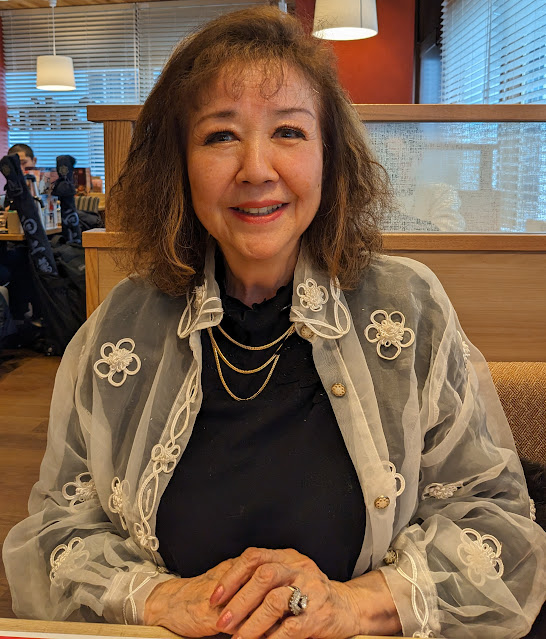
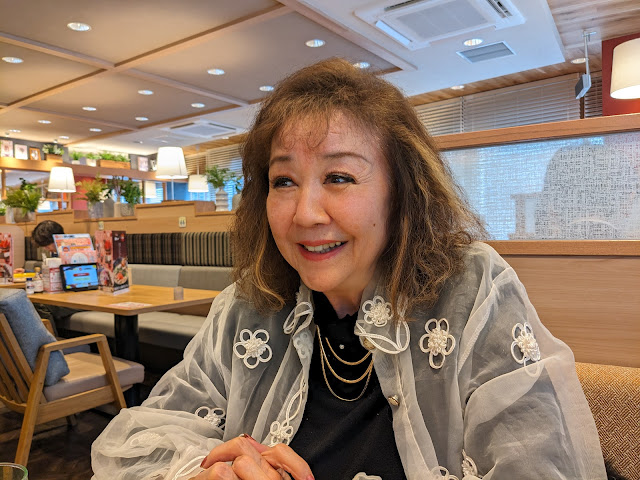
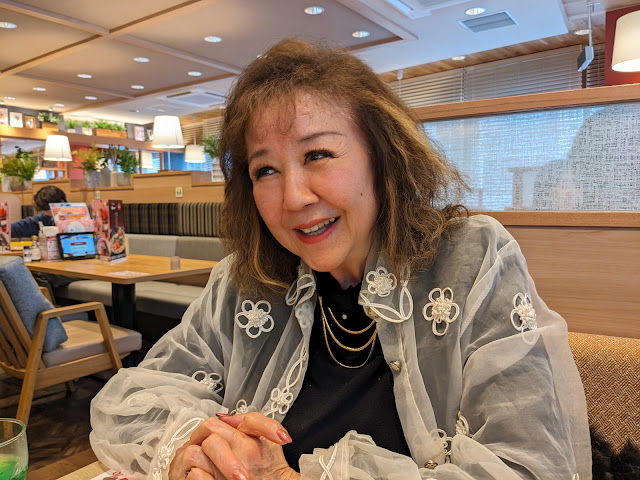
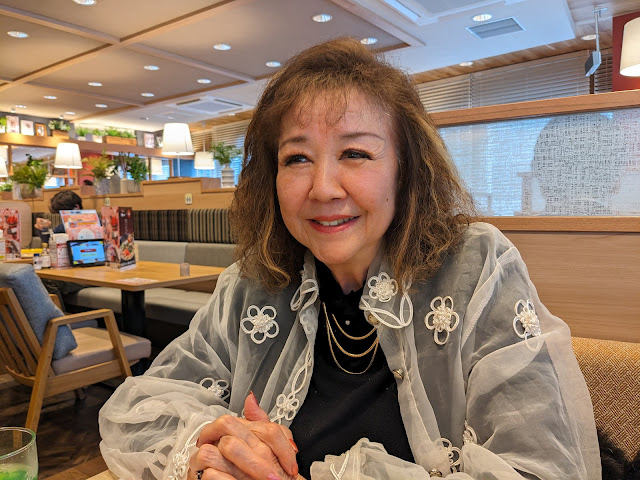
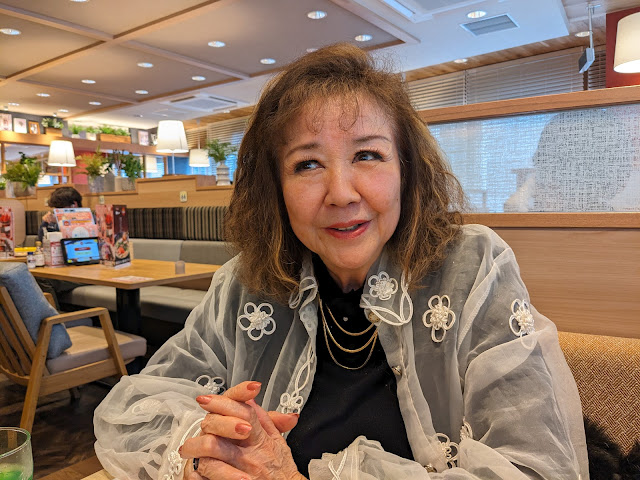
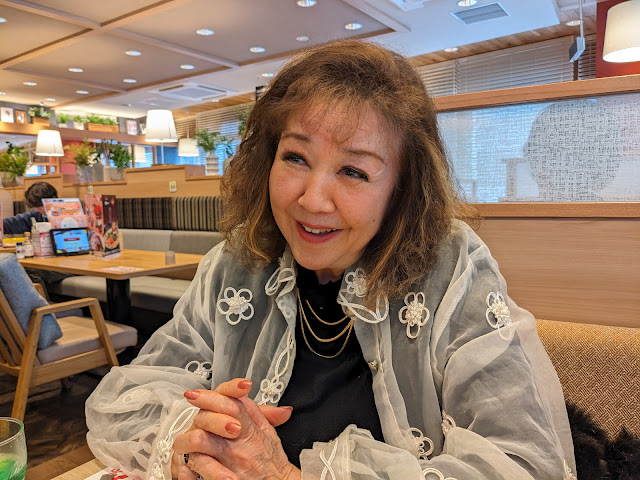
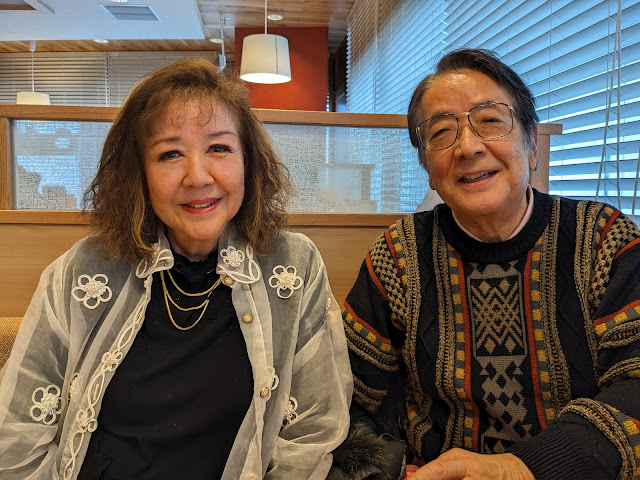
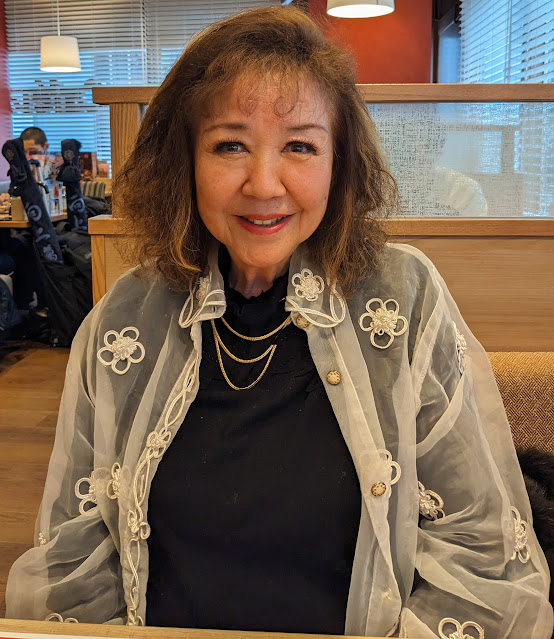
Tomoko Umeda may be known to Western tokusatsu fans for her leading role as Machiko Shima in Godzilla vs. Gigan (1972), but she made her mark on television in Japan in the late 1960s with her roles in various Toho-produced TV programs in the studio’s long-running “Youth” series. In particular, she portrays Reiko Nishiyama on the TV program Grand Youth (1967-68), appears in episode 11 of Go for It! Youth (1968), and plays Eiko Omura on the series Flame of Youth (1969). On film, Ms. Umeda also appears in the Crazy Cats production Japan’s Number One Shock Man (1971) as Misako Ogawa, as well as the Toho Champion Festival feature film Break Out, Youth! (1973) as Yumiko Miyashita. In her other television roles, Ms. Umeda appears in episode 5 of Jekyll and Hyde (1973) and episode 15 of Battle Fever J (1979-80) as Catherine. In February 2024, Ms. Umeda, joined by her husband, retired actor Tadashi Otani, and their daughter Reina, sat down with Brett Homenick for the following interview, translated by Maho Harada, about her life and career.
Brett Homenick: Where were you born?
Tomoko Umeda: In Tokyo.
BH: Tell me about your young life? What memories do you have of growing up in Tokyo?
TU: I always had fun. I was happy. (laughs) That’s it.
BH: What kind of hobbies did you have?
TU: I practiced classical ballet. When I was growing up, I first wanted to be an art teacher, then a classical ballet teacher.
BH: Did you do anything else when you were young?
TU: When I was young, [I went] swimming.
BH: Did you watch TV or movies when you were young?
TU: No, I was so busy.
BH: Where did you go to high school?
TU: Yamazaki Gakuen Fujimi High School.
BH: Do you have any memories of high school that you can share?
TU: I was in the gymnastics club.
BH: When you were in high school, what did you want to do after high school?
TU: In high school, I was already an actress.
BH: How did you become an actress?
TU: I took the Toho audition and was one of the 13 who passed.
Reina Otani: When you were in junior high?
TU: No, when I was in the 10th grade.
BH: Why did you apply for the audition?
TU: Because I wanted to [be an actress].
RO: The acceptance ratio for her high school was 27 times [one out of 27 people was accepted]. It was a smart school [a school that was difficult to get into]. She studied a lot every night, and [so] she could get into the high school.
BH: So it was very difficult to get into high school?
TU: Yes.
BH: Why did you want to be an actress? You didn’t watch TV or movies, so why?
TU: I actually wanted to be a singer. But there wasn’t a way for me to become a singer. There was an ad for [the] Toho New Face [program] in the newspaper, so I applied and passed the audition.
I was also accepted to be on another TV show at the same time, which was also with Toho. So I went to the Toho school and learned acting, singing, manners, and things like that for half a year, and I was on TV immediately after that.
BH: So this was Toho New Face. Please tell us what you had to do for Toho New Face, like the training and studying.
TU: Yes, I studied.
BH: For example?
TU: Classical ballet classes, singing classes, and acting classes. This was all at the same school.
BH: Do you remember any teachers? Did you have a famous teacher at the time?
TU: He was a critic [who often ended his television program by saying,] “Sayonara, sayonara,” but he has passed away. Hasegawa — no, Edogawa…
Tadashi Otani: Choji [Nagaharu] Yodogawa
TU: Choji Yodogawa, a very famous TV commentator.
BH: What did he teach you?
TU: I don’t know. Nothing in particular, but he came [to the school] and talked to our class. Just once or twice. The other teachers weren’t famous. The teachers who taught us weren’t famous.
BH: Do you remember your classmates from New Face?
TU: I’m still friends with them. They’re my best friends. Reiko Tokunaga, Shoko Sekiguchi, and Tetsuo Narikawa. That’s all. I’m still friends with them.
TO: Mr. Narikawa was probably the most famous.
TU: Spectreman! Mr. Narikawa was Spectreman. He was in my class.
BH: What can you tell us about your memories of him?
TU: He was very kind, a gentleman. He was very strong and very handsome. He was a very attractive person. But he’s passed away, so I’m very sad.
BH: Were you good friends with him, or did you just know him a little?
TU: Very good friends. I’m still friends with his wife, Shoko Seki [Sekiguchi]. This was a present from Spectreman, Mr. Narikawa.
TO: I don’t know why, but he gave it to me.
TU: We had a very close relationship.
BH: What is it? What is the thing?
RO: It’s gold.
TO: This is a bracelet with my name.
BH: Oh, I see. It says T. Otani.
TO: I don’t know why he gave it to me.
TU: But he passed away.
BH: That’s right. In 1968, you did [the television series] Grand Youth (1967-68). What do you remember about making Grand Youth?
TU: I played a student in Grand Youth. As I said before, I was accepted for a Toho TV show and the training school at the same time. I went to the Toho training school for six months, and Grand Youth was the first TV show I did immediately after the training school. I played opposite him [Tadashi Otani]. We were the main cast. Raita Ryu played the teacher, and we were the students. That’s how we met.
BH: When you met Mr. Otani, what attracted you about Mr. Otani?
TO: So handsome! (laughs)
TU: I was so disappointed. (laughs)
TO: Me too. (laughs)
TU: I was expecting my co-star to be very handsome, then I met Mr. Otani and was a little disappointed. (laughs)
BH: How about Raita Ryu? What do you remember about him?
TU: Mr. Ryu was very kind, a gentleman. He was a sportsman and very handsome. I’m going to be in a play with him soon. The play starts on March 20.
BH: Yasuki Chiba was the supervisor. Do you remember Mr. Chiba, and do you have any memories of Mr. Chiba?
TU: Sorry, I don’t remember. [Is he a] writer?
BH: Supervisor. Maybe the producer? He’s a famous director, too.
TO: He started out as a director, but he became a supervisor.
TU: I don’t think I met him during the shoots. He was a producer, so he was more behind the scenes. Producers don’t come to the studio very often, so I didn’t meet him.
BH: Do you remember Susumu Fujita?
TO: He was the principal.
TU: Yes, I remember.
TO: He was the principal, but I’m not sure what movie that was. He was a famous Toho actor.
TU: Oh, yes, I remember!
TO: He was fat. I mean, he was sturdy.
TU: Yes, I remember.
BH: What memories do you have?
TU: We weren’t in that many scenes together. But I remember what he looks like because we were in the same TV series.
TO: He was very famous.
BH: Yes, [he was in Akira] Kurosawa movies and things like that. Also, there was Flame of Youth (1969). What can you tell us about Flame of Youth?
TU: In Flame of Youth, I played the partner of an actor who’s very famous now — Yutaka Mizutani. We were a duo. We were both 15 years old. I had a lot of fun with Yutaka Mizutani. We talked a lot, and he was a very interesting person. I had a lot of fun.
BH: What about Mr. Mizutani? Do you have any other memories?
TU: Mr. Mizutani came to our house with his wife Ran Ito and their child Shuri when she was six. Shuri even took a bath together with my daughter. We had a lot of fun! (laughs)
BH: What do you remember about Akihiko Hirata?
TU: We didn’t work much together. We did a TV series together.
TO: He played the vice principal on [the television series] Go for It! Youth (1968).
TU: Yes. He was also in Godzilla vs. Gigan (1972). But we didn’t see each other much because we didn’t have many scenes together, so we didn’t have shoots on the same day. So I knew him, but I didn’t speak to him very much.
BH: What about Jun Tazaki? Do you remember Mr. Tazaki?
TU: Yes, I remember. But we didn’t have any scenes together, so I never met him. When you watch the completed show, you see me, and you see him, but…
BH: Mr. Otani was also in this TV series. What was it like working with Mr. Otani on Flame of Youth?
TU: What should I say?
TO: I don’t know! (laughs)
TU: He was very popular with women.
TO: I was 18, and she was 15.
TU: So he was like an older brother.
BH: [You were also on the television show] Turn to the Gold Medal! (1970-71) — please tell us about this [TV series].
TU: Turn to the Gold Medal! was made after the “Youth” series, and I was the lead actress. It was supposed to be on for three months, but it was very popular, so it went on for two years. I did things like the “flying fish turn” [a swimming technique]. It was very interesting! But it was very tiring because I was swimming all day.
BH: Yuriko Hishimi was also on this show. Do you remember her on this show?
TU: Yes, I’m friends with Chako-chan. It’s not often, but we see each other. We have dinner at her restaurant.
TO: There was also an awards ceremony or some kind of event.
TU: Yes, there was a Godzilla event. It was held at Yuriko Hishimi’s restaurant in Chofu.
BH: Asian Taipei.
TU: Yes! You know it. Asian Taipei. Yes, she’s a friend.
BH: [You appeared in the Toho feature film] Japan’s Number One Shock Man (1971) [alongside the] Crazy Cats. Please talk about the Crazy Cats and this movie.
TU: In Japan’s Number One Shock Man, I played the wife of Cha Kato from The Drifters. It was a long series, but for the last [movie in the series], Shock Man, I played Cha Kato’s wife. I had so much fun! Cha Kato was very handsome. (laughs)
BH: Hitoshi Ueki was in this movie. Do you remember Mr. Ueki?
TU: Mr. Ueki was a gentleman, and he was very kind. He’s very charming.
BH: What about Kei Tani?
TU: I don’t really know Kei Tani. I worked with Hajime Hana for six months on [the television series] Petite Woman (1973), which stars Yukiyo Toake. He’s a very charming man. He taught me a lot of things, and he is very kind.
BH: Wakako Sakai was also in this. Do you remember Ms. Sakai on any projects?
TU: I didn’t really work with her. Wakako Sakai is a little bit older than me. I didn’t really work with her. I think I met her at a party somewhere. I met her a few times, but I’ve never really spoken to her.
BH: Next, let’s talk about getting cast in Godzilla vs. Gigan. How did you get cast in Gigan?
TU: Yuriko Hishimi, Hiroshi Ishikawa, and the actor we spoke about before were all very nice, and I enjoyed working on this movie.
BH: When did shooting start? In 1971 in the fall?
TU: How old was I? Maybe 19? About 50 years ago. (laughs) Maybe about 50 years ago.
BH: Were there rehearsals for the shooting?
TU: We would all memorize the script beforehand and then go to the shoot. Test one, take one, take two. There weren’t any rehearsals. When we shoot a TV series in the studio, we have rehearsals in a different room. But, for movies and TV series, we have to memorize our lines and go to the shoot, then we start shooting right away. We do one or two tests, then start shooting. That’s how we did it.
BH: That’s interesting. What do you remember about the director, Jun Fukuda?
TU: Director Fukuda… We’re talking about 50 years ago, so I don’t remember very well. I worked with Mr. Fukuda, but I don’t remember which TV series it was.
BH: And, of course, Hiroshi Ishikawa is the star. What do you remember about Mr. Ishikawa?
TU: He was the main [actor] for Godzilla vs. Gigan. Was Mr. Ishikawa in a lot of different TV series after that? I didn’t see him much after that. But he was a serious, pleasant young man. This was 50 years ago. (laughs)
BH: You have a lot of scenes with Minoru Takashima, [who played the] hippie.
TU: It was the same with him. I saw him during the shoots, but I don’t know him very well.
BH: Ms. Hishimi is also here. What do you remember about Ms. Hishimi on Gigan?
TU: Ms. Hishimi was a very beautiful, kind, and funny girl. I love her! We still talk on the phone sometimes.
BH: Do you remember Toshiaki Nishizawa?
TU: He’s an actor who’s a lot older than me. We didn’t have any scenes together, so I don’t know him very well.
BH: Do you remember Zan Fujita?
TU: I don’t remember. I was a child, and everyone else was an adult. He was a lot older than me. We didn’t work together because we weren’t in the same scenes. We never had dinner together or anything, so I don’t remember him very well. I’m sorry.
BH: That’s fine. You have very colorful clothes [in this movie]. Did you have a choice in the clothes that you wore? How were your clothes chosen for the shoot?
TU: For work?
BH: Yes.
TU: The wardrobe person – like [the person who did my] hair and makeup, face makeup – the wardrobe person asked me to wear them. So I didn’t choose those clothes. They were prepared by the wardrobe person.
BH: After the shoot, could you keep your clothes?
TU: I had to give them back to the wardrobe person after the shoot. I would say, “Thank you,” and exchange them back for my own clothes. That’s how it worked.
BH: I understand, thank you. In your first scene, you run into Mr. Ishikawa and drop the tape outside an office building. Do you remember filming that scene?
TU: Yes, I remember.
BH: Could you talk about filming that scene?
TU: I fell; I slid. I just fell on my own. I was just supposed to run really fast, but I fell, and they used that in the scene. By accident! (laughs)
BH: Do you remember that location? Where was it?
TU: At Toho Studios in Seijo. There used to be a movie studio in Seijo Gakuen on the Odakyu Line. We were on a set there.
BH: Just to be clear, it’s [your] first scene where [you] accidentally bump into Mr. Ishikawa in the scene, in front of an office building. I don’t think it’s Seijo; I think it’s in another place.
TU: That was on location.
RO: You don’t remember where that was, do you?
TU: No, I don’t remember. We went there in a production van and started shooting, but I have no idea where it was. (laughs)
BH: There’s also a location and the night scene where Mr. Takashima and [you] approach Mr. Ishikawa. It looks like a park at night.
TU: No. I don’t remember. Sorry, I don’t remember.
RO: It was a scene at night, and the two of you were…
TU: Was it on set?
BH: No, it wasn’t. It was on location.
TU: On location? I went to so many. I worked on so many movies in so many places. On top of it all, it was 50 years ago, so I don’t remember.
BH: The apartment scene – was that a real apartment, or was it on the sound stage?
TU: No, it was on set.
BH: There’s also scenes where your character is going to many offices and driving around to many locations. Do you remember how long it took to shoot, going to many offices and driving around?
TU: Well, there were so many places. Some were close, and some were far, so…
RO: If it was close, 20 minutes, up to one hour.
TU: Yes, that’s right. For a shoot in Izu, it would take about three hours. If it was around here…
RO: From 20 minutes up to about one hour?
TU: Yes. From the studio, from Seijo.
BH: Also, there’s the fight scene with Ms. Hishimi, where she’s using martial arts to fight the bad guys, and [you are] there. [Do you] remember seeing Ms. Hishimi fight?
TU: Ah, karate. Yes, I remember.
BH: What can you tell us about that?
TU: Very interesting. (laughs)
BH: Do you remember how many takes?
TU: No, I don’t remember. That’s a difficult question!
BH: Also, on the set, there’s a forest. [Do you] remember how big the forest set was?
TU: That was on set, too, wasn’t it?
BH: Yes, it was a set.
TU: They made a forest in the big studio. “Thank you, Godzilla-san.”
It wasn’t that big. Maybe 1/4 of this place [a Gusto restaurant]. The actors were here, and the forest was there.
RO: 100 square meters, something like that?
TU: Not that big. About this big.
RO: About the size of Gusto.
TU: No, about 1/4 of Gusto. Very narrow.
BH: Oh, very narrow, I see. There’s also the Godzilla Tower set, with a big foot. You see Godzilla’s big foot, and it’s the set of the Godzilla Tower. Do you remember working with the set?
TU: That was on a different day, so I don’t know about it. Was I in the scene on that set? Was I there on the set?
BH: Yes. It’s not a full set. You see a full-size foot of Godzilla.
TU: That was also [shot] on a set. I think it was [shot] on a set, but I don’t really remember. But we would never shoot Godzilla in a [real] forest. And the buildings were small, miniature buildings with Godzilla. So we shot [that scene] on a set.
BH: There’s also scenes where people are sliding down from Godzilla Tower on a rope, and they’re sliding down. Kunio Murai, his character, falls. Do you remember filming that scene?
TU: No. I wasn’t in that scene, was I? If he’s sliding down, and I’m over here, it was a different set. This set was [shot on] another day.
TO: Different angle.
TU: Different day and different angle.
TO: One day, you shot only this angle. And, on another day, another angle. So she doesn’t know what happened.
BH: I see. Also, when Godzilla Tower explodes, there’s a strong wind in the character’s face. Do you remember on set how they did the wind effect?
TU: It’s hard [to remember]. For the explosion, I don’t think there were any actors. The technicians, the engineers, shot that scene. And another day. So I don’t remember; I wasn’t there.
BH: But the wind blows your hair back.
TO: A fan?
TU: Yes, with a fan, blowing [my] hair in my face.
BH: From a big fan?
TU: Yes. So, this [scene] — the explosion — we shot one week before, and, after one week, the other studio.
BH: I see. How long was the shoot? Was it one month or…?
TU: I think about one month. One month, two months.
RO: How long does it take to shoot?
TU: For scenes like the explosion, the engineers [technicians] would take a very long time.
I’m not sure about the technical things because I’m an actor, but usually it depends on the period in time and the director. Some directors would take a very long time, and other directors would shoot very quickly. For this movie, about two months.
BH: How many takes, usually?
TU: Maybe one or two.
BH: And what were the hours of shooting? From 9:00 until 5:00?
TU: If I was in a lot of scenes, I would be there from very early in the morning until very late at night. For Turn to the Gold Medal!, I was there from early in the morning until midnight. But, for Godzilla, it didn’t take the whole day. I think we were shooting for two or three days.
TO: For your scenes, it took two or three days?
TU: You don’t think so?
TO: I don’t think so. I think it took longer.
TU: Maybe. But I wasn’t there when they were shooting the other scenes. So, in total, almost 10 days to shoot my scenes.
BH: I see. And do you have any other memories of Gigan?
TU: I had a lot of fun, and Godzilla was very interesting. How should I put it? I have wonderful memories, and I had a lot of fun.
BH: When the movie came out, did you see it in a theater? Do you remember the release of the movie at all?
TU: I think I saw it at the [post-production] dubbing studio.
TO: Did you see it at a screening?
TU: I think I saw it at a screening at the [movie] studio. What do you call it when you watch it at the end with everyone?
TO: You’re not talking about a rush, are you?
TU: It may have been a rush.
TO: But a rush isn’t the final version.
TU: Right, it’s not the final version.
TO: It doesn’t have any CG.
TU: It wasn’t in a theater. Was it TV?
TO: They have screening rooms at Toho and other studios.
TU: They have screening rooms. That’s where I watched it.
BH: At the time, what was your reaction to the movie? What did you think when you first saw it?
TU: It was interesting!
TO: Including your acting.
TU: I was young and cute. (laughs)
BH: Another movie you did was Green Lovers (1975). It’s a Toei movie.
TO: You didn’t do any Toei movies.
TU: I was with Toho.
BH: So that’s wrong?
TU: Yes, that’s wrong.
BH: I’m sorry. [What about] Jekyll and Hyde (1973)?
TU: That’s so old! Tetsuro Tamba.
BH: Yes!
TU: I was in that [television series].
BH: Please tell me about it.
TU: Tetsuro Tamba was very fond of me. He gave me a nickname – Peter Pan – and called me Peter. He often invited me to meals, and I went to his home where he introduced me to his wife and children. We were very close. Tetsuro Tamba was very fond of me.
BH: Do you have any other memories of Jekyll and Hyde?
TU: In Jekyll and Hyde…what was it? I’m attacked by… Does Jekyll turn into Hyde? Which one was the bad one? The scene where I’m attacked was a bit scary.
BH: Akira Yamauchi was on the show 1-2-3 and 4-5-Roku (1972). Do you remember Akira Yamauchi?
TU: He played my father.
BH: Yes. What do you remember about Mr. Yamauchi?
TU: Mr. Yamauchi was very kind, a very nice person. I really liked him. He was a good father. It brings back memories.
BH: Yu Fujiki was also in the show.
TU: Yes, Yu Fujiki played the monk, Masaya Oki’s older brother.
BH: How about G-Men ’75 (1975-82)? Do you have any memories of G-Men?
TU: Yes. I wasn’t in G-Men, but I watched it on TV.
BH: Never a guest?
TU: No.
BH: On [your] Wikipedia page, it says [you were] on the show.
TU: I don’t know who put it on there [my Wikipedia page].
BH: I’m sorry. [What about] Battle Fever J (1979-80)?
TU: Battle Fever J — yes, I played Catherine, an intelligence officer from France. I forget if she was part of a gang. But she was a bit of a villain. It was a lot of fun! (laughs)
BH: Do you have any memories of Yosuke Natsuki in general?
TU: Yosuke Natsuki played the role of the first teacher in the “Youth” series. He passed away recently, and my husband was the chairman of his funeral committee. I received his shawl as a keepsake from Mr. Natsuki’s younger brother. I sometimes wear it. It’s blue and very stylish. It’s a muffler [scarf].
BH: When and why did you stop acting?
TU: [I became a] mother. A mother is very busy. I was busy raising children, so I didn’t have time to leave the house and work. I didn’t quit; I just didn’t have time to act.
BH: I understand your nickname was Pira.
TU: I hate that nickname. No, no, no. I hate Pira. (laughs) Do you know what Pira means? Piranha. I was 15 and knew nothing at all. At 15, you’re still a child. So maybe I didn’t greet people properly or was rude to people. That’s why they called me Pira, which is short for piranha. I want a cuter nickname. (laughs)

