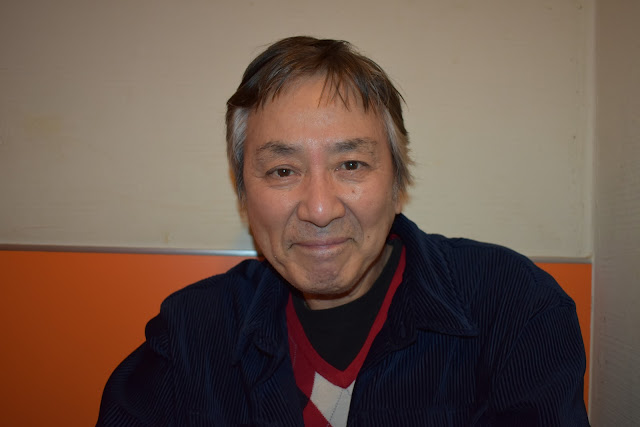
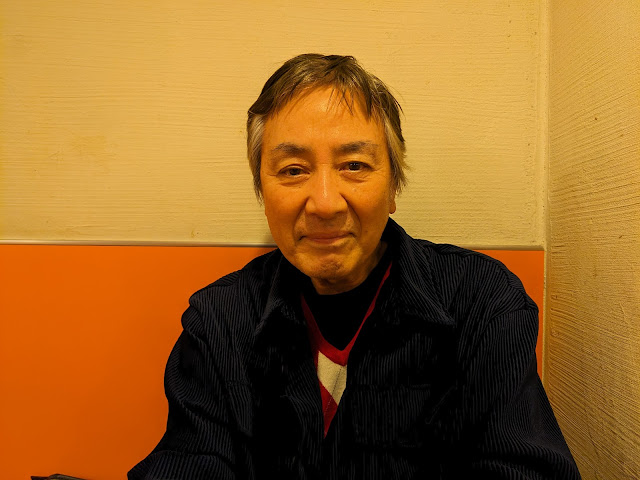
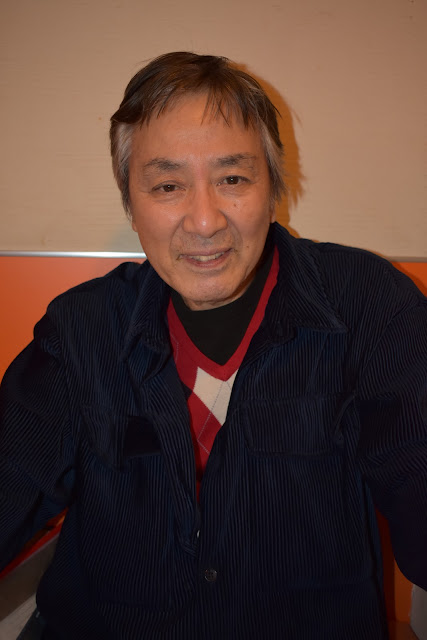
Born on May 24, 1946, Ryo Tamura comes from a famous family of actors, but his talent and longevity in the entertainment industry has made him a standout even among his distinguished pedigree. Mr. Tamura joined Toho in 1966, appearing in director Hiroshi Inagaki’s epic Rise Against the Sword, portraying the younger brother of Toshiro Mifune and Makoto Sato. Rise Against the Sword proved to be the launching pad of a decades-long film and television career that has seen Mr. Tamura work with such legendary directors as Akio Jissoji, Ishiro Honda, Kinji Fukasaku, and Jun Fukuda. In November 2023, Mr. Tamura and his wife, Shigeko, sat down with Brett Homenick to discuss his acting career in the following interview translated by Maho Harada.
Ryo Tamura: When I started working at Toho, I was still a student at Seijo. So, as soon as the shoot ended, I would go to my university to attend class. As soon as my morning classes were over, I would eat lunch and then go to the shoot around 1:00 p.m. So I didn’t really eat or have tea with Toho actors. I didn’t have any friends there.
Brett Homenick: Please talk about your early years. Where were you born, and where did you grow up?
RT: I was born in Kyoto. I stayed in Kyoto until I was seven years old, and then I came to Tokyo when I was eight years old. I went to elementary school in Tokyo.
BH: During your childhood, what were your interests and hobbies?
RT: I played baseball; I played all the time.
BH: Did you watch movies, too?
RT: Not at all. I didn’t go to see any movies.
Shigeko Tamura: Didn’t you see the movies your father was in?
RT: Yes, when I was small. Once, in Kyoto, when I was about six years old, I went to see a movie with my mother. We were in the — what do you call it? — control room, a special room. We watched the movie through a glass window at the very back [of the theater]. My mother was really interested in the movie, but I got bored and was restless. She scolded me and said, “Shhh, be quiet.” (laughs)
That movie was “Banzuiin Chobe” [Five Men of Edo (1951)]. My father was in it — he gets killed in the movie. I was really surprised because he always won. My father was always very strong, so I was really surprised. I thought, “Papa is dead.” I went home without saying a word. They explained that it was a movie. That was the first time I saw my father in a movie.
BH: Your family has a background in acting, so please tell us about your family’s acting history.
RT: My eldest brother, Takahiro, went to Doshisha University and became a salaryman. After my father died, director Keisuke Kinoshita came to the house and asked him if he wanted to be in a movie. That’s how he became an actor. My second brother wasn’t in the entertainment business.
My third brother started learning Noh in junior high, or maybe it was high school. He wanted to be an actor from when he was very young. He became an actor at Shochiku. I think he was also in a movie directed by Keisuke Kinoshita in the beginning [of his career]. I was next.
I didn’t plan on becoming an actor, either, but director Hiroshi Inagaki was going to make his 101st movie, which was a story about three brothers, with Toshiro Mifune, Makoto Sato, and others. There weren’t many actors at Toho who were his type. So director Inagaki said to the producer, “I think Mr. Tsuma has another son, so go seduce him.” Mr. Tsuma was my father. His name was Tsumasaburo Bando, but they were close, so he called him “Mr. Tsuma.” He [the producer] came to the house and spoke to my mother.
He said, “Director Inagaki wants him to be in the movie. What do you think, Mrs. Tamura?” I didn’t want to, but my mother couldn’t refuse director Inagaki. My mother said yes because it was director Inagaki, but I didn’t want to be in a movie. So that was my first movie. That’s how I joined Toho Studios.
BH: Please talk about [appearing in] in Rise Against the Sword (1966).
RT: I couldn’t act, so the director said, “Just memorize your lines. The camerawork will take care of the rest. So just memorize your lines; you don’t have to act.” That’s how we shot Rise Against the Sword. I don’t really like this movie. I was an amateur. I’m embarrassed to watch it now.
BH: In the trailer for this movie, you are billed as the “Hope of 1966.” Do you know why Toho decided to call you the Hope of 1966?
RT: We finished shooting, and then it was New Year’s. There were nine or so New Faces — newcomers that year. There were eight or nine of us standing under the sign for the Hope of 1966. It wasn’t just me; there were others who debuted that year.
Yoko Naito was one of the famous people in that group. You might not know her. Wakako Sakai, Noriko Takahashi, Keiko Sawai, Toshio Kurosawa, me, and maybe two or three others. All of us were called the Hope of 1966. Toho promoted us like that. So it wasn’t just me; it was all of us.
BH: Please tell us about working with director Hiroshi Inagaki.
RT: Some directors are really loud during the shoots, but director Inagaki was very quiet. He was such a gentleman. Others would shout, “Get to work! What time do you think it is? Run!” But director Inagaki would just say, “Start,” and, “Cut.” That was it. He really didn’t say anything; he was so quiet. He was very gentlemanly as a director.
BH: You co-star with Toshiro Mifune in this film. Please talk about your memories of Mr. Mifune.
RT: Mr. Mifune — I think he’s very shy. That’s why, when he drinks alcohol, his personality changes. He talks a lot and gets angry. I think he’s very timid, even though he looks intimidating.
ST: Don’t you have a photo with him?
RT: I do.
ST: But he wasn’t drunk then, was he?
RT: No, it was during the day, so he wasn’t drunk.
ST: He lived nearby.
RT: Yes, he lived nearby, in Seijo. His house was a five-to-six-minute walk from mine. I think he had a difficult time working with me because my father was “Bantsuma” [Tsumasaburo Bando]. So I think he was a bit reserved with me. He never told me what to do and instead just smiled at me during the shoots. There was a movie called The Mad Atlantic (1966), with Mr. Mifune as the chief fisherman and us as the crew. It was shot in the Canary Islands.
That was my first trip abroad, and I was very happy about that. We were staying at the same hotel. Around midnight or 1:00 a.m., I heard his drunk voice downstairs. He was yelling, “Come out, you idiots! Are you refusing to drink with me?” Everyone escaped to their rooms. (laughs) I think he felt more confident when he drank.
ST: Normally, he was quiet.
RT: Yes, normally he was very quiet. He was also very shy.
BH: Please share your memories of acting alongside Makoto Sato.
RT: We might have had tea together or something. He also drank, but he was a good drunk. He would laugh out loud.
ST: He was a happy drunk.
RT: Yes, he was a happy drunk. He looked like a foreign actor. I forget who … [maybe the actor from the TV series The] Rifleman (1958-63).
BH: Chuck Connors?
RT: Maybe. Does he look like him?
[is shown a photo of Chuck Connors] He’s not this handsome, but … (laughs) Maybe something like this.
Yes, he looked a lot like him. Mr. Sato would say so himself. “I look like Chuck Connors, don’t I?” (laughs) I don’t really know what he was like.
BH: There is a fight scene with Mr. Mifune in this film. Please tell us about shooting this scene.
RT: Was I in a fight scene with Mr. Mifune? I don’t remember.
BH: In Rise Against the Sword, [you are] in love with Yuriko Hoshi’s character. Please talk about what you remember about working with Ms. Hoshi.
RT: I forget if it was a Christmas party or a New Year’s party, but she had a party at her house and invited me. There were about 20 of us. I went to this party, but I was still a student then. She was very kind toward me and looked after me. After I quit Toho, we did a TV drama together. When we first worked on the movie, we only had two days together.
ST: Didn’t you do a play with Ms. Hoshi, as well?
RT: Yes, we did.
ST: I think you spent more time with her for the TV drama and the play than the movie.
RT: Yes, because we only had two days together for a scene in the movie, but that was it.
BH: You ride a horse with Mr. Mifune and Mr. Sato in this film. Was that difficult to do?
RT: Yes, we rode horses. Along the Odakyu Line, in Soshigaya or Chitose-Funabashi, there was a horse ranch where we trained to ride horses for a month or so. The Toho staff arranged for us to take lessons there. I had lessons in between my classes at university. I became quite good and enjoyed it a lot.
We shot on location in Gotemba, near Mt. Fuji. When I had time, I would ride horses in Gotemba. There was so much space to ride, so the horses loved it, too. It was so much fun. Thanks to that, I learned how to ride horses.
BH: There are many Toho actors in this movie. Please tell us about your general memories of Susumu Kurobe.
RT: Susumu Kurobe … I would say hello if I saw him at the studio, but I don’t think I worked with him.
ST: I think Brett would know.
RT: Did I work with Mr. Kurobe? What movie were we in together?
BH: There’s a scene with you and Mr. Kurobe, but it’s very short. Do you remember working with Hideyo Amamoto?
RT: He looks intimidating, and you never know what he’s thinking. Sometimes, if we were in the same shoot during the day, we would have lunch together because we lived close to one another. He would talk about foreign countries because he’s been to so many places.
I asked him why, and he said he would go on penniless trips in between projects. He would hitchhike and things like that. Well, he said penniless trips, but I’m sure he took some money with him. He would go for half a year and travel to many places. I was surprised that an actor did that kind of thing. That’s all I can remember about our conversations. He was quite an unusual person.
BH: Please talk about working with Ko Nishimura.
RT: My first impression of him was how well his voice carried. He had a great voice. He had a background in modern theater. People in theater groups do a lot of voice training from a young age. So he had a really good voice. On the other hand, for movie actors, it’s better if we don’t talk very loudly because there are microphones nearby. Mr. Nishimura came from theater, so he spoke very loudly because he had trained to speak onstage to a live audience. He had a great voice.
BH: How about Daisuke Kato?
RT: Mr. Kato . . .
ST: He lived nearby.
RT: Yes, he lived nearby. And, for our first shoot on location, I was on first, and then Mr. Kato was on after me. For the first shot, I was chopping wood. While we were shooting, I missed and cut my foot. My foot was bleeding a lot, so the director and everyone else were really surprised. I went to the hospital right away.
Mr. Kato was waiting because he was supposed to be on right after me, but the shoot was canceled, so I felt bad. The shoot was canceled, and I received treatment at the hospital. I had a few stitches. A few days later, Mr. Kato came to visit me at my house. He was really worried about me and asked how my foot was. I bowed deeply and apologized to him.
Before he left, he said, “Just make sure you rest and heal your foot.” He was such a nice man. All the veteran actors were very kind toward me. I think it’s thanks to my father.
BH: What were the filming locations for Rise Against the Sword?
RT: I went to the shoots at Gotemba and Ikuta, where they built an Edo-era village. I think it was Ikuta.
ST: Wasn’t it near Yomiuriland?
RT: Yes, it was probably Ikuta. Along the Odakyu Line [and] far away in the mountains. I went to these two locations. I’m not sure where the other actors went.
BH: Your death scene in this movie is amazing. This scene features a lot of action, and you even bleed from his mouth. Please talk about shooting this scene.
RT: The scene where I die — how does the scene go? I get stabbed and die, but I block the door, so it doesn’t close. Then everyone comes in and attacks. I don’t just get caught in the door and die; I block the door with my body so my allies can come in and attack. I wasn’t sure if the audience would understand. It might just look like I die from getting shot by a bow and arrow. I hope those who are discerning will understand.
ST: That was really interesting.
BH: In this movie, there are a lot of fires and burning structures. Were these scenes dangerous to film?
RT: Whenever there was any fire involved, there would always be one or two firetrucks. If there was a mistake and something caught on fire, it would all go up in flames. So we were never worried about a fire, and it wasn’t dangerous at all.
BH: How long did shooting last for Rise Against the Sword?
RT: Maybe just over a month. I wasn’t there for the whole shoot from start to finish, just for a few days in between. I think it took just over a month. For the Gotemba location, it kept raining, so they couldn’t shoot for two or three days. Things like that happened, so I think it was just over a month.
BH: Do you have any other memories from Rise Against the Sword that you could share?
RT: Other than hurting myself with the ax and learning to ride a horse, that’s about it.
BH: How did your life change after the release of Rise Against the Sword?
RT: My life didn’t change much. After the shoot, people at university mentioned they saw me in the ad for the movie on TV, but I didn’t like that.
BH: I understand that director Inagaki [was involved with your] wedding. Please tell us about it.
ST: We knew each other already, but director Inagaki acted as our matchmaker at the wedding [a person who serves as an official witness and gives a speech at a wedding]. Not a bridesmaid, but, at a church, the mother or father would do the same.
RT: Yes, I asked director Inagaki to be the matchmaker at our wedding.
BH: Do you have any memories about director Inagaki?
ST: We do. We always went to his home for New Year’s. And he lived nearby, too.
RT: Yes, we all lived nearby. What memories do we have?
ST: We always went to his home for New Year’s, didn’t we?
RT: Yes, but that’s about it.
ST: He did a lot of things for us. And we went to see him at the hospital before he passed away.
RT: Yes, just before he passed away.
ST: He said, “Ryo-chan, thank you so much for coming,” and was really happy you came to see him at the hospital.
RT: Yes. The only movie I was in that was directed by director Inagaki was Rise Against the Sword, so we didn’t see each other much after the shoot was over. But we would visit him at New Year’s, and we went to see him at the hospital. But that was it, I think.
ST: But we did see him every now and then.
RT: I forget — director Inagaki’s son is a cinematographer. I’ll probably talk about this later, but he did the camerawork for Akio Jissoji. I bumped into him recently.
Often, people referred to director Inagaki as “Master” — that was his nickname. They called him Master Inagaki. If someone said, “the Master’s movie,” he was talking about a movie by director Inagaki. Nowadays, people refer to other directors as “master” if their movies have high ratings, whether for TV or film. But that’s wrong. “Master” can only refer to director Inagaki.
Akira Kurosawa made good movies, but they couldn’t call him “Master,” so they called him “Emperor” instead. You’ve heard of Emperor Kurosawa, right? If a movie is successful, people easily use the term “master” to refer to the director. They say, “We have to call him Master,” but only Mr. Inagaki can be called “Master.” I think they did a good job coming up with the title “Emperor” for Mr. Kurosawa. (laughs)
BH: How did you get cast in Come Marry Me (1966)?
RT: Was I in this movie?
BH: Yes. What do you remember about working with director Ishiro Honda?
RT: We lived very close by.
So we worked together then. I don’t remember at all. Mr. Honda made Godzilla movies. I didn’t know he made these kinds of movies, as well.
BH: Yes, he did.
RT: Is that so?
BH: Do you have any memories of Mr. Honda?
RT: Not at all. I don’t know at all.
BH: Do you have any memories of working with Yuzo Kayama?
RT: Did I work with Mr. Kayama? I don’t remember working with Mr. Kayama.
BH: How about Keiko Sawai?
RT: We were both selected as the Hope of 1966. She’s very beautiful and quiet. She never does anything flashy. She always sits there quietly, just smiling. She listens to other people talk. I remember her well. She might be older than me, but that doesn’t matter.
BH: How long did shooting last for this movie? You don’t remember?
RT: I think I only had two or three days of shootings because I wasn’t in that many scenes.
BH: Did you appear in Japan’s Longest Day (1967)?
RT: What role did I play? I was also in the two-and-a-half-hour TV special version [Tears of History (1980)]. It had a different title, but it was based on the same story. My character tries to interfere with the radio broadcast [to announce the end of the war] and, in the end, in front of the Imperial Palace…
ST: What about the movie?
RT: I don’t remember.
ST: You don’t remember director Okamoto, either?
RT: I don’t remember working with director Okamoto.
In the end, Toshio Shiba and I go like this [makes a gesture] and commit suicide in front of the Imperial Palace. That was my role in Japan’s Longest Day. So I get mixed up.
BH: Another movie in which you appear is The Mad Atlantic. Let’s talk about this film.
RT: Thanks to this movie, I was able to go overseas for the first time.
I went there, and it was fun. This is where Mr. Mifune got drunk and shouted. There was a hospital scene, so we were shooting at a hospital. In Japan, nurses wear white costumes [uniforms].
But there I saw nurses wearing pink [uniforms] for the first time. I thought it was really nice. A pretty pale pink, not a glaring pink. I didn’t know that that was possible. I understood that there are some things that you have to go overseas to understand. I remember being impressed to learn that for the first time.
BH: What do you remember about working with director Jun Fukuda?
RT: I remember Mr. Fukuda. Once, when I went to visit director Inagaki, director [Fukuda] was also there. It was long after we had finished shooting The Mad Atlantic. Before I got there, I think director Inagaki asked director Fukuda, “How was Ryo Tamura?” (laughs) Maybe they said to each other, “Amateurs are no good.” (laughs)
BH: Do you remember [anything else about] director Fukuda?
RT: One time, the shoot was going very late. It was 10:00 or 11:00 p.m. We were filming the typhoon scene with the boat. It was on a set, and there were three or four big oil drums above us that were filled with water. The director said, “Ready, start!,” and they poured the water from above.
But it didn’t work out, and the boat on this side was destroyed or something. It was getting late, and the director became really irritated, so he shouted at the staff. That wasn’t good; it wasn’t the staff’s fault. He would get angry and break things. I think director Fukuda was irritated, so it was difficult. The staff couldn’t say anything. All they could do was apologize.
BH: Please tell us about working with Mr. Mifune on this movie.
RT: I can’t say anything more than what I’ve said already. All I remember is Mr. Mifune getting drunk and shouting, making a scene.
ST: Was it the same when you went to the Canary Islands?
RT: Yes. This was at the hotel, where the walls were thin. His voice carried, so everyone in the hotel could hear him. He was so loud. When we’re on location, everyone goes to bed early because we have to wake up early in the morning. Mr. Mifune was drinking alone, but no one wanted to stay up and drink with him. That’s all I remember.
BH: What about Mie Hama?
RT: Mie Hama was also very beautiful. I don’t remember anything.
BH: That’s fine. Please describe your memories of working with Tatsuya Mihashi.
RT: He was such a gentleman. When he came to work, he would always dress nicely. We would be dressed like this. But, when he came to the studio, he always wore a jacket. He would say, “Good morning,” to everyone and was very gentlemanly. He liked cars. I don’t know if he bought it, but he had a Mustang Fastback. That was amazing! He drove it everywhere, and we said it was like he was throwing money away because he spent so much on gas. He liked to talk about cars a lot.
BH: Next, please talk about making Ghost Story of Two Travelers at Tenamonya (1967).
RT: Oh, I talked about this before. I think we shot this in Takarazuka in the Kansai area for the first time. [There were] Makoto Fujita, Minoru Shiraki, Ichiro Zaitsu — people whom we saw on TV a lot back then. I remember thinking, “This is how these people are.” I had fun.
Makoto Fujita always made us laugh with Mr. Shiraki. The shoot was a lot of fun. It was the first time we were shooting at the studio in Takarazuka, so we went to watch plays at the Takarazuka Theater in between shoots. So it was a fun several days.
BH: Please describe your memories of working with director Shue Matsubayashi.
RT: I don’t remember. What did we work on together? Oh, Tenamonya?
BH: Yes.
RT: Right. It was the first time I did a sword battle scene, so I wasn’t very good. But the director said to me, “Your father was so amazing,” and taught me a lot of things. I remember his being a fun director.
BH: Generally, what do you remember about Yu Fujiki?
RT: I know of him, but what movie were we in together? I don’t really remember talking to Yu Fujiki.
BH: Do you have any memories of working with director Zenzo Matsuyama [on Our Silent Love (1967)]?
RT: He was also a gentleman. He was always very well dressed. His wife was Hideko Takamine, an actress I liked a lot. The story was about a deaf person, someone who couldn’t speak, so I thought there would be no lines, which I was happy about. But, when I saw the script, I had a lot of lines. I was told that I had to say all that with sign language. So I had to take sign language classes every day to learn how to sign.
BH: Keiju Kobayashi was also in this movie. What was he like?
RT: Mr. Kobayashi was also very kind, but I never spoke to him. I only saw him at the shoots, but he was very considerate of people around him and was very kind.
BH: What do you recall about shooting Pomegranate Time (1967)?
RT: I remember the title, but I’m not sure what role I played in the movie.
BH: Hiroko Sakurai…
RT: Was Hiroko Sakurai at Toho?
BH: Yes.
RT: Oh, right. Now I remember. Wasn’t she in Ultraman (1966-67)?
BH: Yes. And the director was Eizo Sugawa.
RT: Eizo Sugawa?
BH: Yes. For example, Yuriko Hoshi, Toshio Kurosawa, Ayumi Ishida, and Junko Ikeuchi were in the movie.
RT: I know Junko Ikeuchi. That was for Pomegranate Time?
BH: Yes, that’s the movie, also with Hiroko Sakurai.
RT: I don’t remember what the movie was about.
BH: You played Lieutenant Mikami in Admiral Yamamoto (1968). Please talk about your memories of making this movie.
RT: I don’t think I had a big part.
BH: It’s not a problem if you don’t remember. What are your memories of working with director Seiji Maruyama?
RT: I know who Seiji Maruyama is, but this is in Admiral Yamamoto?
BH: Yes, this movie.
RT: I remember hearing that Seiji Maruyama was good at making war movies. I never really spoke to him, so I don’t know.
BH: According to Chotaro Togin, you were originally cast in Destroy All Monsters (1968) but, for some reason, left the project and were replaced by Mr. Togin. Is this story true? Were you originally cast in Destroy All Monsters?
RT: I’ve never heard of Chotaro Togin, nor do I know what he looks like. How many years ago was it?
BH: It was for Destroy All Monsters, a Godzilla movie.
RT: Right. I was supposed to be in this movie? I didn’t take the role, so he replaced me?
BH: Yes, in an interview four years ago with Mr. Togin, he spoke about this as a memory.
RT: I don’t think so, but . . . Destroy All Monsters . . .
BH: So you don’t remember Mr. Togin?
RT: No, I don’t. There are so many things I can’t remember.
BH: Around 1970, Toho ended its contract system, and the studio’s actors became freelancers. What do you remember about what happened at Toho during this time?
RT: My older brother, Masakazu, the second oldest, managed all my contracts. This is probably when the Five-Company Agreement fell apart. The agreement between Shochiku, Toei, Toho, Daiei, and Nikkatsu was called the Five-Company Agreement.
There was a rule stipulating that, if you belonged to one company, you couldn’t work for the other companies. Once that rule was gone, you could work for any company as a freelancer. Before that, with the Five-Company Agreement, I had a contract with Toho, so I couldn’t be in a Nikkatsu or Daiei movie.
BH: So the Toho contract system . . .
RT: [I had to do] at least three movies a year. I told them that I didn’t want to do that many movies because I had to attend class. So I asked them to keep it to three movies or less. If not, they could pay me per movie. My contract wasn’t that complicated. I wonder what other people’s contracts looked like.
ST: I don’t know how it was for others at that time.
RT: Not married then…
ST: I don’t know what the contracts were like with the movie companies.
RT: No, we don’t know.
BH: So the Toho contract system in the 1960s, did you like it?
RT: Not really. I didn’t really like the Five-Company Agreement. I wish I could have worked for any company, and they could have topped it off. If Nikkatsu wanted me to be in one of their movies, let’s say for one million yen, they could pay 1.5 million yen and give 500,000 yen to Toho. I wish they could have done it that way and let us do what we wanted. They could have paid extra. For example, Yujiro Ishihara from Nikkatsu.
BH: Yes, a big star.
RT: For example, if he were to be paid 10 million yen to be in a Toho movie, they could give him 13 million yen, with the remaining three million yen’s going to Nikkatsu. I wish they had a system like that. But what do I know? I’m not a producer.
BH: In 1970, you made a couple of movies at Daiei. How did this come about?
RT: I think this was after my contract with Toho ended.
ST: It was because you no longer had a contract with Toho, so you could work with Daiei.
RT: I think so.
BH: One movie was The Hot Little Girl (1970), directed by Yasuzo Masumura. Please talk about your work on this picture.
RT: He made a lot of good movies. People said he was intimidating when he got angry, but he never got angry at me. He liked swimming, and there was a scene in a pool. I could swim, but he said, “Mr. Tamura, this is how I want you to swim.”
He was wearing swimming trunks and swam frantically, although he was able to swim very fast. I think he really wanted to swim. He was a very good swimmer. Back then, my older brother was my manager, and Mari Atsumi was the marquee player at Daiei. She had a lot of sexy roles.
BH: Do you have any memories of working with Yusuke Kawazu?
RT: I know Yusuke Kawazu. He was very quiet and never said anything between shoots. He just sat there and watched. During the tests, when the lighting crew were adjusting the lighting, he would just watch. The rest of us would be chatting, but he was very quiet.
BH: How was Toho different from Daiei during this time?
RT: During this time, Toho made a lot of movies about salarymen. When I was there, they made a lot of salaryman movies, like the comedies with Hitoshi Ueki and the Company President series with Mr. [Hisaya] Morishige. Mr. Ueki portrayed ordinary salarymen with songs like “I Know, But I Can’t Stop.”
And, in another series, Hisaya Morishige did the Company President series. They were all big hits. There were also actors like Norihei Miki and Daisuke Kato. Toho put a lot of effort into those movies. With actors like Mr. Morishige, they had to put in that much effort.
BH: You worked with director Akio Jissoji on Mandala (1971). What can you tell us about working on this film?
RT: I really respect him. He’s the person I respect the most. There was a movie called Mujo [This Transient Life (1970)], which means nothing lasts forever. It was a trilogy.
ST: The first was Mujo.
RT: The first one was Mujo, the next one was Mandala, and the one after that was Poem (1972). Director Jissoji asked me to be in all three movies of the trilogy, so I was in all of them. Mujo won the grand prize at the Locarno [International] Film Festival in Switzerland, the Golden [Leopard] prize. But the Locarno Film Festival isn’t about actors; it’s about directors’ debut movies.
Director Jissoji’s first movie won a prize at the Locarno Film Festival. The Locarno Film Festival isn’t a well known festival in Japan, so nobody really talked about it. People in the movie industry knew about it, but the general public didn’t. It’s not as well known as the Academy Awards or the Venice Film Festival.
BH: Please describe working with director Jissoji.
RT: A stone Buddha. I was in a scene where I was digging by the side the road with a hammer. Director Jissoji said, “We’re going to shoot for a while, so keep digging until I say cut.” Normally, when you say a while, it means 30 to 40 seconds. But a minute passed, and we kept shooting. I glanced over and saw him sleeping. (laughs) I was doing my best to act, but he was sleeping. Then he suddenly woke up and said, “Cut.” (laughs) He was quite unique.
BH: Shin Kishida is another actor in this film. What can you tell us about working with him?
RT: He was also unique. Having said that, I don’t really remember what he was like. Mr. Kishida liked butterflies. He was always talking about butterflies. When I told him that I found a konohacho [orange oakleaf or dead leaf butterfly] but didn’t manage to catch it, he said, “It was probably a moth.” He knew a lot about butterflies, like which ones you couldn’t find in Japan, and which ones you would find in Thailand. Once he started talking about butterflies, he would get so enthused that he would stop eating his meal.
BH: You appeared in the Toho movie Tough Guy (1975), directed by Kengo Furusawa. What do you remember about this project?
RT: This was a hit on TV. Mr. [Teruhiko] Saigo and I were a duo. It was only supposed to run for half a year, but, because it got high ratings, it went on for three years. Because it had such good ratings, Toho wanted to make a movie. But the script wasn’t interesting. The TV script was written by Kobako Hanato, which is why it was so interesting. But the Toho one wasn’t interesting at all. It was a stupid movie. People at Toho will scold me for saying that. (laughs) Mr. Furusawa has passed away, hasn’t he?
BH: Do you remember Mr. Furusawa?
RT: I remember what he looked like, but . . .
BH: Was he a very loud director?
RT: No, not for this movie. We had been acting for a long time, so he didn’t have anything to complain about. My character, Ozaka, and Saigo’s character, Moyan, were already established. So he had no complaints about our acting. But there wasn’t a single cut that I thought was amazing. It was a really boring movie.
BH: What are your memories of working with director Kinji Fukasaku [on The Fall of Ako Castle (1978)]?
RT: He’s one of my favorite directors. He has a loud voice, but he wasn’t fussy about details. He was pleasant to work with, like splitting bamboo [straightforward]. He made some big hits with yakuza movies, right?
BH: Yes.
RT: I enjoyed watching him take shots from different angles. But he was a lot older than me.
BH: Do you remember working with Tetsuro Tamba and Shinichi Chiba on this film?
RT: Mr. Tamba always arrived late for shoots. We always started at 9:00 a.m., so we would arrive just after 8:00 a.m. for makeup, costumes, and wigs so that we could start at 9:00 a.m. But Tetsuro Tamba would arrive around 9:00 a.m. and say, “I arrived before 9:00 a.m., didn’t I?” He asked where Mr. Yamamura was, and people told him that he was already on set.
He said, “Mr. Yamamura is already here? Does that mean things aren’t going well with his wife?” He carried the conversation in that direction. (laughs) He was surprised that he arrived so early and said he was going to ask him why he came so early. That’s the kind of thing he would say, so you couldn’t get mad at him.
Is Mr. Chiba still alive?
ST: I think he passed away, and his children fought over the inheritance.
RT: Right.
BH: Do you have any memories working with Mr. Chiba?
RT: Not really. But he had trouble remembering his lines. He couldn’t input [remember] them. I don’t know if he was always that way or if he became like that when we started working together. But he could never remember his lines. Maybe it was because of his age. Or maybe he was that way since he was young; I’m not sure. He did a lot of action.
BH: That’s right. He was an action actor.
RT: Yes, so maybe he didn’t want to have any lines. (laughs)
BH: Which is your best movie?
RT: The movie Mujo. It wasn’t with Toho, but with Dokuritsu Pro. I really liked the movie Mujo. We stayed at this cheap inn in Kyoto for a long time. We all stayed at the same inn and ate together. It wasn’t anything fancy, but it was like training camp. I had a lot of fun.
BH: Which movie was the most fun to make?
RT: Mujo was fun to make, with director Jissoji. But it was hard work. We would shoot until 10:00 or 11:00 p.m., then we had to drive for an hour and a half.
ST: Maybe it was fun because you had to work hard, from morning until night. And none of you was famous, and everyone was staying at the same cheap hotel.
RT: It wasn’t a hotel. It was an inn — the Tajimichi Inn. That’s right. It was so much fun.
BH: Which director was your favorite to work with?
RT: Director Inagaki and Akio Jissoji.
BH: Which actors did you enjoy working with the most?
RT: This is a difficult question. Maybe there weren’t any actors who were fun to work with.
BH: Which actors were the best to work with?
RT: Natsuko Kahara. She was a grandma and has passed away. We worked on a movie together.
ST: Was she the one who founded [the theater group] NLT?
RT: Yes. She was like the grandma of Japan, always cracking jokes. She was never intimidating or on edge. She was easy to work with and fun to be with.

