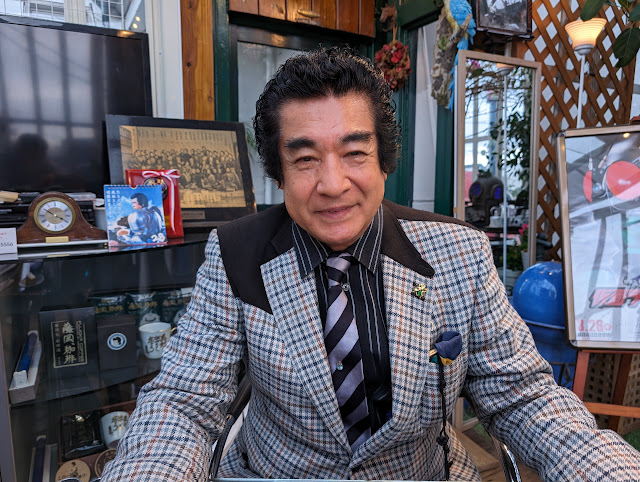
Born on February 19, 1946, actor Hiroshi Fujioka made his film debut at Shochiku in 1965, after which he appeared in a small role in the kaiju classic The X from Outer Space (1967). Shortly thereafter, Mr. Fujioka rose to fame with the popular TV superhero series Kamen Rider (a.k.a. Masked Rider) in 1971 as Takeshi Hongo. The lead role in Kamen Rider led to his starring in several Toho tokusatsu movies in the 1970s: Submersion of Japan (1973), Espy (1974), and Conflagration (1975). Mr. Fujioka was selected for the leading role in the Hollywood thriller Ghost Warrior (a.k.a. Swordkill, 1984) and became the first Japanese actor to become a member of the Screen Actors Guild. Aside from acting, Mr. Fujioka is also well known as an accomplished martial artist. Moreover, he is a member of a private volunteer group and for decades has gone to trouble spots and refugee camps around the world to help people in need by supporting humanitarian operations. He also has written many books, and he continues to act in various fields. In this March 2024 interview, translated by Nagako Okuda, Mr. Fujioka answered Brett Homenick’s questions about his life, acting career, and future aspirations.
Brett Homenick: Mr. Fujioka, thank you very much. First, please tell me a little bit about your early life. What are some childhood memories that you have?
Hiroshi Fujioka: In my childhood, I spent a lot of time playing in nature — mountains, rivers, and highlands. It was in these places that I played, and you could say my body was trained. I had a very healthy childhood in such an environment, so I feel like I was fortunate to have grown up there. My body became strong, and my senses or, rather, my body’s abilities, became very active.
It wasn’t in the city; every day was wild and expansive. There were many different animals. I played with various animals such as deer, wild boars, rabbits, raccoons, pheasants, and so on. I spent a lot of time in nature, interacting with these animals during my childhood.
BH: Why did you want to become an actor?
HF: Well, why was that? I was deeply moved by movies from around the world, as well as Japanese films. I was captivated by them, and my dreams expanded toward the world. I wanted to chase after those dreams and live in the world of visuals. I found great appeal in a worldview that transcends borders and ethnicities. My vision expanded toward the world of visuals. I felt I could chase my dreams together with it. That’s what I felt through the visuals. That’s why I pursued the world of visuals. That was the trigger. At the same time, because I was moved, that’s the main reason I was deeply moved by movies.
BH: Please talk about joining Shochiku.
HF: Shochiku was the oldest movie company at that time, so I was naturally interested in it. I happened to meet someone who was affiliated with Shochiku, a high-ranking executive, or a significant person at Shochiku. This person scouted me. When he asked me if I liked movies, I replied, “I love them.” So he said, “If you want to fulfill that dream, I’ll introduce you,” and he took me to the Shochiku movie company.
From there, I was able to join the actors’ training school where I could study to become an actor. Before that, I had been studying to become an actor at a theater company or training school, the [Gekidan NLT] Actors School, where I learned while working part-time. I was scouted there. So I was able to study at two different schools, the first one I went to and the one introduced to me by the person I met there. That was very beneficial.
BH: What was life at Shochiku like? Were you busy?
HF: It was a very large-scale company, and, since it was an old company, it had made many important Japanese films. I received guidance from the old, professional staff who had been making films for a long time, and that was also beneficial.
Essentially, the staff and members who had been making films on a large scale nurtured me. What I learned there was on a very large scale, and that became the foundation for my approach to films. It provided the foundation, laying the groundwork for me. For me, the opportunities there proved to be very useful later on. It became the foundation for me.
BH: One of your first movies was The X from Space (1967) in a very small part.
HF: Ah! You know?
BH: Of course!
HF: (laughs)
BH: What do you remember about the movie?
HF: I was a New Face at the time. For me, it was a mix of anxiety, fear, and a first-time challenge. So it’s very memorable. I still get surprised by how nervous I feel when I recall those moments. It was my first movie, you know. Oh, it was something. Not many people know about it, but you seem familiar with it. Impressive.
Guilala … At that time, Toho’s Godzilla was quite popular. And then even Shochiku started releasing [kaiju] movies. I was in that [movie] under those circumstances; it felt like I was really being featured for the first time.
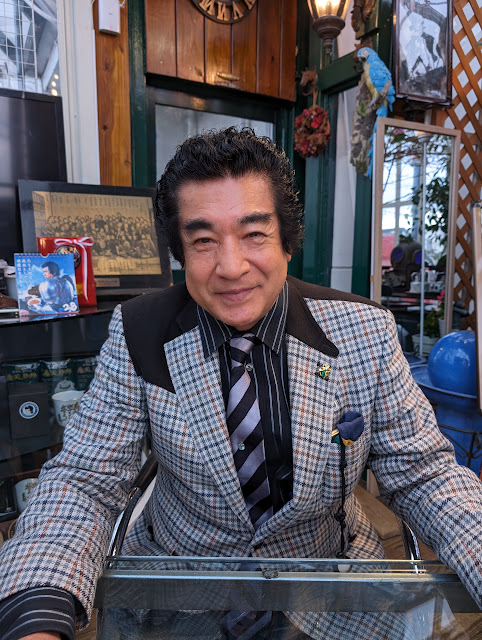
BH: You also did a movie with the Village Singers called Falling Leaves and Kisses (1969). What do you remember about this movie?
HF: Well, that was my first leading role. It was my first major leading role, so I was still young, basically following in the footsteps of my predecessors who received similar chances as newcomers. I still had some uncertainty and a lack of confidence as an actor, but I had to lay myself bare and just go for it.
It’s a good memory, reflecting on my youthful self from back then. It was a movie that perfectly reproduced the image of a young man chasing his dreams, clueless about everything. So it’s one of the deeply cherished memories from my youth.
BH: Around this time, the Shochiku contract system ended. How did that affect you?
HF: It allowed me to explore the allure of other companies, to challenge myself in various ways. By stepping away from Shochiku, I felt rejuvenated. Shochiku was known as an actress’ kingdom where actresses were highly valued.
On the other hand, there were many other film companies that revolved around male actors, so being able to challenge myself there felt like pursuing a big dream again. It brought me joy. Knowing that I could appear in other films was very gratifying. I couldn’t do that before because I was bound by contracts. But being able to challenge myself again was the most gratifying part.
BH: You also, at Toho later on, did The Black Battlefront Kidnappers (1973), with director [Eizo] Sugawa. So please talk about this film.
HF: That was a tremendous new challenge. It involved action stunts, all done by myself. It’s a work I’m very confident about, to the point where I can’t forget it. I tackled it using my entire body, and, when it went well, not only I but the staff and cameraman were also taking on challenges they’d never faced before. Everything from camerawork to filmmaking was put to the test.
The director allowed for such things, and, when I expressed my desire to do something, he let me try it. The cameraman captured it in unprecedented ways. It was a situation where there was a lot at stake, very dangerous situations that could have been life-threatening with a slight mistake. I knew the risks, but I believed that, by taking this seriously, it would enhance my value as an actor. So I embraced the adventure, the challenge, and it worked out.
[The movie’s cinematographer Daisaku] Kimura later became a director. He was the cameraman for the first time in my movie The Black Battlefront Kidnappers. He had such a spirit of challenge, and it resonated with me. It’s a work I still remember, a work I’m confident about, and one I want to preserve. It’s the most memorable for me.
BH: You also worked on Submersion of Japan (1973) with director [Shiro] Moritani and [co-star] Ayumi Ishida. So please tell us about this movie.
HF: Well, Ayumi Ishida was already very famous at that time, both as a very famous actress and a singer. It was my first encounter with her, and she was a wonderful person. She was dazzlingly bright, and filming started from our scenes together. Starting with those scenes, which were romantic in nature, was a huge help for me.
Despite the film’s grand scale and the pressure and stress I felt, especially with many veteran actors around, starting with scenes with her was very reassuring. It gave me confidence, and gradually I became more accustomed to the environment. Working alongside big-name veteran actors was a great learning experience.
I learned a lot, especially by watching the performances of the senior actors. Many famous actors were there, and being able to learn from each of them within a single project was invaluable to me. It provided me with the most treasures, which served as the foundation for my subsequent films.
BH: How about Espy (1974) with director [Jun] Fukuda?
HF: Espy came out during a time when there was a lot of interest and attention on psychic abilities and the unknown world they represented. It was somewhat of a boom for that kind of thing back then. I was also very interested in Espy. It had a wildly imaginative story line, but for me it felt futuristic and enjoyable. After it was completed, I thought, “Wow!” It was like my imagination was coming to life.
As we worked on it, the dreams expanded, and the excitement grew. There was a strong sense of anticipation about how the movie would turn out. When I saw the finished product, I was moved. I thought, “Ah, it turned out like this.” It was a fun and different challenge because it was science fiction. It holds memories for me as a unique film and a different kind of work.
BH: My last topic is Samurai of the Sky [a.k.a. Zero Pilot (1976)], so please talk about that and [Saburo] Sakai, as well.
HF: Mr. Sakai recommended me for this role as the actor to play himself, as he was globally known for his feats in Zero fighter planes. I was both delighted and, at the same time, wondered if I could portray a Zero fighter pilot. However, I had a great interest in Zero fighters, so I thought it would be a good opportunity and accepted the offer. As I worked on it, Mr. Sakai provided me with a lot of advice directly during the filming. I learned a great deal from his valuable experiences and stories from that time, experiencing and surviving the war.
Hearing many of Mr. Sakai’s actual experiences during the filming supported me in my role in the movie. It was a valuable experience for me to hear his firsthand accounts, and I learned a great deal. It was a practical, real-life story brought to the screen, based on a book written by Mr. Sakai himself, so it was a true story.
As the protagonist of that true story, it was a new challenge for me, portraying someone who had actually experienced those events. It was the first time I portrayed someone who had actually lived through those experiences. So, for me, it was a serious matter. There was talk afterward about whether I should try studying to become a Zero pilot. I initially said I didn’t have that ability, but Mr. Sakai encouraged me, saying, “No, you should go,” and he recommended it to me.
So I went to America to try studying to become a pilot. If I hadn’t had that encounter, I never would have thought about flying a plane or even considered it. Thanks to that encounter and the actual challenge, I realized that, indeed, I had the ability to become a pilot. It was a film born from such an encounter.
I thought it was great how, through such encounters, human potential and abilities are developed or drawn out. In my life, many discoveries have come through various encounters, through work and such. Life is like that. It’s about finding those things through encounters with people and being made aware of them. So it was great to enter this world of films for that reason.
BH: What is your dream?
HF: Well, my dream now is to collaborate with my family in creating memorable films together. I want to produce family movies that capture our family’s memories together. It’s also the dream of my children. The reason is that their dream is for their father to create a film that preserves our memories together as a family. What’s exciting is that all four of us are challenging ourselves in the world of cinema, as actors and actresses. This isn’t just a dream; it’s achievable. So I’m thinking of pursuing it as a dream, and I want to expand on these ideas while continuing to challenge myself.
I hope that this movie can be realized, and I would like to ask for your cooperation, Brett. My idea is to blend American culture, Japanese culture, and Nisei culture together, and create a movie that inspires dreams. I believe it would be enjoyable, and I would be grateful for your support in making this vision a reality.

