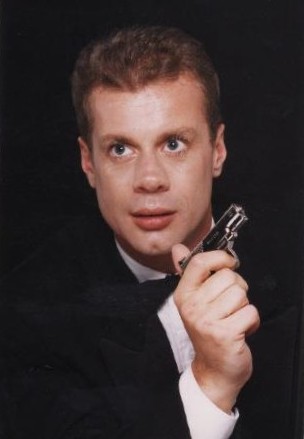
Simon Broad has been a staple of the entertainment world in Hong Kong for decades, and dubbing has played a big role in his career. Having given voice (in the English-language versions) to Seigo Okouchi, Demon Kogure, Abdul Zalman, and Osamu Amezawa in Godzilla vs. Biollante (1989), Kenji Ando in Godzilla vs. Mothra (1992), and a helicopter pilot in Godzilla vs. Mechagodzilla II (1993), Mr. Broad’s contributions to the Godzilla series are renowned. His work with low-budget filmmaker Godfrey Ho is also legendary, though perhaps in a slightly different way. In October 2023, Brett Homenick interviewed Mr. Broad about his storied dubbing career in Hong Kong.
Brett Homenick: Where were you born, and where did you grow up?
Simon Broad: I was born in Pahiatua in the Wairarapa, North Island, New Zealand, in 1963 – the youngest of three boys. My father owned a law practice there. Pahiatua is a small service town, catering to local farms, with a population of 2,800 today. New Zealand had just got television the year before, and there was one channel in black and white. There is and was a cinema there, and I would love going to the flicks for the children’s movies on Saturdays.
At the age of 10, the family moved to Wellington, the capital city. My brothers had both started boarding school in Wellington earlier, but I was spared the horror. We lived in Seatoun, just minutes from Karaka Bay, home to Peter Jackson, and Scorching Bay, a lovely inner-city beach. Idyllic days of swimming, exploring, and dreaming.
I remember when we only had one TV channel [in New Zealand] – it was black and white. And then I remember we got two channels, and there was color. I just thought, “How [much] more advanced could the world be?” We didn’t even have FM radio. The film industry at that stage – I was really interested in film and television – was absolutely zero.
This was before Peter Jackson, of course – before any kind of development was there with films, [before] any Hollywood films that were filmed in New Zealand or mentioned New Zealand. No, I just lapped it up because, “Oh, my gosh, we exist.” There was absolutely nothing going on, film-wise. I think one of the first films was Goodbye Pork Pie (1981) that [received] international recognition.
But I left in 1981. I was just wide-eyed and bushy-tailed and just couldn’t believe I’d landed in such a cosmopolitan city as Hong Kong in the early ’80s.
BH: But, when you were young, were you interested in movies?
SB: Absolutely, yeah. The town [in which] I was brought up is very, very small, but it still to this day has beautiful, wonderful theater called the Regent [Theatre] – I think it was in those days. It was art deco, and it was in the center of the town. I remember just the aura of going down to see movies on a Saturday morning when you’re very young. All the kids were there; it was just amazing to me. It was just such a different world. And my mom would take me to the next-nearest city to go and see movies. I just loved it.
In New Zealand, too, in those days, it was so restrictive on Sundays. You couldn’t go to the movies. You couldn’t go to see first-run films; you could only see double features. Coincidentally, my parents were very friendly with a Protestant minister who ran a thing called Mission to Seamen in Wellington. So, whenever there were any merchant seamen in town, they would come to the mission and get coffee.
Every Sunday, he would show movies. So he would bring his son and myself, and we could sit and watch the movies. It was a really great experience – saw some great movies. And my father, on Friday nights, would make it a thing that we would go for dinner and then go and see a movie. I remember going to see some movies on my own when I was really young; I really loved that.
In New Zealand, too, in those days, it was very traditional for your birthday party – your friends would come over, you would go to the movies, your parents would ring up and say, “What time does it finish?” and pick you up afterwards.
We were so far away from the States and from the UK that it just really got my imagination going, and it would just open up so many worlds to me. So I always knew I wanted to be involved somehow in television or film.
I was always going to the movies and watching TV. New Zealand produced very little programming or movies, but we were lucky to get an almost 50/50 split of U.S. and UK programs on TV and cinematic films. I lost myself in many a movie house, as I prefer to watch films alone.
BH: During that time, in your childhood, did you have other hobbies or interests?
SB: Yeah, lunch was very important to me. (laughs) I was very academic at school. My brothers were very athletic, and I was more the pudgy one with asthma. So I did drama at school, and I did debating and stuff like that. And then I had to do a lot of studies because I got pushed ahead a couple of years.
I’ve always enjoyed being alone, so I did stuff on my own a lot. I was always quite envious of people that were in gangs and hanging out together. I just never fit in with all that, so I was always a bit of a loner.
Wellington being a port, and because I knew that one day I would travel and see the world, I had a great interest in aircraft and ships; they fascinated me, and I loved the design.
BH: How did you discover Chinese culture and Asian culture in general?
SB: Well, before I went to Hong Kong, I remember I had a really good friend in Wellington. I went and met his family and then tried some Chinese food.
When I was in New Zealand, a lot of the green grocers and market gardeners were from Hong Kong originally or Canton [Guangzhou]. Also, in 1976, my parents took me around the world as an adventure, and the last stop we had before we went back to New Zealand was Hong Kong in January 1977. I just couldn’t believe it, and my mother and father were just amazed by it, too. The bustle, the lights, the constant energy of that city was great, little knowing that four years later I’d be living there.
And New Zealand does consider itself part of the Asia-Pacific region, I think. So it was always around. I was always very interested by it, and, growing up, in social studies one of the biggest projects we did was Japan and China, and that just fascinated me.
I remember studying Japan and Chinese culture in social studies classes. I was thoroughly intrigued by these two countries. Because New Zealand was so cut off from the rest of the world in the ‘60s, I had a real thirst for knowledge and understanding of foreign countries.
I remember my neighbor went to Expo ‘70 in Osaka, and – oh, my gosh – it was so futuristic. I just couldn’t believe the stuff that was coming out of Japan, too, at that time. [There is the] classic picture of the bullet train on the rails with Mount Fuji in the background.
It was incredible, [and it was] showing there was such energy and such creativity coming out of some of Asia that I was just fascinated by it. So, when my father got the job there, I just jumped at the chance to go with him. And I really, really was looking forward to it. I had to pinch myself for months after I first got there to say, “Wow, I’m actually here!” So it was great.
BH: Where did you go to school? Did you attend university?
SB: Yes, I went to a prep school, a church school, and then I went to a school called Wellington College, a high school, which my father had attended, my grandfather and all my relatives [had attended, too]. My father was [on] the board of governors when I was there.
My family has a long tradition there. Funnily enough, I had the same teacher as my dad had, Mr. Bradley, commonly known as “Horse” due to his prominent front teeth. It is a single-sex school, and we had to wear short trousers until we were 16, freezing in the winter! I did several school plays while at high school and was an avid debater. Both my brothers were great athletes at school, but sadly my talents lay in other directions, mainly lunch break and drama. My best and favorite subjects were English, biology, and history. Schools were strict in those days; we were caned for misdemeanors and malarkey, and heavy emphasis was placed on producing generations of civil servants, doctors, lawyers, accountants, etc.
I started at Victoria University in Wellington at the age of 16 3/4, studying philosophy and Renaissance English literature, aiming to get into film appreciation in my second year. At that time, New Zealand had no film industry to speak of, apart from the government’s National Film Unit and, shockingly, a very small wine industry. Today, those two industries are quite big. I dreamt of traveling overseas to experience the world.
From the age of 14, I would attend speech and drama lessons on a Saturday with a lovely lady called Mavis Ring, whose son was a radio DJ. My mother did not want me to have a pronounced New Zealand accent, and these lessons helped a great deal. While my peers were playing rugby and cricket, I was learning about diction and diphthongs. Every year, an examiner was flown out from England from Trinity College School of Speech and Drama to test our standards, and I continued with that until I left New Zealand in 1981. I have always loved etymology and find words, languages, and accents fascinating.
BH: After that, let’s talk about moving to Hong Kong, so talk about the circumstances that led you [there] and also the time frame when you moved there.
SB: Well, I moved there in 1981. In late November 1979, our family was struck by tragedy, as my uncle and cousin were killed in a plane crash. An Air New Zealand DC-10 hit a mountain in Antarctica while on a sightseeing trip. My uncle was my father’s elder brother, and after the accident my father looked for jobs overseas.
I think it made my father realize that life’s too short, and he wanted to get out and see the world more. So that’s when he started applying for jobs. Me being the youngest, he didn’t have to worry about kids at school anymore.
In the end, there were two options: Rabaul in New Guinea – since wiped out due to a volcano – and Hong Kong. He was successful in getting a job in Hong Kong, and so my mother, father, and I packed up the house and left for Hong Kong in July 1981, leaving one brother behind in New Zealand and another in Australia. He had married a lovely lady from Queensland.
So my dad applied for a job with the government. He was a lawyer. He was in the Law Society and had his own practice in New Zealand, and he applied and got this job in Hong Kong and started off as a magistrate. One brother would come visit us a lot [in Hong Kong] – he stayed for a while. We arrived on Air New Zealand on July 12 [at] 4:30 p.m. [in] 1981, and I had no idea what the future was going to hold for me.
I remember, after a few months, I really [felt] I had to get out and do some work. The government was very generous to expatriate families in those days. There weren’t enough apartments in Hong Kong at that time, so we had to stay in a hotel. I had my own room in the Hongkong Hotel, later at the [Hotel] Merlin – since demolished. They would pay for one trip home a year till I was 18, and then we found an apartment.
I started doing what everybody does when they’re in Asia; I started by teaching English – just conversational English. I was probably the youngest of all this group of people that had come over there. I wasn’t hanging out with expat children; I was hanging out with people that had actually made a decision to live in Hong Kong.
Life was good; there were not too many young expats here at that time. Most of us were the children of government, army, or merchant families. My dubbing life was just around the corner.
I met this woman from New Zealand – she was a girl then. She was a model – the name of Tina. She needed somewhere to stay for a while, so she got to stay with my parents and myself. She’d done a film, I think, and she had to do the ADR – the dubbing – of it, and she said to me that they’re looking for more people to do English dubbing. I did a couple of modeling jobs before that. I still think I’ve got a great face for radio. (laughs)
So I did a couple of modeling jobs, and then I did one TV commercial. I played a dog; I had to bark the name of the product. It was for a television company, Grundig. I think that was the first thing I ever did.
And then Tina introduced me to this crew that were doing English-language dubbing of Chinese costume dramas for both ATV and TVB, which were the two main TV channels – ATV used to be called RTV – for Indonesia. That was the bulk of the business. That’s how I started.
At that time, anything in [the] Chinese language, printed or spoken, was illegal in Indonesia and had been since around 1966. The shows would be subtitled in Bahasa but needed an English track for import. The company was called ACE and was located [on] Austin Road. I went for an audition and got a job there, meeting a new team of people who were learning this quite strange craft of lip-synced film and television dubbing.
So my entry to HK film and television English voice[-dubbing] had begun with huge jobs and opportunities just about to open up for the next nearly 40 years.
All the clients, companies, and people involved in HK film in the ‘80s were about to be a part of my life. ACE closed down relatively quickly, which led to an amazing opportunity and awakening of dubbing in HK.
We were just mass-producing show after show after show, getting paid cash. I really fell into that. It just grew from there, mushroomed out from that point.
The dubbing director [at ACE] was a guy called Mr. Chow [whom] we used to work for, and I think he ended up being the chief dubbing guy at ATV later on. So it morphed from there. I think the company just kind of folded, and then I moved into another group. There were two groups. There were two different recording studios – one for TVB and one for ATV. So we would commute between the two.
The one for TVB was in Kowloon Tong where the TV studios were, and it was in this old mansion. We would dub upstairs in what used to be bedrooms, I think. It was converted; it was a beautiful old house.
And the other one called Systems Video was where we did all the ATV dubbing. Through the people I worked with, when I moved into that, it expanded my network of talent that I was working with. You know, there were actually independent people that were looking for freelancers like us to work on separate film projects, as well as those television projects. That’s how I started getting into doing film.
It was a small market, small talent pool, and you just kind of worked your way up to getting to know everyone in town – all the producers, all the companies that were making English-language versions of global product.
BH: Around what time did you start working with Godfrey Ho?
SB: Godfrey Ho – I think that must have been, like, ’83, ‘84. They wanted me onboard with him; he needed more people. Godfrey, we always worked with at night, and in this really, really small studio that was a converted apartment in Tsim Sha Tsui [on] Kimberley Road.
And Godfrey’s movies would always be at night. I’ve told this story: We had to knock on this door, and this old guy with slippers would answer the door. We used to call him “Hemorrhoid Harry” because always in the fridge when you looked down there was hemorrhoid cream – we thought it was his.
Godfrey worked in this one studio. It was late and really old equipment. Every other unit in that building was an apartment, residential. And Godfrey would be there; he would always wear, like, tracksuit bottoms. He’d crouch on the floor and watch your take every time. In those days, film was looped. So you had to dub a whole loop of film.
So, in those days, there was no computerization; everything was just on a reel, and the film was cut up. I think Godfrey used to ask us to cut it at 70 feet – from 70 to 90 feet. Just put your chalk marks on and call it “reel 1, scene 2,” or “1-2,” then it would all be chopped up.
Your scenes weren’t always on. I think we used to get paid, in those days, by the film. I don’t think it was hourly. It was never done in sequence; it was always done when your parts, [which were] mostly crowd scenes, were done.
Later on, I got to do scripts with Godfrey and with Tomas Tang, IFD. I think they call it a Moviola in the States; we always called it “steam bag” for some reason. I think that was the brand name. So I learned from Godfrey, and his films were like three films cut into one.
I remember at that stage “ninja” was all the rage; “ninja” had sold really well. So every film title Godfrey did was “Ninja something,” I think. So he would get an old film from the Philippines or somewhere and then an old Hong Kong film, and then he’d shoot his own stuff, and merge it all into one and make up a whole new story for the film, which was really bizarre, and then call it “Ninja.”
The scenes he filmed were usually with ninjas, so [they were] people jumping out of bushes all dressed in black. And he used some of the people I worked with – he filmed with them – like John Culkin, and there were some other big names, Stuart Onslow-Smith. They used to dub, as well.
So it was always quite [at] late night you had to work there, and it was just a strange environment. (laughs) As I said, he’d sometimes give you a book of the story, and then you’d have to write the actual film around the story that he’d developed. You had to do the actual dialogue, the lip-sync scripts, [based on] what he would give you. Sometimes, we worked off a subtitle list that we made into a lip-sync script. Sometimes, the script would be just written around the synopsis that he’d made up for one of his ninja classics.
And now he’s a very well-respected professor, I think – well, he’s teaching – at the Hong Kong Polytech about film. But he was part of that whole IFD/Filmark [world]. We never knew what was really going on; it was all quite murky. The infamous Tomas Tang – do you know the mystery of Tomas Tang?
BH: Actually, I don’t. Could you tell me about that?
There was somebody called Tomas Tang that they said ran one of the companies, but no one ever saw him, and no one knew who he was. Some people thought it was Godfrey; some people thought it was somebody else.
Nobody knew who he really was, and he was behind IFD and Filmark. If Godfrey was not him, then I think they fell out. The rumor was that he died in a fire [when] the Garley Building caught fire rather badly [on November 20, 1996], and some people were killed, and they always said Tomas Tang died in that fire. But he was a man of mystery; we never really knew who he really was.
So that was, as I said, those Godfrey Ho productions [and] Filmark. And it was very OTT, especially the trailers. It was just very over-the-top. They were fun days. Now, I think they’ve got a cult following. At the time, we were like, “Who is watching this?” But now I think they’ve got a real cult following, Godfrey Ho’s films.
BH: What other memories do you have of working with him?
SB: I remember that he was a really nice guy, always smiled. He would never say something was wrong or really bad. He would always just smile at you: “Uh, maybe we could do that again.” Because, as I said, it was the loop system, if one person made a mistake on the film, you’d have to do the whole thing again. I think there were two tracks – one track for music and effects called the M&E [music and effects] track. So, if somebody made a mistake, you’d have to just do the whole thing again.
So we liked to do it as short as possible. What always got to me in those early days of film was the crowd scenes. With Godfrey, not so much, but some of the other films we did. I mean, you’d have to be, like, 20,000 guys coming over a hill sometimes, and there’s only six of us. And street crowd scenes, too – you’d have to sit there and do all the noises for the background scenes. I’m sure, if you listen very carefully on some of those films, you could hear some of the bizarre things that we were saying.
Godfrey spoke English, but he would never know what kind of accent we had or what we were really saying in the background sometimes. But it was always a good experience working for Godfrey. It was funny. We enjoyed it.
BH: Did you ever appear on camera for him in one of his movies?
SB: No, I didn’t. I didn’t want to do that, but John Culkin did, Stuart Onslow-Smith did, Andy Chworowsky did, and Richard Harrison, of course – I only met him once, I think. He did a lot with him; he did a lot of films with him. When he filmed the local scenes, I think he liked to use guys that had some martial arts training.
So I didn’t have any training whatsoever in that department; I just liked being the voice. As I said, great face for radio. (laughs) Now I wish I had pushed it kind of, but I didn’t. I was just more interested in doing as many films as possible with voice.
BH: Do you remember any specific titles of Godfrey Ho movies that you worked on?
SB: Oh, anything beginning with “Ninja.” (laughs) Or with “Ninja Master,” “King of Ninjas.” There must be literally hundreds of them, but they all had the word “Ninja.” I mean, I could look it up on IMDb.
BH: Well, when it comes to the actual process of working with Godfrey Ho, could you walk us through a typical project? Also, [for] the dubbing session, what were the hours, specifically?
SB: I’ve kind of touched on how the scripts were done. So one of us, whoever he trusted to do it – there were only three or four of us who could do that – would do a lip-sync script for him. And then, while we were doing the script, we would also cut the scenes. Sometimes Godfrey did that, but we usually, as I said, put the chalk marks on the thing, showing the guys where to cut each reel. So they were on every nine to 10 reels of film.
Then we cut it to as many as 25 scenes per reel – each one’s about 10 minutes long. What happened in those days was – and I think it still goes on – there are certain things you write on scripts in Hong Kong that show dubbers each reaction or if it’s no sound. [For] the reaction, you could put “RE” in brackets.
Now I know a lot of people laugh about the dubbing quality of films from that era. And, yes, there were some shocking cases. But a lot of the time, really, it was the machinery. It was so old. I remember that studio. The projectors broke all the time, or the film broke, and the technicians, as I said, were great – they were fantastic – but they weren’t really fluent in English. So sometimes the M&E wouldn’t match; they didn’t match it up properly. Or they would mix the M&E too loud. So that’s why the quality was suffering so badly in those days.
But we really, really did make an effort to make it lip-sync as much as possible. There were some techniques in cheap-budget films where we would stretch words when it wasn’t fitting. What you wanted to [have] at the end of every scene was that Godfrey approved it. He sat there, and he watched every scene when we dubbed it, and he had to approve it before we could move on to the next one.
So you had all these lists – like, you’d have 9-10, which is reel 9, scene 10. Once we cut it and [had] written the script, he could see who was on every reel, on every scene. Then he would do it in order – if it was only two people for about 10 scenes, they would just be there on their own, and then other people would come in.
I think we were usually there about four hours. I think it would start at six or seven, go till 10, 11, 12, sometimes one in the morning. You had to wait till the film finished. I don’t think we ever took two days [when I was working] with Godfrey – maybe once in a while. I mean, some good-quality stuff would take seven, eight days to do a film. Bad-quality stuff? Godfrey’s [work] in general would be dubbed in, like, two hours, two and a half hours.
You rehearse it, usually once, you put some reel up, you know who’s in it, your character name’s written down, and you know who you are. You’d watch it once or maybe twice. I mean, you didn’t really want to keep asking, “Can I see it again?” And then you just dub it, and he’d tell you what was wrong. If there were any problems, you’d just do it again until he was happy with it.
BH: So it would actually just be one day, usually, for Godfrey Ho?
SB: Absolutely, yeah. For me, usually. I mean, I don’t think we did more than one day. I think, maybe, maximum two evenings. I assume budgets were not big. I don’t think I did it with Godfrey much, but with other guys I wouldn’t even rehearse it; I’d just do it. If there was a mistake, let’s stop it. But that was later on once we got computerized and Betacam. We could stop and start, but with that we couldn’t, so we had to really rehearse and make sure you got all your parts down.
And then there would be a second track. I think there were more than two tracks, but you could add on with other tracks if something was missed out. That would go on another track, as well.
BH: Do you know around what year you stopped working for Godfrey?
SB: No, I can’t [remember]. It must be the ‘90s, sometime.
BH: Do you remember a movie called Thunder of Gigantic Serpent (1988)?
SB: Yes, I do. Who could forget that?! (laughs)
BH: What do you remember about working on it?
SB: That it was totally bizarre, as most of his other films were! (laughs) Yeah, I did work on that. Was that kind of like Day of the Triffids (1961)?
BH: [explains the plot of Thunder of Gigantic Serpent]
SB: Yeah, it was like Irwin Allen’s Land of the Giants (1968-70). I think Edowan [Bersma] was in that, who I still know to this day. I think he was the actor in that, if I remember. I think he’s still in Hong Kong. Yes, I basically remember that.
BH: Do you have any specific memories of this movie?
SB: Not particularly because there were so many. I think he [Edowan Bersma] was the bad guy. I’m sorry I can’t be of much help. Most of my ones are the zombie and ninja ones that he did. I just can’t remember. There was Edowan in it; that’s about it.
There [were] plants, and then was there a snake?
BH: Yeah, a giant snake.
SB: Yeah, that’s about all I remember.
BH: Is there a reason that you stopped working with Godfrey? What happened there?
SB: I think he kind of changed direction. All of us kind of finished about ’94, doing what we were doing, and then a new generation of dubbers came along, and we all kind of moved on. I was still doing some stuff at that stage. I’ve still got the dubbing company to this day that my business partner runs. But it’s a completely different market now.
I think we all kind of stopped at that stage, and new people came along. I don’t know if Godfrey made much after ’94. He kind of disappeared for a while, and then we found out he was lecturing at the Polytech. I think that’s the next we heard of him.
BH: Going back a little bit to the start of dubbing, were you given any advice or hints about how to do it? What were you taught when you first started?
SB: Do it properly. (laughs) No, not really. Just to make sure that it was lip synced as well as possible and to turn up on time. When I got there, [it] was just the tail end of people like Vaughan Savidge and Ted Thomas’ groups. They all had other jobs, and they were just doing it basically for fun, I think.
I think ours was the first generation to kind of do it nearly full-time, but there was so much going on in the ‘80s. We were kind of the next generation. It was kind of expected of you to be good at what you did. Your director/producers would always tell you what they wanted from you, so you just had to produce it, really.
I always feel that they should bring out the best in you rather than have to tell you what to do all the time. We always say that, within 10 minutes, you can tell any kind of actor whether they can dub or not. Some people could; some people just couldn’t get the concept. It seems so easy to me. It’s quite a competitive business. I don’t think I really had any mentors. I just had some guidance from your directors; that was about it.
I came in with this new group, and they had only been working for a couple of years. If they liked you, everyone would help out as much as possible. But it was more like just a great group of friends. We would make sure the quality was good as much as possible.
BH: Did you ever work with Ted Thomas?
SB: Yes. Actually, I did. Not for his company, but he sometimes came in and worked for Rik Thomas – no relation. I worked for Rik Thomas a lot, and Ted would work for him. I think the last dubbing job he did before he passed away was with me, with our company. He passed away last December.
He did a couple of things for us. He played some of the odd characters because, with the new generation of Hong Kong dubbing, my business partner, Jack Murphy, believes in complete authenticity as much as possible, whereas we were just making it our own, I would say. I don’t think that flies these days. I’m always being told by him that I’m undirectable.
Because we had no real guidance about characters. These films in those days were filmed in three languages. There [were] Mandarin actors, there was English-speaking, there was Cantonese-speaking. It was all dubbed into one language – either Mandarin or Cantonese or English.
And then we started seeing the difference in Hong Kong films. [We could tell] they were getting a lot better and really good quality. But you could tell they weren’t spending the money on the writing. So we kind of made it our own and put our own humor and our own interpretation in most of the time, except when I was working for some of the clients, like Studio Lip Sync Anime.
We did all the John Woo films, and she really wanted it to be the way she saw it. And that was great. I think she’s really good at directing; she was tough. But she knew what she wanted, and I think she knew what the end product was going to look like, and her scripts – you had to really stick to them because they were written for mouth shapes, which is always a tough thing to do.
BH: Before we move on from Ted Thomas, do you have any personal memories of what he was like or anything like that you could share?
SB: He was a nice guy. He was well known in Hong Kong, anyway, not just for dubbing but for his PR company. He was quite big around town. I mean, there was him, there was Warren Rooke, there was Chris Hilton and Rik Thomas. They were kind of the old days with Golden Harvest and Bruce Lee films. I think, as I said, they did it as part-time jobs.
Ted was always very polite and very nice to us. Some of the older generation of dubbers were a bit prickly at times, but I think that’s because we were just the young punks coming in, and they wanted to show us who was boss. But Ted was always a very nice guy.
BH: Who was prickly to you?
SB: (laughs) Well, I don’t want to name names. They went, “We’re the elders. We know what we’re doing, and you should follow what we’re doing and don’t ever question us.” That was just a couple of the older generation. We started because they started having to play old actors, and we were playing the young heroes all the time.
They were just witnessing the changing [of the] guard as the new generation came through. It still freaks me out to this day that I play old grandfathers and old generals now rather than some of the young heroes. But, when we were younger, that’s what we used to do.
BH: Let’s move on to joining Omni Productions.
SB: Yes, Mr. Rik Thomas and his wife. She just recently passed away, Ina Chow. Because I worked in the television stuff, he got to know who I was and wanted us to come in. He was a very unusual man. (laughs) Ex-army from the UK. He got in with Ted Thomas and his group, and he had his own company, and he had his own clients. It was an experience working for Rik.
The one thing that Rik did was, he had his favorites. If you were a favorite, then it was OK. But I was very nervous about working for him in the beginning, I think, because he could have a temper sometimes – not in a very bad way. Sometimes, he could be a bit moody. (laughs)
I remember we used to work at Clear Water Bay Studios [Clear Water Bay Film Studio], which I think we were doing all the films from there. We worked at Clear Water Bay a lot, which was in those days very far away from everywhere.
We’d get there at, like, 10 in the morning. Sometimes, it was [until] two in the morning, three in the morning. And you’d just wait around all day. They had a canteen there; we’d all go for lunch together. But they were long days.
But Rik had some very interesting clients. I think he worked for NHK and Toho [Studios]; that’s was his clients. That’s how, of course, we got to do some of the Godzilla films. With TV, I did small roles – do you know Oshin (1983-84)? That was huge in Japan; it was like the biggest TV show ever in the ‘80s or early ‘90s. I think the Diet, the parliament, stopped on the day of the final episode of Oshin; it was such a big show coming out of Japan. And we dubbed the English version. It was such a media phenomenon in Japan at the time.
So he had quite a lot of contacts with Japan. He even took me to the Tokyo [International] Film Festival once. We were trying to sell some Hong Kong films, or Toho was doing something. So anything you see out of Japan was dubbed with Rik and Omni.
BH: Do you know how Rik got those contacts with Toho?
SB: No, you didn’t really question Rik about that. (laughs) I don’t know because we did a lot of films with him. No, I don’t. I think it was an already-established relationship when I got there. [With] some studios, he did have nothing – like Golden Harvest, I think, didn’t want anything to do with him.
His wife was the one who usually directed us, or he did sometimes. But she was the one that kind of oversaw everything, the sessions that we did – Ina.
BH: How would you describe Omni as a company?
SB: It was rickety. A couple of you had to do the scripwriting, and they had 10, 12 of us at any one time – maybe less than that – and we would dub for them. Depending on the size of the budget of whatever they were doing, that was it. That was all it was; it was just a group of us that all knew each other, and he knew that we were a pretty small group, really. Every production was breaking even.
So it wasn’t big. I know by about 1994 [there was] this new generation of dubbers. A lot of them are still around Hong Kong today. They took over, and then Rik sold the company after I left. I started my own stuff in the early ‘90s.
BH: How often would you dub at Omni?
SB: It depended. It was dependent on what we were dubbing, like, if it was Oshin or a TV series, then it would be regular because you have to get a TV series done. Feature films, whenever they became available. Sometimes they’d send you out to do TV commercials. I think he was the voice of a cinema telling you not to smoke at the movie. It was such a varied business.
In those days, I would say once a week on average, once every two weeks. That’d be your project. And we had so many other people we were working for at the same time, but Rik really wanted us to work for him exclusively. Towards the end, he got really kind of insistent that we only work for him. If you’re not guaranteeing work and a salary, it was hard to keep that loyalty if you can’t guarantee income. But we all knew each other socially; we would all hang out. Everybody knew each other, socially as well as at work. All I want to say is that it was an interesting experience for me. (laughs)
BH: What were the hours of dubbing?
SB: It depended. As I said, we did those films out in Clear Water Bay. That would be from 10 till two in the morning, three in the morning, till finished – a whole film. If it was TV, it’d be during the day. I mean, they were completely different. They paid you per project. I think Rik was very discretionary about what he’d pay. Sometimes, if you were one of his favorites, he’d say, “Well, I’ve slipped you a little bit more for this,” and you’d have to be very appreciative.
Every project, different hours. What they would do is, just ring you up and book you for a certain date, tell you what time to turn up, and about what time you’d finish. Actually, we never really got told what time unless we had another job; we’d say, “I have to be out by that time,” and they would go, OK.
BH: Usually, how many takes would there be during a looping session?
SB: Again, it’s totally dependent on budget and time of day. (laughs) It was so dependent on how many people were in the scene, how experienced some of the other people were because, if they made a mistake, you’d have to do the whole thing again. I like to do one or two, maximum. At the beginning, I was petrified. [I’d] think, “If I made a mistake that’s going to screw up everyone, we’ll all have to do it again.” I was so nervous about that.
I mean, the thing was, too, that, when they were getting older, his generation was starting to be a bit late on its starts. In those days, they couldn’t pull more film so you could pull the soundtrack up so it did start on time. I always started on time, so sometimes they’d asked me to start a bit late so, if they pulled it, I wouldn’t be early. So it was a matter of getting everyone in sync and making sure it looked OK and that everything was caught in the scene and make sure that the lips kind of weren’t out and that every mouth had been covered. Especially during fight scenes, it was difficult.
Some of the scriptwriters found it really difficult to identify who was who, especially in the fight scenes. They’d say “Yellow Shirt” all the way through, but, if that character changes his shirt color, you could be the same person, but it was somebody different.
We had to come up with nicknames for some of them by physical characteristics. So that could be hard. If you’re doing a fight scene that’s just generic, you had to choose one person and say, “I’ll do that guy,” and follow him during the fight scenes to make sure you covered all the reactions. That was always very important.
BH: Do you remember any funny nicknames that stand out in your memory?
SB: There was one guy, because he lived in the same village as one of the producers that we worked with, and he was in a triad gang, I think we called him “Dog Killer,” because they were killing dogs and eating them, and they were dog lovers, the producer. They called him “Dog Killer,” so we used [the] name “Dog Killer.” That’s an example of what we [used to do].
BH: Was he really a dog killer?
SB: Yeah, yeah, they had seen him in the village. In those days, it was more acceptable to eat dogs, I think. (laughs) So he was seen in the village doing that. So that’s what they called him.
BH: Going back to Rik Thomas, do you have any other memories of working with him or what he was like? He’s still kind of an elusive figure.
SB: Well, I’ve just paid so much money to therapy to try and forget all that, though. Yeah, I have a ton of memories. I just don’t know how far I can go with talking to you about it; that’s all. (laughs) Because it was a very unusual scenario working with him. It was very tight-knit, and he could be very demanding at times, but also very generous at other times. It was all very dependent on the way he was.
I mean, his wife was very strict on the quality that she was trying to produce. It all depended on what mood Rik was in that day or how he felt about things. He also wanted to be friends with all of us, as well, which could lead to some problems sometimes.
BH: There’s some disagreement about whether his name is spelled R-I-K or R-I-C-K. What do you remember?
SB: I know it as R-I-K. Last I heard, he was living in Penang [Malaysia].
BH: I don’t know about that. I’ve heard he’s dead, but I don’t [know for sure].
SB: Have you? I know his wife passed away recently. It’s weird because apparently there’s only one picture of him online where he’s got a baseball cap on, and he’s dubbing. I remember him so vividly. When he sold the company, he did move to Penang; I know that. I don’t know, but he’d be in his 80s now, I think. He must be.
I know he used to tell us that he was in the police force in Rhodesia, that he was a mercenary in Vietnam during the war. But he liked to have a few beverages after work, too, so…
I could write a book about my experiences with Rik Thomas. (laughs) I don’t know if people would believe that that stuff actually went on, especially these days. It was quite bizarre and unusual. (laughs) But it was our reality at the time. He was never considered [to be] producing top-quality stuff. Annie Mather – they had quite a rivalry.
She had a company called Studio Lip Sync, and they were kind of competitive, those two. He was Omni. She did all the John Woo films. She did all those, and she [strove] to be good-quality. I think Rik – he put some stuff out that was acceptable; it was good, but I think his was more like how much business he could get rather than the quality of what he was doing.
BH: Let’s switch gears to talk about the Godzilla series. You voice-acted in Godzilla vs. Biollante (1989), Godzilla vs. Mothra (1992), and Godzilla vs. Mechagodzilla II (1993).
SB: I’m still scared of moths to this day! I can’t fly a helicopter [as the character he dubs in Mechagodzilla does]. Yeah, that was Toho, and I actually loved it, their opening logo. We dubbed those always in the studio – it was called “108” because it was in 108 Boundary Street in Hong Kong.
In those days, you either worked in the big studios in their sound studios, or you worked in converted apartments or office buildings or industrial buildings. So this was a little studio we worked in. I’m sure that’s where I did Godzilla. [It was] called 108; we did quite a lot of stuff there. And I remember doing the Godzilla films, yeah.
BH: Would you happen to remember if Omni Productions handled the dub of Godzilla vs. Biollante, or was it another company?
SB: I’m pretty sure it was Omni but not 200% sure.
BH: What could you tell us about doing the Godzilla films? Do you have any memories?
SB: We liked films that had less dialogue, and they had less dialogue. (laughs) We called it an M&E scene. It was just music or effects and no dub – ND. I remember they were great. It was a different pace for us because a lot of time we were used to listening to Cantonese or Mandarin, and this was Japanese. It was a really different pace.
Even as a kid, I knew who Godzilla was. I really enjoyed doing that because it was part of something I knew much more than the Hong Kong kung fu movies or the ancient Chinese stories and costume dramas we did. No, I really enjoyed working on the Godzilla films. Rik did spend a lot more attention on that probably than most films, which was good. We wanted to do a good job for the Godzilla films.
BH: Especially for the Godzilla films, did you act in your regular voice, or did you use a special voice for that?
SB: Again, it depended on budget. I think Toho had better budgets for Rik. Usually, the main characters would only do their own voices and one or two side characters. Some people liked to do three or four and change their voices up. They always wanted us to do American accents in those days, and most of us weren’t American. Anyone that tries to do an American accent that hasn’t been trained properly kind of butchers the language a bit.
So sometimes you’d play two or three, maybe, but some of them would be very small, just like henchmen – Man A, as we called it, Man B. And then you’d have side characters, as well.
Again, depending on the budget and the amount of people in the film and who was available, but usually only the main hero or top two or three stars, you’d get one person to do each one, and then other ones would have a few characters each to do.
BH: Do you know the story behind the two Godzilla vs. Mechagodzilla II dubs? When the film was released on home video in the U.S. in ’98, the dub was apparently re-recorded. Do you know about that?
SB: Yes, I’d read that somewhere. I think somebody rejected Rik’s version or something like that. Is that right?
So what we did was usually then sent to film marketplaces. So the distributors would buy it, and, if they wanted to dub their own version, fine. We did the English version a lot of the time with film markets that would then subtitle it in their own language, and they could use our version. But it was there mainly as a sales copy coming out of Hong Kong or Tokyo to give them that English version.
I know we did the original, original Transformers cartoons, and that was the same story. It was bought by the States, and then it was re-dubbed. I think once I did a film in Hong Kong, then they flew me to Hollywood to the ADR of Jet Li, but they were going to re-dub it. I think most of the time, if it went to the States, it was re-dubbed in the States.
It all depended on what distributors bought or what they did with it; that was up to them. I once went to the Cannes Film Festival to sell Hong Kong films and to the Tokyo [International] Film Festival with Rik, and usually it’s sold to distributors, and then it was up to them to do whatever they wanted to do with it.
A lot of the Hong Kong kung fu movies we were told played kind of in underground cinemas, so people would just go watch the action. So I don’t think they really cared what the dubbing was like or the story line. It was more for the kung fu and the martial arts. With something like Godzilla, I’m sure, if it was bought by the American market, it would have been redubbed. So there are different versions.
BH: Would you happen to remember if you voice-acted in the Omni dub of Godzilla 2000 (1999)? To this day, it’s never been released. [It was made in] 1999.
SB: I don’t think I would have done that because I think Rik and I parted ways in ‘94, ‘95. I don’t think so. I think I was persona non grata with Rik at that stage. Still am, I think. So that would be more like the new team of people, like Russell Wait and Mike Quinn and Candice Moore. They were the new generation of Omni – the last ones before he sold the company. They kind of took over from all of us, as we all went our separate ways.
BH: What did you think of the Godzilla movies you dubbed? Did you enjoy them, or how did you feel about them?
SB: Yeah, I thought they were great. The only Godzilla film I’ve never liked is that first one they made in the States. No, I thought they were great. I love Japanese product for its random weirdness. I grew up watching Marine Boy (1965-69) and [Kimba the White Lion (1965-66)]. So I always grew up with that kind of Japanese influence.
Oh, Speed Racer (1967-68) – again, a disappointing film when made in Hollywood. So I grew up with that kind of product coming out of Japan. As I told you earlier, I was really interested in Japan and the culture. No, I really did like them; I thought they were great.
BH: The Story of Ricky (1991) is one of the strangest and most violent movies I’ve ever seen, so what do you remember about this movie?
SB: It’s one of the wackiest films. It’s from Japan originally, right? It was a manga originally, the story. I know the guy that was the star was told that this would be his big break, and he would just go on to bigger and huge things. I don’t think he worked, probably, for 10 years after that. It was one of the weirdest films I’ve ever dubbed. That one does stand out in my mind, I think.
I think even Conan O’Brien used to show the clips from it on his TV show all the time.
BH: Actually, that was The Daily Show. That was with a guy named Craig Kilborn.
SB: That’s right; it was Craig Kilborn. It was just so bizarre. The effects were, like, punching through the bodies and going into the meat grinder. When the prison warden transforms into that Hulk-like monster, it was just… (laughs) I mean, we were laughing at the time. We had to; it was just so ridiculous.
But now I can’t believe how many people have seen it. It’s become such a cult film.
BH: Do you remember who you played?
SB: I think I played the deputy warden or the actual prison warden. I’m trying to remember. There was a new guy in town, very elusive American guy called Scott Smithee [the correct spelling of his last name is unknown], who played something in that. But, again, that film only took us a day or two, if that. There was a lot of fighting in it.
At the time, we were never told where any of our product was going or what it was for. We never thought that it would ever gain any popularity overseas, really, because we were just mass-producing stuff – for whatever market we were never told. So we had no idea where it was going, and that’s why sometimes I’m so surprised how these films have got such a following these days.
But The Story of Ricky does stand out for its extreme absurdness. Have you seen it all the way through?
BH: Oh, yeah, for sure. I have seen it, yes. It’s really, really wacky.
SB: That’s a good word – wacky. I think we just did laugh at the ridiculousness of it all while we were dubbing it. No one could take that seriously, but it’s out there.
BH: Generally speaking, were there any interesting or funny dubbing mistakes that you remember?
SB: That I choose to remember? Yeah, there’s a lot. Some of them were intentional, and some were not. We could put a lot of subtext into stuff because nobody knew. There was a lot of subtext in the intonation that we were saying.
Again, we did take it seriously, but sometimes the ridiculousness of it all just kind of made you have a laugh now and again. Some of them were intentional mistakes. Usually, if you did something obvious, the director would pull you up on it. Again, what we did a lot was subtext and intonation or background scenes.
As I said, if you listen to a lot of background streets or crowds, you’ll hear some very funny things if you could identify different voices – some very funny things. Sometimes, I think, because we were doing so many, and we were never told what it was for, we did have a laugh once in a while.
BH: Could you give any examples of that?
SB: Not offhand. I’ll do some investigation with you, and I’ll deny everything. (laughs) [It was] just on some of the films. On some of them, we were very dedicated and serious. It depended, again, on budget, who we were working for, how long we’d be working, and what kind of mood we were all in, I suppose. We weren’t the best-behaved of people at times.
BH: Would any of the subtext have made it into the Godzilla films or not?
SB: No. I mean, with Rik and Ina – they were always watching every scene. So they watched; they knew what we were doing. And Rik, being a native English speaker, would understand what we were doing.
The funny thing, too, was that we couldn’t do comedies out of Hong Kong because it was all wordplay. There were things written in the scripts sometimes, which could be taken a couple of different ways, as well, but usually it was just us ad-libbing or just doing it with intonation.
BH: Other voice actors at Omni included names like Warwick Evans, John Culkin…
SB: Warwick Evans, John Culkin! Yes, I know them. I know John very, very well; we’re very dear friends.
BH: Other names include Pierre Tremblay, Chris Hilton, Warren Rooke.
SB: Yeah, I know all of them. Chris Hilton was a Radio Television Hong Kong [employee] – RTHK – which is the government radio station, still there. He was a nice guy. I think he retired to the UK.
Warren, I think, moved to Macau. Rik would bring in Warren and Chris to play the elder statesmen-type characters of [a] film, usually.
Pierre Tremblay was one of the team that worked on the TV series with us [and became] an ATV reader. So he was there. He’s Canadian, and he did voices OK. He’s still in Hong Kong, I’m pretty sure. We got on OK; he’s fine.
John’s certainly a nice guy. He was with RTHK, too. He was a well-known local man about town. He’s moved to Phuket.
Warwick Evans is a very private guy. He was also [with] RTHK, so a lot of these guys came from RTHK, which is Radio Television Hong Kong, in those days because they had their own radio shows, and they were producers. Warwick was also a newsreader on one of the TV channels; so was John.
BH: Are you still in touch with any of the other voice actors?
SB: Yeah, absolutely. Our paths still cross. I could ring some of them up today, and we’d have a chat. John, I talk to all the time. I work with some of the younger Omni people that went to Omni after I did, like: Candice Moore, she does a lot of theater in Hong Kong, Russell Wait has his own business, Mike Quinn worked for me, doing corporate training, as well. He’s moved to New Mexico.
Yeah, I stay in touch. It’s still quite a small and unique band of people. Some of the ladies have passed away, a few of them. I think Chris Hilton has passed away. But I know where most of them are and what they’re doing and things like that.
BH: That’s right, Chris Hilton did pass away, and he was a very unique-looking individual.
SB: Yes, with a beard.
BH: Do you have any other memories of Chris Hilton?
SB: No, he was a really nice guy; I remember that. He had some bad things happen to him later on. But he was really nice – almost like that Brian Blessed type, big character. He had a good voice, too. And these guys knew the English language so well. They were people you did look up to.
Warren Rooke – really nice guy, too. Australian, I think – really nice. Moved to Macau, always nice, always pleasant. I think they came in as a favor to Rik. They’d come in, and then do their scenes. They were all friends, and then have a few beers afterwards. They were good.
Vaughan Savidge, I only knew very briefly. Matthew Oram, I worked for a couple of times.
BH: What do you remember about Matthew Oram?
SB: I hardly worked for him. He didn’t do much, really, by the time I was there. Matthew and his wife Elizabeth – his son’s still in Hong Kong, or was, acting. He’s doing some drama there. Matthew’s also a Kiwi, if I remember right.
He also ran a horse-racing magazine and a car-driving school in Hong Kong. That’s right. Sometimes, because he ran the racing, if we worked on Saturdays, we could place bets while we were working, and they would do that for us, on the horses, which was always fun.
Matthew, I think, we worked at the studio a couple of times. He was always nice. We did the job that we were supposed to do, and I think I worked for him four or five times. Nice guy.
BH: I know you touched on this a little bit, but why did you ultimately leave Omni?
SB: Why did I ultimately leave Omni? Because Rik didn’t want us working for other people, and I wanted to work for other people. So I was working on a TV show without him knowing, and then somebody told him I was, so we just kind of parted ways. Then I went and started doing my own stuff and started my own company.
And I don’t want to compete with Rik; I just wanted to do more of what I was doing. I think I spoke to him a couple of times after that. He was very good friends with one of the dubbers called Henry Coombs, and they still stay in touch. Sometimes, you’d get a phone call from Rik when he was in town, wanting to go for a drink. And I’d be like, “No, thanks.”
Because I was working for somebody else in ’94, he didn’t want me to do that. I didn’t have a contract with him or anything, so I just felt, “OK, we’ll part ways.”
BH: Finally, to close it off, could you just give us the highlights of what you’ve been doing since then, especially with regard to dubbing and your company?
SB: I leave it to my business partner because, after such an intense period from ’81, ’82 to 2002 – I’m not burned out, but you just want to do other things. So I started bringing in my business partner; he came from the States. He’s from St. Louis. So I started giving more of the admin stuff to him and directing jobs because I didn’t like directing very much [at] my company. So he kind of took over that. Lots of animation stuff, I think we did. I don’t always work with him because he likes to do things a bit differently, but I help out as much as I can.
We’ve done a lot of Japanese animation since then. I do like that; I really had fun. We did versions of Anpanman (1988-present). So that was through my company. My favorite, because it’s so laid-back and gentle is Maruko [Chibi Maruko-chan (1995-present)]. It’s a Japanese cartoon. She’s a little girl, and it’s really famous in Japanese animation. I play her grandfather called Tomozo, who’s her best friend.
So Anpanman was really cool. I really do enjoy doing that because there was only, like, three women and me and Jack doing that. He does Jackie Chan stuff.
I got more into emcee work and doing TV commercials. Then I got to corporate training. I was role-playing for major banks and stuff like that. Then I got more into facilitation and role-playing, and so I kind of drifted into that more.
In Hong Kong, the freelance market’s changed a lot since COVID, so I keep heading back once in a while. But it really has changed; the whole dynamic has changed. And I don’t think people know who I am as much as they used to. I’m getting older, and I don’t want to keep fighting for all that stuff.
Dubbing’s changed, as well. As I said, my business partner really believes in authenticity more, so he tries to get local actors with an accent to do dubbing now for Hong Kong films, and I think that’s the way the trend’s gone. It’s good because it’s more authentic.
I worked with an actor; we did a lot of dubbing in Hong Kong. His name is Mike Harley. He always said, “When you’re an actor, the best thing you’ve got to do is to make yourself believable,” and I think there is more credibility what’s coming out of Hong Kong now than there was before. But we had a lot of fun doing what we did in those days, and I’m glad that there is still an audience for it, even if it is cult, and people think some of it’s funny.
They were really great fun. And everyone always said, “You can’t make a living out of it; it’s not real life.” But I enjoyed it, and I’ve always had fun doing that. I just had the best time for all those years that we worked on all those films and TV shows.
 Vantage Point Interviews