
The history of Hong Kong dubbing, especially with respect to the Godzilla series, remained largely a mystery for decades. The various dubbing companies, and the actors they employed, went essentially nameless and faceless during that time, and it took the efforts of several Internet sleuths to begin putting names with the legendary voices. Omni Productions, which handled the English-language soundtracks for many Toho kaiju features of the Heisei and Millennium eras, is one of the most notable dubbing companies to emerge from this research, and Darren Pleavin is one of the company’s most notable voice actors. In July 2025, Mr. Pleavin answered Brett Homenick’s questions about his Hong Kong dubbing work in the following Q&A.
Brett Homenick: Please tell us when and where you were born.
Darren Pleavin: I was born in Canada, in 1976, in Matsqui, British Columbia, to be a little more precise.
BH: What sort of things were you interested in as a kid?
DP: Trying to figure out where to start answering that question is a daunting prospect!
As a child of the ‘80s, I felt like I had a bazillion interests. I’ve always been a big fan of movies, music, and reading, as well as games — everything from the traditional board game, or [the] pen-and-paper role-playing game, to video games. I grew up loving science fiction and fantasy, and, as I got a teensy bit older, I found my love for horror.
Trying to nail down specific interests in those realms is nigh impossible — Star Trek, Star Wars, The Goonies, Labyrinth, Fighting Fantasy books, Dungeons & Dragons, Alien, Aliens, Predator, to name but a few, and the plethora of slasher movies from the ‘80s — I’m looking at you, Freddy, Jason, and Michael. All of these things grabbed me and held on.
I also spent a lot of time outdoors when I was a kid. All the things I loved translated into play with my friends. Jumping on our BMXs and riding into a land of fantasy, action, and horror were my pastimes.
When I ended up in Hong Kong in the ‘90s, I was also introduced to other worlds, like Warhammer 40,000 and the world of miniature gaming.
BH: What could you tell us about your schooling?
DP: I’ve never been a good student, so my schooling is a mixed bag. I went to kindergarten out in British Columbia and then elementary school in Ontario. I loved elementary school, but I never got to finish it since we moved to Hong Kong after grade 7.
My fondest memories revolve around the time I spent at Steele Street Elementary. Even though my report cards were filled with Cs, Ds, and Es, I excelled in English literature and language because I really enjoyed creating, especially writing short stories.
For high school, I went to KGV [King George V School] in Hong Kong and then a school called COSS [Canadian Overseas Secondary School] when I was preparing to go to college.
Then I did a brief stint at Georgian College back in Canada. I was originally planning on becoming a police officer, but that clearly didn’t happen! I actually tried college a couple of times. I dropped out after six months each time. It just wasn’t for me.
BH: Were you particularly interested in Hong Kong or Asia during this time?
DP: I wasn’t. I actually loathed living in Hong Kong when I first moved there. It was a big transition for 13-year-old me, and I guess I tolerated it when I was a teen.
BH: What brought you to Hong Kong?
DP: My dad was a pilot. He got a job with Cathay Pacific when they were hiring European and North American aircrew at the end of the ‘80s. Since Cathay Pacific is based out of Hong Kong, the whole family up and relocated!
BH: When did you arrive?
DP: As I recall, we moved to Hong Kong in September of 1989. At least that’s when I first moved there. I moved back two more times, once in 1996 and again in 2004.
BH: How did you wind up getting involved in dubbing for Omni Productions?
DP: In 1996, I moved back to Hong Kong after dropping out of college the second time and went to work at Pepperoni’s in Sai Kung. One night, Rik Thomas, Ina Chow, Henry Coombs, and Henry’s girlfriend Sally came in and sat at one of the tables I was waiting on.
The moment I opened my mouth to take their order, Rik offered me an audition. “We’re always looking for American accents,” he told me. I was a little gobsmacked back then, and I still am, thinking about it now. What crazy sort of cosmic alignment did it take for that to happen right at that moment?
BH: Around when were you hired by Omni?
DP: That would have been summer of 1996. I remember showing up at my audition over two hours early and waiting nervously outside the studio.
BH: What were your initial impressions of Rik Thomas?
DP: I remember Rik being stern and precise. He didn’t try to soften his criticism with unnecessary platitudes, and he kept the team on task inside the dubbing studio. The man told you what he thought when he thought it. And, as much as that terrified me, I really wanted to impress him. His bluntness was a gift.
If you messed something up, you knew about it right away. But that side of him was tempered by a deep well of charity. Right from the get-go, he was incredibly giving and supportive.
BH: Did your thoughts about Rik Thomas change over time?
DP: Over time, Rik went from being a boss to a friend.
BH: What memories do you have of his wife, Ina Chow, both inside and outside the dubbing studio?
DP: Ina was amazing to work with. She was razor-sharp and focused. When I started, and, through much of my time with Omni, Ina was our director. She was incredibly dedicated to her craft in the studio, and her attention to detail was next to none. She was my favorite director to work with.
Outside the studio, I can remember her having a great laugh. She and Rik were both incredibly generous and giving.
BH: Who were some of the other directors at Omni, and how would they direct you?
DP: Ina was our most prolific director. She was the gold-seal standard that everyone else aspired to. A number of us tried our hand at directing over time, like Candice, Victor, and me, but it was only Andrea Kwan who really did it with the same precision and consistency as Ina. She was always excellent to work with.
BH: Of course, many other voice actors worked at Omni throughout the years. Which of your colleagues do you have the strongest memories of?
DP: When I first started, Henry, Gemma, and Craig were the people I looked up to. They knew how to hit their marks. But, really, we had so many awesome dubbers over the years.
One of my favorite memories is dubbing Godzilla films with Henry and Craig. It was always late at night by the time we were finishing up, pushing midnight a couple of times. I usually played the plucky sidekick to Henry’s hero and Craig’s old-timer.
We were in this one scene, and we got through a loop when Henry turns to me and says, “You know what? Whenever we do dialogue together, I’ll do a line, and then you do your next line louder.”
I didn’t realize I was doing it. But, when we got to the next loop, he did his line, and, on cue, I belted out my next line. Completely unintentional. I remember Henry, Craig, Ina, and I — Rik was asleep on the couch behind us — bursting into laughter. It was amazing.
I have memories of everyone I worked with over the years, and there are so many of them. I’ve probably forgotten a bunch of them, as well. There were so many talented people that worked for Omni.
We used to mess with each other, as well. Not often, but it happened. I remember dubbing Police Story (1985), which was a samurai-style cop show, if I recall correctly. We were two-tracking this particular episode, which is where we record different people on different tracks. Handy for mistakes and [for] when someone was in a different studio when we’re dubbing the episode.
Anyhow, our tech was two-tracking because the guys were in, and the women were going to come in and do their dialogue in the scene after. The tech let us add an additional track where we dubbed in animal noises in place of the original soundtrack for when the women came in to do their bit. We could hardly keep a straight face.
It’s hard to narrow this down to just a few faces and names. Henry, Craig, Gemma, Martin, Shaz, Andrea, Colin, Mike, Vivian, Ryan, Rhedora, Kent, Brett, Lawdon, Peggy, Dave Ross, Adrian, Dave Bridges, Russell, Kurt, Victor, Vinay, Claudia, Candice, Sarah, and even my brother Shawn and sister Lauren, to name but a few. And I have great memories about all of them. They all had an impact on my life.
BH: Could you describe Omni Productions as a company? How did it work?
DP: Omni was an efficient workhorse. It was amazing that we were able to pump out so many episodes, or shows, so quickly and so accurately. That was on account of Rik and Ina, and what a tight ship they ran. They really looked after us. They negotiated the contracts with the different studios, auditioned the new dubbers, and made sure we all had as much work as they could give us.
BH: Please talk about the process of dubbing a film or TV show.
DP: Generally, the process of dubbing was a well-oiled machine.
The translation of the media would be handed to a scriptwriter, who would then work their magic and turn it into a usable — most of the time! — post-sync dubbing script. They weren’t always great, and sometimes we’d have to fix lines on the fly in the studio. I remember Martin and Mike being our best scriptwriters.
They could crank them out quickly and accurately. I did some scripts here and there, and it was hard work. Rik used to say they read like Shakespeare — not in a good way. When you’re writing a script, you’re basically dubbing the entire show as you go — all the characters, everything — to make sure it all matches up. It’s a hell of an accomplishment to be able to do them fast.
Then we’d get the scripts in the studio — sometimes faxed in a page at a time, depending on how tight a turnaround we had going on — and the team would take their places. It was usually a team of five to six of us, all rotating in and out of the booth as our turns came up on the script. There were no rehearsals. We did them on the fly.
You’d sit at the table, get told who you were going to do the voices for, or picked the random one-offs silently between your other team members, and then you’d put the original soundtrack in one ear and skim your lines. You wanted to capture the first couple of words of the line and watch for your character to start talking.
Then it was a process of anticipating pauses, matching the tone of the character in your ear, looking up and down between script and screen as you read and acted all in one go. The really talented dubbers, like Andrea Kwan, were amazing to watch at work.
Seeing some of them nail a page of dialogue without missing a pause or reaction was so satisfying.
BH: What do you think was the key to writing a good dubbing script, if any?
DP: One of the things about writing a post-sync dubbing script is the timing. When you write a script, or, when I wrote a script, I’d pretend I was dubbing the lines as I wrote them. That allowed me to fit the lines for speed and space. And that was out loud. If I tried to do it in my head, I’d usually write the line too long.
So I guess writing a good script comes down to consistent speed. The worst thing we could get in the studio is a script that was short and long all over the place. It really slowed down the process of dubbing when we had to rewrite lines as we went, stopping constantly to do it.
But that’s not the only thing. The lines needed to be easy to read and speak, so the language needed to be clear. A rough translation might look OK until you try and say it out loud. Then you realize how little sense it would make or how difficult it was to actually say. Plus, you need to convey the information correctly. A single line out of place could change the entire meaning of a scene or an episode.
And the pauses needed to be communicated on the script. When you’re dubbing at high speed like we were, you need to look up and down from the script constantly, which means you had to rely more on the script to know when you were performing a slight pause or something longer. Matching the mouth flaps was pretty crucial; otherwise, you’re all over the place.
The writers that could churn out the best scripts, like Martin and Michael, were the foundation of our success or struggle in the studio.
BH: How long would it take for you to write a complete dubbing script?
DP: To dub a 22-minute cartoon usually took between an hour and a half to two hours to dub. Scripting one would take close to four hours. Movies could take a couple of days depending on how fast and dedicated the scriptwriter was. Martin used to knock an hour-and-a-half movie out in about a day. He was the best of the best.
The biggest hurdle, I found, were the big speeches. On a line-by-line basis, two people having a conversation back and forth, writing was fairly easy. Read the rough translation, come up with the line, try it out, bang it into the keyboard, move on.
With the speeches, you’d pretty much need to start from the beginning of the speech every time you added to it to make sure the pacing was consistent and each of the lines fit. But writing one, and then watching one of the dubbers nail it on the first read inside the studio, was incredibly satisfying.
BH: How often would you do dubbing work?
DP: When we were busy, I’d work six to seven days a week. Most of the time, we’d work five to six days a week. It was wild. And also it never felt like work.
BH: How was the pay during that time?
DP: I like to tell people it was my favorite job — ever. And the pay was a big part of that. We got paid based on the episode and how experienced we were with Omni. And then there was money on top for writing scripts and doing voice-overs. For expats in Hong Kong, it was a goldmine. Plus, like I said, Rik and Ina used to really look after us.
BH: Did you find anything difficult about dubbing?
DP: The only real difficulties arose when your teammates weren’t paying attention or when the script sucked. Script-writing was the foundation of what we did. If we got a script that was bad, it could make the whole process drag on. Most of the time, we could anticipate a script being short or long.
If it was short, we knew we’d have to add an extra word or two to every line, and, if it was long, you’d have to take off a few. Some of the scriptwriters had never dubbed, so they didn’t understand that part of the process.
Of course, when a script was both short and long, we’d have to rewrite it on the fly, which was terribly time-consuming.
BH: What were some of the projects you worked on at Omni?
DP: I remember doing a hundred-plus episodes of Inuyasha (2000-04). That was one of my favorite projects. Plus, Ghost in the Shell (2002-03), Police Story, which I mentioned before, Ranma 1/2 (1989-92), [and] Yu Yu Hakusho (1992-95). Of course, there will always be the Godzilla films we did and The Bride with the White Hair 2 (1993), which is the first movie I did that had a North American release. I’m pretty sure I still have the LaserDisc of it.
BH: What do you recall about dubbing Godzilla vs. Mechagodzilla II (1993)?
DP: A lot of the dubbing we did for the Godzilla films sort of merges together in my memory. It’s been a long time since I sat in that studio with all of my colleagues and threw lines at the screen. When we do the loop films, a lot of the scenes are filmed out of order, so the people with fewer lines of dialogue can get in and out of the studio. My favorite part of the loop films was always being there for a solid 12-hour day. Most of the time, we didn’t leave the studio until really late at night.
BH: What about Godzilla vs. SpaceGodzilla (1994)?
DP: SpaceGodzilla was one of the very best to dub. This is one of my fondest memories. Being in the studio with Craig, Henry, and Ina, while Rik slept on the couch behind us as we closed in on midnight, is one of those points in time that live rent-free in the back of my mind.
I think I mentioned it earlier on, but I will never forget the group of us laughing as we dubbed some of the final scenes of the day. It was always a real highlight being included with the veterans like Henry and Craig, and I really looked up to them. What they did, they did effortlessly.
BH: After that came Godzilla vs. Destoroyah (1995). Does anything stand out about your work on this movie?
DP: I loved doing Godzilla vs Destoroyah. I think it was one of my favorites, even just based on the creature design of Destoroyah. I loved hearing the original track, especially when they’d say “Oxygen Destroyer” in my earpiece. It’s something that’s really stuck with me. And we had fun doing the crowd work, especially where the soldiers are storming the facility. I’ve always been a big fan of the movie Aliens, and I remember using that to inform my delivery during those scenes.
BH: You also dubbed Rebirth of Mothra (1996) and Rebirth of Mothra II (1997). What could you tell us about these projects?
DP: I don’t recall the Mothra films as much as I wish I did. I think I wasn’t really in them very much. One of the greatest parts about being able to dub films, especially monster movies, is that I’m a fan first. And watching the movie while contributing voices to them is a pure shot of adrenaline right to the soul.
BH: Did you work on any other Japanese monster movie at Omni Productions?
DP: We dubbed Godzilla: Final Wars (2004). That was my return to Omni in 2004 and marked one of the first big projects I got to take part in with the new team. It’s amazing to think now that, over the span of time between 1998 and 2004, the team changed so much. Seeing new faces, and even a few old ones — Dave Ross and I went to KGV together — was incredible.
BH: What brought you back to Hong Kong in 2004?
DP: As I recall, I got an email out of the blue from Andrea. We hadn’t talked in about six years at that point, and my brother had just moved back to Canada when my dad retired. He’d been working for Omni prior to coming back. She said work had picked up again, they had a ton of cartoons coming through from Animax, and asked if I’d be interested in coming back and doing my thing again. I jumped at the opportunity.
BH: Do you have any other memories of dubbing Godzilla: Final Wars?
DP: The one scene I remember the most is my character’s death scream. Kazama is piloting a fighter into the Xilien’s mother ship, and I had a big long scream to do with one breath. It was great. I love heroic deaths in movies like that.
BH: What are your memories of working on the classic anime film Tokyo Godfathers (2003)?
DP: This was such a great project to do. I’m not normally someone who’s cast as an older character. My voice tends to be used for either the plucky sidekick or the young hero. Being able to voice someone with such a gravelly voice was a treat. Plus, I got to work alongside the talented Russell Wait and the ever adaptive Candice Moore.
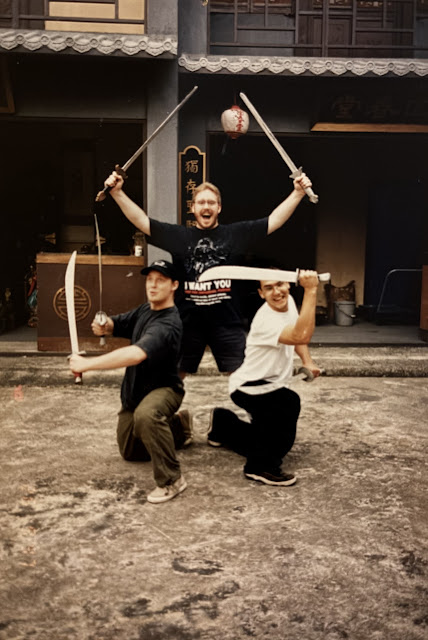
Russell is one of the people I’ll always remember being a great dubbing partner, and, when we got paired up in the studio, I knew I was always in good company. Looking back at some of the footage now reminds me of all the time we spent in that particular studio, doing everything from anime to kung fu movies.
BH: Did you ever have any dealings with Ted Thomas or Matthew Oram, two other heavyweights in the Hong Kong dubbing world?
DP: I never met Ted or Matthew.
BH: Why did you stop dubbing?
DP: In 2005, Rik and Ina were beginning to really consider retiring. They were trying to find someone to buy the business and had lined up a couple of ideas that had fallen through. Andrea Kwan and a couple of other people put their hats in the ring to inherit the company, but ultimately it was Victor who was able to put up the cash to take it over. Prior to him taking over, I knew that I needed to start thinking about the future. Rik and Ina had provided for us, they had taken care of us, and really were Omni. I didn’t think anyone else could take their place.
I was an OK voice actor, nothing really special, and I knew that wasn’t going to carry me very far in life. I had no skills I could fall back on and no university degree to lean on, so as I pushed 30 I started to feel like I needed to think about having a career, especially if Rik and Ina were going to retire. I didn’t think Omni was going to last when they left.
Dubbing was my life. I loved it. I would have done it forever if I could have, but in 2006 I made the decision to return to Canada to try and figure out what to do with myself.
BH: What was Victor’s last name?
DP: Victor Lee, I think.
BH: What do you remember about Victor?
DP: He was a big guy with a really deep, booming voice. He was fun to work with. The most significant thing I remember is, he broke both of his legs at the Rugby Sevens one year. That was pretty wild.
BH: How were things at Omni around the time you stopped working there?
DP: They were still really good. It was really painful to let go and leave, to be honest. All of my friends were still doing what they loved. It was tough to say goodbye.
BH: Could you share some of the highlights of your time in Hong Kong?
DP: There are so many to choose from. It’s hard to pick just a couple. Going to school at KGV, dubbing with Omni, even working at Pepperoni’s and Al Fresco’s.
One of the things I used to love was just spending time in Kowloon City or Mong Kok, shopping. Going to the different toy stores, to HMV, wandering through Ocean Terminal. I remember going to see Jurassic Park (1993) in Hong Kong and Scream (1996). There are so many great memories about spending time with people, friends, and family.
Nine years seems like such a short time to spend in such an amazing place. Even just trying to sift through my memories makes me realize how much fun I had when I was there, how much richer my life is because I was able to experience Hong Kong and all the people that live there.
BH: When did you leave Hong Kong?
DP: I left Hong Kong in October of 2006, a lifetime ago.
BH: Since returning to Canada, what have you been doing?
DP: When I first came back to Canada, I bounced around a little, doing different jobs until I settled into my current career path. I work for Canada Post as a letter carrier. I also started a family and have two great kids — currently 11 and 15.
While I don’t voice-act anymore in the conventional sense, I’ve been pursuing one of my other passions: tabletop role-playing games. I’ve been running games for people off and on over the years, using the talents I honed in the studio to entertain and provide great stories. I can be found running games for Pe Metawe, an indigenous-owned and -operated gaming store in Edmonton, Alberta.
BH: Do you have any final comments before we close out the interview?
DP: I like to tell people that dubbing in Hong Kong was one of my favorite jobs I’ve ever had. If I had a time machine, I’d go back and visit those years over and over again. You don’t know what you’ve got until it’s gone, as they say. And I had so much. In the end, the friendships I made there, the memories I made there, and the experiences I had there will always be, to me, the stuff of legends.
 Vantage Point Interviews
hey bret has anyone you talked to mentioned a name that could be candidate for the unknown man who dubbed gengo in godzilla vs. gigan?
LikeLike
No, not yet, unfortunately.
LikeLike