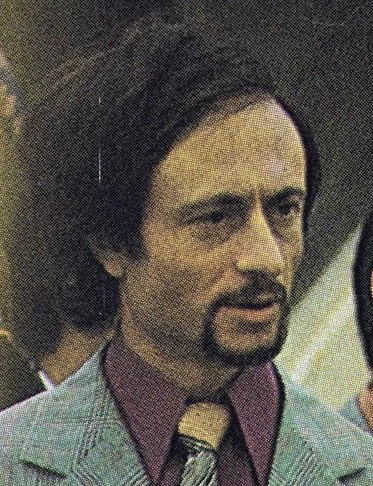
In the 1960s and ’70s, Hong Kong saw a bevy of novice voice actors enter recording studios to provide English-language dialogue to various Asian films for overseas release. One voice actor in particular dubbed everything from hippies to giant monsters — sometimes in the same movie! Among many other roles, he provides the voices of Keisuke Hirata in Gamera vs. Barugon(1966), Lord Heibei Nagoshi in Return of Daimajin(1966), Matsumiya in Goke Body Snatcher from Hell(1968), Shosaku Takasugi in Godzilla vs. Gigan (1972), and Professor Hideto Miyajima in Godzilla vs. Mechagodzilla(1974). In First of Fury(1972), he plays the English-language voice of the one and only Bruce Lee. But his most unusual role is likely that of Angilas in Godzilla vs. Gigan, as he and Godzilla (dubbed by Ted Thomas) exchange a few words on Monster Island and beyond. The voice actor in question is none other than Leonard Michael Peter Kaye, who, in May 2023, spoke to Brett Homenick about his standout dubbing career.
BH: First, please tell me a little bit about your early life, where you were born, and your background.
MK: My background: I was born in London, England, United Kingdom, Europe, the world. Yeah, that’s it. I was born, actually, in quite a tough neighborhood in London, the East End, which is quite tough. It prepares you for film dubbing very well.
Let’s see. I managed to win a scholarship to a very nice school called the City of London School and finally finished up as sort of head of the modern languages bit in the sixth form. Then I went into the Royal Air Force where I was listening in to Chinese aircraft because I learned Chinese while I was in the RAF, Mandarin Chinese, which didn’t do me much good when I arrived in Hong Kong because they speak Cantonese mostly in Hong Kong.
When I was in the RAF, I went out to Hong Kong to use this language that I had been taught. It wasn’t much use to me on a day-to-day basis because people do speak Cantonese, and what they taught me was Mandarin. Mandarin, of course, would be one of the languages that would be used in the films, the sort of films that we would eventually come to dub.
[It was] about 14 years I was in Hong Kong, and then finally I came back with the record of having done broadcasting, both radio and television – I was sort of the head of the English-language television unit in Radio Television Hong Kong – and finished up [at] the BBC in English-language programs, and then I moved into so-called language services. I finished up as the deputy head of the French service, and then I finished up my career in the German service as the head of it.
En route, I also worked in the Russian service for a while, too. Take into account the fact that suddenly they stopped jamming. What the Russians used to do was jam the British broadcasts to Russia, so all you got was rubbish. And then they suddenly stopped doing it. When they stopped doing it, what we discovered was, the only thing that we were broadcasting was boring old news. They wanted something a bit sexier, so I went in and made a program for them, which became very successful and was more entertaining than simple, straightforward news.
And it was lovely; I did that for about six months. The Russian service was fascinating. There were about 90 people in the service – most of them Jewish and expatriated Russians. That was fine.
Eventually, I quit the BBC and then went on to do various things on my own. But the dubbing was confined to Hong Kong. I became chairman of the Hong Kong Stage Club, which there was no professional British theater or English-language theater in Hong Kong. So, if you wanted to do anything in English, you joined the amateur theater, nd I joined the Garrison Players and the Stage Club. Eventually, I became chairman of the Stage Club when I was in my mid-twenties.
It was around about that time that I was approached, I think, by Ted Thomas directly, but it may not have been – but certainly for his outfit – to do some film dubbing. I didn’t know what that was, but I soon found out.
I reported to a rather tiny studio in the middle of Tsim Sha Tsui in Kowloon, and I was introduced to dubbing, which mainly consisted, on my first visit, of standing with about six other people and going, [makes various grunting sounds], as a crowd, which I didn’t find very, very difficult to do, but not terribly thrilling. But eventually I was given some words to say. Again, in the end, I finished up as sort of a competent dubber – let’s put it that way.
When I was in Radio Television Hong Kong, I counted on becoming the head of the outfit when the incumbent – James Hawthorne, Irishman – left, and I thought I would take over television because I’d been doing it in English for some time. Let’s put it this way: I think Jimmy Hawthorne was a lovely guy, and I swear by him – he was a great guy. But his one defect was he didn’t give me the job when he left. (laughs) He gave it to some guy from Southampton, and he went out yachting most of the time with his wife.
It was a great disappointment, so I left Radio Television Hong Kong, and I thought, “What can I do?” because I had no connections in Britain. I didn’t know what to do, so I did what I was able to do, which was to dub the films. As luck would have it, no sooner had I started than Golden Harvest came to me and said, “Look, we’ve had a go at a particular movie with this guy Bruce Lee, and it didn’t work very well, and Bruce Lee didn’t like it. So would your outfit like to give it a try?”
Well, of course, in the really early days, I was a little bit apprehensive, but I did it, and it worked. I mean, in the end, they brought it back to me and said, “We like the dub; we like everything about the dub, except for the guy doing Bruce Lee. Bruce Lee doesn’t like it.” So I said, “Oh,” and he said, “Yes – oh. Where do we go from here? Do you have anybody else who could do Bruce Lee?” And I said, “Well, I can have a crack at it.” He said, “OK, you’re on.”
So I did the voice of Bruce Lee in Fist of Fury (1972), which was I think the first movie that was dubbed on that great series that Bruce Lee did in Hong Kong. That was the first one, and I was the voice of Bruce Lee in English. It seemed to go very well; at least Golden Harvest accepted it.
Also, because I was now free of the bonds of Radio Television Hong Kong, [they] also took me on as a director to do a film for them – a massive movie about kung fu or martial arts around the world. It sound[ed] like a great idea, and we had great plans. We got as far as Japan, and it was absolutely disastrous. We had nobody planned, I hadn’t been there. It was a total mess, so, in the end, that didn’t work.
And I just kept continuing with the film dubbing until, in the end, I just got tired of film dubbing and nothing else. It was really lonely and a bit sad, so I then bolted back to England, and there I started freelancing for the BBC, and I enjoyed doing that – BBC World Service – which was natural for me, as I’d been abroad. And I did that; I enjoyed it very, very much. Gradually, I moved into a job as a producer, and that went on for a little while. Then gradually I moved into management. I became – what’s the word? – a head of my little service, which was an English-language staff.
And then moved into the language services where I became the deputy head of French and the head of German in turn. After I’d done the German – I did it for several years – and managed to hold off the people who wanted to cancel it completely, get rid of German, because they said, “Everybody speaks English in Germany, anyway.” I held on to it until about ’97, and then, in the end, they brought down the ax, and they got rid of it. And I said, “[That] got rid of me effectively, too.”
So that’s the basic story of my life. After that, I started working for the BBC proper, as you know, and it was all right. It was all right; I enjoyed that, too. So that’s it in a nutshell. I may have things out of order, but that’s roughly what it was.
BH: Let’s backtrack a bit to the very beginning. I know some people don’t want their birthdates broadcast. But, just for the record, would it be possible to share your birthdate for this interview?
MK: Yes, 30th of June 1938. I am 84 years of age.
BH: Let’s also talk about your childhood a little bit more. What kind of hobbies and interests did you have when you were a child?
MK: My interest when I was a child was running away from people who wanted to beat me up in the East End of London, and I used to enjoy the chase. I was quite a good little runner. And I can remember I used to wear a dark Mackintosh – I think you call it a raincoat – and I used to wear that all open down the front, and it would flap behind you, like wings. And I’d run quite fast; I was quite pleased. Nobody ever caught me because, if they had caught me, they’d have beaten me to a pulp. But they didn’t, so that was OK.
In those early days, I can remember that. I can remember at school learning how to box, and I finished up in the school boxing team, and I never lost a fight. Mind you, I only had about three or four. But we used to visit other schools, other so-called public schools, which are not public but private. I don’t know why they’re called public schools; they’re open to the public – I think that’s what it means. If you [have] the money, you can go.
I boxed against other public schools. It was fun, it was scary, it was a lot of things. It was OK; I enjoyed it. But, in the end, I grew too old, and I didn’t want to go in the ring with people [who were] 18 or 19 because I was likely to get hurt. So I gave it up in the end, but there you are.
Most of my hobbies were connected with singing and acting. In Hong Kong, I was part of a skiffle group. It’s the stuff that Lonnie Donegan and people like that used to sing. It’s American folk singing sung by Englishmen and Scots. Lonnie Donegan was a Scot, and he became very, very celebrated in the United States. [sings lyrics from “Wabash Cannonball”] Those kinds of songs; we used to sing those.
BH: Speaking of boxing, I understand that Ted Thomas used to box. Did you ever box Ted Thomas in Hong Kong?
MK: Not on your nelly! What are you talking about?! The man was about a foot and a half taller than me and probably about two stone heavier. You know, you fight weights in boxing; you don’t just fight anybody. (laughs) Ted would’ve made mincemeat of me. He was twice my size and weight. So, no, I didn’t fight with him, except onscreen. (laughs) If we were dubbing, and there was a fight scene, then I might be involved, and he might be involved.
Ted was very careful not to do too much dubbing because he was in charge – he and a guy called Ron Oliphant. Ron Oliphant was a very, very, very mysterious man. I think he used to write the scripts for Ted, and he wore shaded spectacles. He was always incredibly smart and very quiet. He would murmur when he talked, very quietly, out of the side of his mouth. He was obviously somebody who liked living dangerously.
In Macau, which is a former Portuguese colony, about 40 kilometers away from Hong Kong across the Pearl River Estuary, Ron would go into a Chinese restaurant and would ask for rice worms. The rice worms would be brought, and then he would take some salt and pour it on the rice worms, and the rice worms would pop. They were so irritated by the salt that they burst their skins. And then Ron would eat them – live or half-dead.
And so he was a man of very, very peculiar tastes. He always spoke very quietly, very, very quietly. I remember he used to come to the dubbing and sort of pace around, obviously worried that people weren’t going to do justice to his script. But it was fun; we enjoyed the dubbing enormously.
Ted was very good. I don’t think he was a terribly good dubber in his own right, but who knows. I never heard him do a bit part because he was always in charge. He was the guy running the ship, and Ron was the number two, who would move around the room rather silently, somewhat threateningly. But he did a good job on the scripts; he was very, very good.
Ted did do some dubbing, but he always allowed other people to do it. He was the chief, and he made sure that we finished. He would tell us off if we were too slow. If you did a loop more than twice, then Ted would get very annoyed because you were wasting time, and time is money. We did fights, we did crowd scenes – we did a lot. Everything was dubbed with a group of, at any one time, maybe six or seven people in the studio, which was always very tiny, a very small studio. You didn’t smoke; you didn’t drink. Well, not that I can remember.
You had to remember two phrases. The first phrase was, “Let’s record.” [In Cantonese, it’s] “Luk yam! Luk yam!” That was “record.” And the other was, “Tai hah! Tai hah!” “Let’s have a look.” So, at the beginning of your dubbing, you would say, “We’re going to record.” “Luk yam.” “Let’s record.” At the end of the loop, you then want to see whether it worked, and what you were looking for was what they called lip flaps. The lip flaps were if the lips were moving, and no sound was coming out. In other words, the actor had completely misunderstood how the speech was going and had missed it – had missed great chunks of it, just hitting the wrong places.
So it could be very, very tricky. It could also be hilariously funny. We had one guy, Nick something – I can’t remember what his surname is. He was a Canadian guy. Ted Thomas will remember him. He was a lovely guy, but he wasn’t very good at dubbing. But Ted liked him an awful lot, so this guy would come along and help.
As I say, Ted really didn’t like wasting time. We had a scene – I suppose it went on for about two or three minutes, which is a very long time for a loop. Basically, what it was, we were all porters lifting crates or chests. The chests were lifted by the porters, and they set off walking. As they walked, they went, [makes rhythmic grunting sounds]. And that went on for several minutes, and everybody was getting both amused and very cheesed off because [we were] rehearsing it over and over again. People kept saying, “No, no, you have to do it again.”
What happened was, we put these crates, these chests, on our shoulders. They came with a strap, and you put it on your shoulder, and you went, [makes grunting sounds]. You all did it in time together, and you marched down the hill, up the next hill, over the top of the hill, down the next hill, up the third hill – and it went on like this. I think it was the longest loop we ever did. It was minutes, not seconds.
Ted was getting more and more angry and anxious and saying, “Look, you’ve gotta get this right because I don’t want to F’ around with this damn, stupid bit of dubbing forever, so let’s get it done quickly.” He sounded really, really, very, very upset, so were very keen to get it right.
[We] went up the hill [more grunts], down the hill [more grunts], up the hill – and so it went on. And, right at the end, the bearers – that was us – were supposed to open the things we’d been carrying, the chests. Inside were swords, and at that point the people who were meeting us grabbed the swords and killed all the porters. So [makes dying grunts], dying. Already, people were fit to burst, and they found it very, very funny, this thing. There we were, and then it happened – of course it happened.
We did the up, the down, the up, the down – so three minutes of that, and everyone was going [makes grunting sounds]. We got to the end, and the chests were opened, and a voice said, “Gee, he’s gonna give us all a sword!” And of course everybody just corpsed – everybody just fell about laughing. It took about 20 minutes before people could get going again.
Ted – I don’t blame him. I would have been furious in that circumstance, but it was so funny. I mean, such a long wait before you got to your line, and then get the line completely mangled. And everybody just fell about on the floor laughing. Ridiculous.
But we had a lot of fun. Ted was a very good, very generous employer. He used to take people off to a Mongolian restaurant. We used to do the dubbing in a small studio in Kowloon – Tsim Sha Tsui. It wasn’t on Nathan Road but very, very busy with restaurants nearby. One we frequented was Mongolian food, and it was wonderful, very delicious.
Ted was always very pleased to get to the end of a good evening of dubbing. When he was pleased, he would treat everybody to a decent meal. So he was a good employer; he was a good employer. The only time I ever got across him was actually when I finally gave up Radio Television Hong Kong and became the owner of my own dubbing group. Ted was not best pleased. He rang up and sort of: “You’ll never work in this town again,” blah, blah, blah – all that sort of stuff. His wife – bless her – said, “Oh, Ted, knock it off. Leave him alone.”
It wasn’t bad. But, you know, “You’ll never work in this town again,” that kind of stuff – it sounded like a bad Chicago movie. But I can understand; he had the field entirely to himself. If anybody wanted English-language dubbing, you went to Ted Thomas. And he [did] it very well – I take my hat off to him. He [ran] a very, very good ship. It was generous, it was warm, it was fun, and he gave us some extra pocket money.
So everybody was pleased, but he wasn’t best pleased when I, for the reason I think I’ve already given – that I was suddenly without work, without a job – and I thought, “Well, why not have a go at this because there’s plenty of work around.” But, when I did, Ted was not best pleased. And he made a phone call to me, which was quite strong. His wife apparently – I wasn’t in a position to hear it – but she apparently remonstrated with him and said, “Look, Ted, come on, there’s room for more than one dubbing group in Hong Kong.”
In the end, I think that there were several. A man called Warren Rooke – I think he did one, as well – and Barry Haigh, of course, was involved. Barry Haigh was my hero in my group. Every time I wanted somebody to be big and ballsy and really cool, it was Barry. But Barry, unfortunately, did not please Bruce Lee, and Barry did the voice of Bruce Lee.
That’s when Bruce Lee’s backers, Golden Harvest, came to me and said, “Will you do it?” because they weren’t very keen on that version of the dub. And that’s when they came to me and said, “Can you do it?” We did it, and I asked somebody – I can’t remember if it was Barry or not – but somebody did Bruce Lee, and then the message came back from Golden Harvest, “Bruce doesn’t like it.”
So everybody was running around, chasing their own tail, because Bruce Lee didn’t like it, which meant that he didn’t like the dub. That was the end of that. But the Golden Harvest guy said, “Do you have anybody else who could play Bruce Lee?” And I said, “Well, no, not really.” I said, “Well, hang on, [why not] me? I’ll have a go.” And he said, “OK, have a go,” which I did. And I have to say it was the toughest piece of dubbing I ever did in my life.
It was really hard because Bruce Lee had so many amazing sounds he could make when he was fighting, when he was preparing to fight, when he finished fighting. It was very, very difficult; it killed my throat – the way this is doing at the moment – killed my throat and left me absolutely exhausted at the end of it. It was really, really difficult.
So I take my hat off to Mr. Lee because he really was an amazing athlete [and] a pretty good actor in the scenes where he wasn’t actually punching somebody’s head off.
Bruce Lee liked Ted and liked Ted’s outfit, and I went on working with Ted, even though we had this contretemps, and he didn’t like the idea of me doing this stuff. But I agreed to go and help out because what Ted was doing was dubbing a silent movie. Now dubbing normally, you get sound in your ear. It may be Chinese, but the sound – you get some sort of sense of how it should sound when you’re speaking it in English.
But, [with] the silent version, [there was] no sound at all – no music, no background, no nothing – just silent footage, and you are supposed to make your speech fit what we call the lip flaps – in other words, the movement of the mouth.
I went along, and I arrived. I saw Ted Thomas at the other end of the studio because he was in charge of the dub. And he said, “Hi, Miguel!” – he always called me Miguel. “Hi, Miguel!” And I said, “Hi, T. T.!” – because he was always called Big T. T., Big Ted Thomas. We waved at each other across this Golden Harvest sound studio.
And I heard, “Hello, Miguel.” I thought, “Where is that coming from?” I looked down – I’m not tall, but I looked down, and it was Bruce Lee. He was dressed up in the kind of gear he wears in the movie, which I thought was a bit pretentious, but what the hell – it was his studio – he could do what he liked.
He was obviously offended that I wasn’t all over him or something – I don’t know what it was. There was a little atmosphere. So, when we started dubbing, I realized very quickly that there was no sound; there was nothing to guide us. All it was, was the movement of the lips on a silent screen. And that is very tricky because you’re trying to look and read your own script at the same time. So it’s quite difficult.
I was playing some minor gangster. Now the reason they were doing it this way [was] because this was a real film that was in the process of being made. It wasn’t a dub in the sense we were used to it. This was taking silent footage – there was no sound to guide us. What we had to do was watch the lips, just watch the lips, and make the words fit the lips. And that is really the hardest test of all.
I did my little bit as the Chicago mobster. I forget what the line was. It was just something stupid – “Hey, watch it! I’ll fill ya full of lead!” – [that kind of] rubbish. I did it, and then Bruce Lee somehow just got it in for me. I don’t know why – he just didn’t like the cut of my jib or the way I walked. I don’t know what he didn’t like, but he didn’t like me. He started picking on me, and he said, “Come on, Miguel!” – because he heard Ted call me Miguel, so he thought that was my name – “OK, Miguel, do it again!” He kept hitting me with two fists on both shoulders. “Go on! Now! Now!” Well, this is just rehearsing, obviously; he wouldn’t speak in a take.
In the end, he got terribly impatient, and he said, “Move over! I’ll do it, I’ll do it. I’ll show you how it’s done.” And he did it. What he hadn’t noticed was that the actual words did not fit the flaps, so the sound and the picture were not coordinated. I spotted that, and I ad-libbed a bit and actually put in a couple of words where I knew they were necessary to make it work. I did that, and then Bruce Lee said, “No, that’s no good! That’s no good! Do it again!” And Ted said, “But it looked pretty good to me.” Bruce Lee said, “No, no, no. Tai hah! Tai hah!” [which means,] “Let’s have a look.”
The manager of the studio at Golden Harvest – he was the real boss – he was facing me, but Bruce Lee had his back to me, and he was talking to the guy. He was obviously saying, “Which version is better, his or mine?” The manager [said], “His is better.” Bruce Lee then just spun on his heel, walked away, and said, “OK, next loop.” He was really choked off.
You’re either doing a job, or you’re not doing a job. If you want people to lick your ass, go somewhere else – don’t go in the dubbing studio. But, anyway, he was OK, apart from that one little incident. He was a decent guy, a very nice guy, and very personable. A good actor and a marvelous athlete, terrific athlete. He did all that fighting himself, no stand-ins. He was astonishing, but died young and left us a son who was also a film actor and a lot of memories. I mean, people still worship Bruce Lee.
When I came back to London many years later, I was freelancing. I had no job to come back to; I was freelancing. I actually did a magazine called Clash. It’s very rare, the magazine; it’s worth a lot of money if you can find a copy! (laughs) [There used to be] a big poster of a star, and on the other side of the poster would be a story connected with the star. They put one out.
I met this publisher, and the publisher said, “Oh, you were Bruce Lee?!” He was German. “You were the voice for Bruce Lee?!” I said, “Well, yes.” “OK, we’ll do a magazine!” Sure enough, we did. And it was called, “I Was the Voice of Bruce Lee,” which is totally ridiculous, but there you are. That’s what they chose, and it sold extremely well. This is in London. Next thing I know is, I’m the editor of Clash magazine, and we did quite a number of editions before it was finally closed after I left the organization.
Bruce Lee did me a lot of favors, and I enjoyed meeting him. I honor his memory. I think it’s a great shame he died when he did, and his son particularly had a rough, rough time after his father died. He was the epitome of Hong Kong, except he did it the wrong way. He went to America; he was living in America. He [was] originally an American minor star in movies before he came back to Hong Kong where he’d actually been educated and brought up.
He went to Diocesan Boys’ School, which is a Catholic school in Hong Kong. He was a good student, apparently, but he was also the guy who kicked ass when he was wandering around the playground. If anybody was giving anybody else trouble, Bruce Lee was the man who would step in and say, “Oy, don’t do that.” He patrolled it. He was good, and that was when he was a kid.
BH: What kind of favors did Bruce Lee do for you?
MK: Well, not those kinds of favors. I mean, he did me a favor in the sense that, for example, when that guy said, “His is better,” Bruce Lee just turned to one side and said, “OK, next loop.” He didn’t turn around and say, “Argh! No, you must [use] mine!” He was fair.
Bruce Lee was shorter than me. I mean, that’s very hard to believe because I’m only five-foot-seven or something like that, and he was shorter than me. When I arrived, it was a huge sound stage – big, big, big room. All the film was silent, absolutely silent. No sound effects, no nothing. [You could use] only lip flaps [to] work on the picture.
Ted called out to me from his corner of the studio – he was over in the far corner. He probably said, “Hi, Miguel! Welcome!” And I said, “Hi, T. T.!” and walked towards him. As I’m halfway across the studio, a voice said, “Hi … Miguel.” And I thought, “Where’s that coming from?”
I looked down because Bruce Lee was slightly shorter than me. (laughs) I looked down, and there was Bruce Lee. He was dressed the way he would be in the movie, with the long black trousers, sneakers, and a vest. He looked like he did in the movie, as though he were still playing the role. I thought that was a bit strange. (laughs)
But he said, “Hi . . . Miguel.” And I said, “Oh, hi, Bruce,” like that. For some reason, he thought that was me being very impolite or cheeky or something because that’s when he decided he was going to have a go at me when we actually did the dubbing, and you’ve heard what the result was. “His is better.” So it’s a nice story; it contains a certain poetic justice. It didn’t really matter in the greater scheme of things. It didn’t matter that I never dubbed the voice of Bruce Lee again. (laughs)
Ted did. Ted dubbed Bruce Lee several times, I think. I don’t know whether he did it personally or whether it was just his group that dubbed. I know his group did dub Bruce Lee movies. They’re very good. Bruce Lee was a very good actor – I’m not kidding – he was a good actor. He presented extremely well on the screen. Even though he’s a small guy, he was very muscular – he could move fast; he could do all the kinds of things you need to do in an action movie. So he was great.
But the one person I admired more than any other in all that film dubbing was the guy playing Zatoichi, and I think I mentioned that to you the first time we talked. The blind Japanese masseur – and I thought those movies were miraculous and wonderful. There’s a cult around Zatoichi, and he’s a man of grace and dignity who only fights when he absolutely has to. He’s totally blind; the only thing he can do is hear, and he can feel.
Probably the most wonderful action sequence I’ve ever seen in a movie was in a Zatoichi movie, and Zatoichi barely had to do a thing. But it was fantastic. He always had to sort of feel his way around, and he was sitting there at a table. There was a guy opposite him who was a bad man, real trouble. There was an object on the table – an object with a spiral; it was like something you would open a cork with but bigger. You can see him touching it, realizing it was there.
There was something above his head, and this guy said, “OK, I want to see if you can actually cut a coin in half because I hear you’re a very good swordsman. Let’s see you cut a coin in half.” And so Zatoichi says, “OK, fine,” the blind man. He’s got this thing in his hand, this thing with the spiral, and he’d already sort of sussed out that somehow, from noise, that there was something in the ceiling.
The guy said, “OK, I’m going to spin the coin,” and the guy flicked the coin in the air, and it went into slow-mo, and in slow motion you saw this coin turning and turning in the air – beautiful photography, very clever. Suddenly, it went [poof], disappeared. What had happened was, Zatoichi picked up the spiral thing and threw it, and the spiral went through the hole in the middle of the coin and pinned it to the ceiling.
As the coin had nowhere else to go, it started turning and going down this spiral, and you could hear it going [makes rhythmic sounds]. You could see a very big closeup shot of the blind man’s ear, and the ear was moving. He was obviously listening to these noises. When the noise stopped, he produced his sword and cut the coin in half. It was the most amazing piece of film and photography – and brilliantly conceived. I just loved it. Wonderful – and my hero won. (laughs) There you are.
BH: Going back to something that you talked about earlier with Ted Thomas getting angry, I spoke to Linda Masson, who was Ted’s wife at the time, and she mentioned…
MK: Linda Masson belongs to an incredibly marvelous family, most of whom are jewelers. She came from a wealthy family. She is beautiful; she is talented. She used to go and sit in on Ted’s movies and play the woman being raped. In practically every Chinese movie, there’s a scene where a woman is being raped by a rotten Japanese, and the Japanese gets his comeuppance in the end.
But Linda would sit there absolutely calm, beautifully dressed, and she is a very beautiful lady. [She would] sit there, cross one leg over the other, and sit there looking absolutely bored, and going, “Argh! Ahhh! Oh, no! Ahhh! Argh!” without getting fazed, without moving – just the voice. She was absolutely astonishing; she was absolutely astonishing. She acted as kind of – not a go-between, but a sort of bridge between Ted when he got angry and the people he was getting angry with.
Ted was not best pleased when he heard that I was starting a company, a group to do dubbing. But I had nothing else to do; it was the only thing I knew apart from broadcasting, and I couldn’t do broadcasting anymore because I’d been denied my access to the top job. So I left; I quit.
But Linda heard T. T. having a go at me on the phone – “You’ll never work in this town again! I’ll make sure…” – all that kind of Chicago crap. And I could hear her voice saying, “Ted, he’s got a right to do it. What difference does it make?” She was a real saint; she was lovely. She was absolutely lovely. And there you are.
BH: I bring up her name because she mentioned a man named Bob Toole. I mentioned Matthew Oram and Barry Haigh, and I [asked], “Was there a rivalry with them?” She said no, but there was a rivalry with Bob Toole because he left early on, and I guess Ted felt that Bob was not loyal. Do you remember Bob Toole at all?
MK: No, no. I mean, the name rings the faintest of tintinnabulation. In other words, a little bell. No, no. The name just scrapes the bottom of my memory, but I can’t say that I can picture him or could conjure up any memory of the man. Just a faint memory of the name; that’s about it.
BH: Well, you worked with a lot of other people. I think there’s names like Chris Hilton, Matthew Oram…
MK: Matthew Oram, yes, Chris Hilton, yes. Chris Hilton was a very good musician. He may still be. But he was a very, very good musician. I think he played bass. I led a tiny, little sort of folk group in Hong Kong called The Yugadug Preservation Society, Incorporated in 1793. (laughs) But that’s what it was called, and Chris used to play bass. He was an excellent musician, except that he got really pissed off at the ineptitude of everybody else in the group because we were all amateurs. He was a former professional, and he joined because we were the only thing going for a bass player. You can’t play bass on your own; you’ve gotta be in a group.
The Yugadugs were some pop and some folk music – Lonnie Donegan, that kind of thing. We were on television, probably about once a month on HK TVB – Hong Kong Television Broadcasts. We appeared once a month with The Yugadugs – we became known as The Yugadugs in the end because the joke name was far too long. The Yugadug Preservation Society, Incorporated in 1793, really didn’t cut the mustard. So we became The Yugadugs.
I’ve got a book of souvenirs, and it’s got pictures of The Yugadugs all holding their respective instruments. I didn’t have an instrument because I was the singer. Not a very good singer, but I was the singer. So there you are. Anyway, that’s The Yugadugs.
BH: How about Matthew Oram? Did you work with him very much?
MK: I think I must have. The name is very, very, very familiar. If I saw a picture of him, I would probably say, “Oh, yeah – that one!” It’s been a long time since I was in Hong Kong, and remembering all the people who may have done dubbing is a very big ask, I think.
I mean, Ted is the best authority, I think. He probably remembers everybody who dubbed for him.
BH: Well, I think you may not know, but Ted passed away last year.
MK: Oh, no. Really?
BH: [explains the backstory] I’m surprised nobody told you. I’m a little shocked by that.
MK: Well, no, come on. I’ve been back in the UK for so long, and I moved in totally different circles. I didn’t mix with any of the people I knew in Hong Kong, apart from Barrie Wiggham, who stood in as deputy governor at one point – a very nice man, very conscientious, brilliant linguist, spoke perfect Cantonese. My Cantonese is OK, but my Mandarin is a bit better. But there you are.
I didn’t know about T. T. Oh, that’s a shame. He was larger than life – I mean, not just in stature, but in presence. His presence was terrific.
[Linda Masson] always was very taciturn. She put up with a lot from T. T. – a lot. That was her bed; she chose to lie in it. It’s a mixture of sort of feeling sorry and feeling sort of jealous because she was such a beautiful woman in every way. She was lovely. Beautiful, quiet manner, very calm, very elegant, very eloquent. I just admired her enormously. But there’s no telling what people will find attractive, and Ted was a very, very attractive guy.
I mean, he had a nasty scar on his face. He was in the navy, and he was on a ship patrolling off the shores of Palestine to try and stop ships containing Jews going back to Israel, as they called it after ’48. He was a sailor, and he was on the ship, and then they boarded another vessel full of Jewish would-be emigres. He was pushing people around[, telling them,] “Get back in line,” or whatever, and somebody stabbed him with a knife in the cheek.
I don’t think he was terribly keen on Jews after that. He didn’t really like Jewish people, but there you are. Which is a shame, really, because I’m Jewish. (laughs) Anyway, there you are. And I opened a rival dubbing outfit to Ted, so one way or another I don’t think I would have been his favorite man. But his wife is something else. Extraordinary woman – I thought she was amazing, what she had to put up with. But there you are.
BH: Do you have any strong memories of any of the other female voice dubbers who were working in Hong Kong at the time?
MK: No, I can’t say that I do. What I remember about her was, absolute calm while she screamed the place down because she was always being raped. (laughs) She had to play all the women in a film because the fewer people, the better, and Ted, I think, agreed with that, as well, because the less money for the dubbers, and the more money for them, was a good idea.
And Ted was incredible generous after we finished dubbing, and we used to go on for hours. It was always in the evening – unless it wasn’t, but mostly it was in the evening. It was in a small, smoky studio – “Luk yam! Tai hah! Luk yam! Tai hah!” Yeah, all that – all these people laughing, people shrieking with laughter sometimes, and people saying, “Oh, for crying out loud, can’t you get it right?!” and stuff like that.
But, at the end of the evening, Ted always came through, and at about 10:00 – something like that – we would all troop off to a restaurant, usually the one he liked best, and we liked best, was a Mongolian restaurant. And we would go there and sit round a big circular table because there usually was no more than about four or five people who survived till the end of the evening.
Some people came and went. But there would be four or five people, and they would sit round this table and have this Mongolian stew. It was absolutely fabulous. You had a great big bowl, and it was full of a liquid of sort of tasty, tasty, tasty, tasty stuff, and, in the middle of the table, all these dishes [were there].
On the edge of a big bowl full of boiling water was this little net, and you hooked it over the side, and it went into the water, and the water cooked the food. So the food was always very slim, very thin, very delicious. As the evening wore on, the stuffing that they were dipping the food in became richer and richer and more and more tasty. By the end of the evening, you were having a wonderful time just drinking the soup that had been created by you during the evening.
And that was a Mongolian restaurant. We went there quite a lot, and everybody just loved it. And Ted paid – Ted always paid for the dubbers. So he was a generous guy, but he didn’t book opposition of any kind.
BH: Do you remember any of the Godzilla movies or any of the Japanese special effects movies that you dubbed?
MK: No, Zatoichi was the only thing that I came across when I was dubbing. Godzilla must be after my time because I know what it is. I don’t think I’ve ever seen a Godzilla movie, and I don’t think it’s a great loss, but there you are – maybe I’m wrong. No, I didn’t really have anything to do with that. I just remember Chinese movies, mostly in Cantonese. There may have been the occasional Mandarin thing.
And, when they dubbed, what they used to say was – when they started the first loop – “OK, guys, this is for the boys in the barrio!” “This is for the boys in the barrio,” because the boys in the barrio were in the Philippines, and they couldn’t speak Chinese. Well, not all of them. There were Chinese speakers in the Philippines, and they had a pretty hard time of it in the Philippines.
“Let’s do it for the boys in the barrio,” because those films we dubbed into English were then sent to the Philippines where they were seen by the local people. Did you know that?
BH: I didn’t know that, but that’s very fascinating.
MK: That was the motto. “Come on, guys! Let’s do one for the boys in the barrio!” The barrio being the quarter, the area of town, where the tough guys lived, where the people are poor, but they love watching movies, and they love watching movies with Bruce Lee because he loved fighting, and they like fighting. The boys in the barrio.
BH: So, when you left Ted, did your company have a name?
MK: No, no, no, no, because it wasn’t a public company. I wasn’t actually advertising that way. I mean, I only had a couple or three possible customers for my services – or for our services. So, I mean, what was the point in giving it a name? It was just Michael Kaye’s outfit, Ted Thomas’ outfit. I don’t think Ted had a name for his outfit, did he?
BH: Yeah, Axis International.
MK: Oh. Really? (laughs) I never knew that. All those years I worked with Ted – I never knew it was called Axis International. Well, that’s a good title, whatever it may mean. It sounds like he only had Germans and Italians playing for him! (laughs) Because that was the Axis powers. Anyway, there you are – the Second World War, gave my age away.
BH: Do you have any other strong memories about your time dubbing in Hong Kong?
MK: The thing is that, just for your own elucidation, the best dubbers are to be found not in Hong Kong, not in the States, not in London, but in Paris. Paris does the best dubbing in the world. That’s been so for donkey’s years. Yeah, really. They are fantastic. What they have is, they have a line that moves across the screen, and, where it stops, that’s where you speak. So there’s a wonderful cue that helps you get through the loop – this moving line, which we never used.
I mean, the stuff in Hong Kong is absolutely primitive. It’s two guys, one of those little loops: “Another loop!” “Gimme that loop again!” You know, just something 50-, 60-feet long, max. And that was it. But there were no real aids at all. But, if you wanted to do a crowd scene, what we used to do was, we would split it up – there’d be seven or eight of us – and it’d be two people leaning close to the microphone, two more about a yard back, two more a yard and a half back, and so it would go on.
It would be layered so that, when they were doing the crowd scene, it sounded like even more people. That was just a technique [that was used] within the studio by the dubbing groups because you couldn’t possibly have a huge crowd in a tiny studio. You had to do it somehow. Sometimes, they might do a scene twice, but very infrequently. Mostly, it was done just by layering the actors in depth down the studio, and you got that sense of a massive crowd.
BH: Usually, when you were in Hong Kong dubbing, how many takes would there be of a loop?
MK: Well, if you were really red-hot, and it didn’t have any dialogue, just noises, that would be one. (laughs) If you wanted something really complicated, like Bruce Lee talking to his tutor, the man who advises him on how to comport himself as an honorable fighter – they always have a scene with a sifu. Sifu is a teacher.
There’s always a scene where there’s a sifu who is a man about the age I am now with a little white beard and white hair and a bald head and wearing a long gown and his hands slipped into the sleeves. He would talk very wisely about when to use power, when to use fighting, when to step back – all wise things, based mostly on Buddhism – Buddhism and Taoism, which people always mispronounce [with a hard “T” sound]. It means “the way of the way.” Tao is a way.
BH: Yes, I understand.
MK: Oh, you understand. Well, it’s more than I do. (laughs) Anyway, there you are. I think you have wrung the sponge dry because I can’t imagine what else you might [want to know]. Did we shag in the studio? No, nobody actually shagged in the studio. “Shag” is Cockney slang for “to have intercourse.” Now we didn’t do that. Once or twice, certain people who should know better actually brought lovely young ladies into the studio to show them how wonderful we were and then would disappear with them at the end of the evening. But no names, no pack drill.
BH: (laughs) What years were you in Hong Kong?
MK: I went into the RAF when I was 21. That would be ’59. Then I did my national service; that was only a couple of years, so that would be ’61. I did 14 years [there], so that’s ’75. So I left in ’75; I arrived there in ’59. In ’59, I was in the Royal Air Force, and I remained doing that for a couple of years, and then before I left the RAF I went to the Hong Kong government because I learned Chinese when I was in the Royal Air Force. I learned Chinese – Mandarin, not Cantonese, but of course by the time I left I knew a bit of Cantonese, as well.
So I was there from ’59 to ’74. That was 14 years I was in Hong Kong, and I loved it. I love Chinese culture, I love the language, I love writing Chinese, although I don’t do much of that nowadays. It just appealed to me; it was amazing.
When I was in the RAF, the first thing I did, I went to a place – it doesn’t matter where it was – it was just a place where you choose your job, what kind of job you wanted to do in the Royal Air Force. It was a place where you saw all the various trades you could practice in the RAF, and I looked at it. I thought, “How about something electrical?” They told me that I was colorblind, and I couldn’t do it.
And then suddenly somebody came over to me and said, “Look, a senior officer would like to see you, a squadron leader.” I said, “Oh. Well, why?” “Oh, no, he’d like to see you now.” So I went into the office, sat down in front of the squadron leader. He said, “I gather that you speak some foreign languages.” And I said, “Yes, that’s right.”
He said, “Well, which foreign languages do you speak?” And I said, “Well, French and German and some Italian and a little Spanish.” “Oh. Well, how would you like to learn another language?” I thought, “Oh, yeah, I’m up for that.” I thought, “Good. This is going to mean I’m going to have an interesting, fruitful, productive two, three years in the Royal Air Force.”
So I said, “Yes, I’d love to do another language.” He said, “How would you like to do Russian?” And I said, “Oh, yeah, I think I would like to do Russian.” He said, “Well, yes, OK. Are you free? Can you go to Russia? You have no problems with that?” I said, “No, not at all.” I said, “But where do I have to go?” At that time, it was the Cold War. I said to myself, “How on earth do I go to Russia when we’re enemies with Russia?”
And the guy said, “Well, don’t worry. Don’t worry about that. You just go somewhere else.” I said, “Where would I go?” He said, “Berlin.” And I thought, “Berlin? From Russia?” I didn’t know what this deal was. I knew what Berlin looks like. I hadn’t been there, but I had seen a lot of stuff about Berlin while I was studying German.
It was a bizarre area; the city was absolutely flattened by the RAF and the USAF. They just bombed it to bits, and it was awful. There were women plying their trade on street corners because that was the only way they could get money for their families to eat. There were cripples, there were people who were damaged in the Second World War; it was absolutely horrible. I knew a lot about this because I read about it when I was studying German.
I thought, “No, I don’t want to do that.” So I said, “No, I’d just as soon not go to Berlin.” The guy said, “Oh, all right. Well, how would you like to do Polish?” I said, “Oh, yes, I know my Polish because my grandfather was Polish, and I would love to learn his language.” And then I said, “Well, hang on a moment. Polish – where do I go with Polish?” And he said, “Berlin.” (laughs)
We worked our way through all the languages of Eastern Europe, and every time it was, “Berlin, Berlin.” He was getting disappointed, and I was bored and fed up, and then he said, “Well, how would you like to learn Mandarin?” I think it was the first time I’d ever heard that word, and I said, “Mandarin?” He said, “Chinese, Chinese.” I thought, “Chinese? Surely, surely, I don’t go to Berlin to use Chinese.” He said, “No, no, Hong Kong.” I said, “I’ll take it. I’ll take it.” And I went to Hong Kong.
I was newly married to a very nice girl, who wanted a nice family life with her own family, and I dragged her off to the Far East. But that’s another story. And I loved it; I fell in love. When I was studying Chinese, I fell in love with Chinese culture and Chinese language, particularly the writing, the characters.
It’s a fantastic civilization and the oldest extant civilization on earth – 5,000 years of continuous civilization is quite a record, puts Britain and the United States into a shadow. Chinese are amazing. Anyway, there you are. That’s my thoughts on China.
BH: And Berlin isn’t too shabby, either.
MK: Well, not now!
BH: (laughs)
MK: In fact, the funny thing is, when I finished up in the BBC, my last job was head of the German service. And the German service – I didn’t realize it, although I had a couple of warnings it might happen – the German service went out of business just after I left the BBC. But we had a lovely office in Berlin. We, the BBC, were the only radio station that was allowed to have a frequency in Berlin – the only ones. We had that privilege, and it was an enormous privilege.
Neither the Americans nor the French, nobody else had it, except the BBC. It was something to be treasured, and then, in the end, the BBC just let the German service go, so they didn’t need a frequency anymore. It was something worth its weight in gold, and it went. Just tragic. The people in the German service were superb at their jobs. They were absolutely marvelous; a lot of them are still living in England, but an equal amount has gone back to Germany.
But a wonderful resource – very, very useful not only to the United Kingdom but all the allies of the United Kingdom. And they just let it go, let it go, and they let all the European languages go. So all that soft power has disappeared; it’s just gone. Very sad. Anyway, that’s my opinion on that.
 Vantage Point Interviews