
One of Japan’s most enduring media stars, Kaoru Yumi began her entertainment career in 1966 as a singer, dancer, and film actress. In the 1970s, Ms. Yumi began appearing in numerous tokusatsu productions for Toho, which include her playing Mariko Nishiyama in The Last Days of Planet Earth (a.k.a. Prophecies of Nostradamus, 1974), Maria Harada in Espy (1974), Reiko Abe in the Submersion of Japan (1974-75) TV series, and Uzume in Kon Ichikawa’s Phoenix (1978). However, Ms. Yumi has accomplished so much more over so many years. The following interview, which was translated by Maho Harada, was conducted by Brett Homenick over two separate sessions — one on March 22, 2023, and the other on November 8, 2023. The conversation also features the participation of Shigeru Shimmi, Ms. Yumi’s manager.
Brett Homenick: Please tell us about your early life in Kyoto.
Kaoru Yumi: I was born in 1950. It was just after the war, and my family ran a business. I have three older brothers. I’m the youngest sibling and the only girl. I always played with my older brothers. We lived near Toji Temple [in Kyoto], and we always played around the five-story pagoda there. I was always running and jumping like a boy.
When I was three, I started attending kindergarten at Toji Temple. Normally, you start kindergarten when you’re four, but my youngest brother is only one year older than I am, and my parents arranged for me to start at the same time as my brother. Because I was the youngest, the principal always sat next to me on the bus that drove us to and from kindergarten. He was the principal and also a high-ranking Buddhist monk. I was very innocent and treated the principal like a friend. I often shouted, “Hey, principal!” instead of calling him Mr. Principal. I was fearless.
Before I turned four, there was a woman who taught classical ballet in the neighborhood, and I followed her around. While she taught her ballet classes, I tried to imitate what the students were doing. I started enjoying ballet, so I asked my mother if I could learn ballet, even though I hadn’t even turned four. That was how I started taking ballet classes. If I hadn’t followed this woman around, I may never have gotten into ballet. As soon as the music started playing, I would start dancing. I was always dancing classical ballet.
BH: What hobbies did you have when you were young?
KY: Music and ballet. Ballet was my hobby. When I was older, we moved from Kyoto to a place called Kawanishi, which is near Takarazuka. I loved to play, but I was always playing with my brothers’ friends. I was very active. In elementary school, I started taking abacus lessons with my brothers.
There was also a Takarazuka ballet teacher in the neighborhood. She also taught singing and piano. My mother said this teacher was very good and encouraged me to take lessons with her. When I came home from school, I changed clothes, went to my abacus class, and then to my singing and piano lessons. I was very busy! Those were all my hobbies, and I loved doing them. That naturally led me to the entertainment world.
Also, I was lucky in that I always met amazing people, and they opened up my destiny. They were all very positive and led me to great places. The first one was the woman who taught ballet. All of these encounters determined how my life unfolded. I was very lucky.
At the beginning of junior high school – I think I was in the seventh grade – a friend was also taking classical ballet classes, and she invited me to go with her to the Nishino Ballet Company in Osaka. When I went the first time, most of the students were adults. I was only in the seventh grade, so I tried very hard during the lessons not to fall behind.
Then another lucky incident took place. My instructor, Mr. Nishino, was creating a new corner for a TV show called 11PM (1965-90), which was a show for adults, but he chose me. I sang a song called “Teacher’s Pet” by Doris Day while I danced, wearing a very short miniskirt. That led to my debut. Even though I didn’t know much about the entertainment world, I loved it. But my father was against the idea. He said, “The entertainment world is too difficult; there’s no way!”
Manager: Her father was a policeman, so he was strict.
KY: Yes, he was very strict. So I went on a hunger strike and refused to come home. Actually, I was staying at a friend’s house. (laughs) That’s how I convinced my father. But I made a promise to him. He said, “Promise me you won’t quit halfway. Once you decide to do something, you have to continue until the end without ever giving up. And, no matter how hard things get, you have to do your best. I’ll let you do this if you promise to do this.” I made that promise to my father, then I had my debut.
BH: How did you join Nikkatsu?
KY: I was only 15 when the show 11PM aired on TV. Because I was young, they couldn’t air it live since the show aired late at night. So we recorded the show on videotape. As soon as the show aired, the phones rang off the hook at Yomiuri TV and almost blew out the phone lines. People asked, “Who was that?” “When is she going to be on TV again?”
Among the many viewers was the famous [actor] Yujiro Ishihara. He called and offered me a role playing opposite him. I was surprised at how lucky I was. That offer came through, and I played opposite Yujiro in the Nikkatsu movie Kill the Night Rose (1966). I was amazed at how one thing led to another.
The last scene in the movie was a love scene that took place at sea. I was completely absorbed and didn’t know what was going on. I was also afraid of drowning. It was supposed to be a love scene, but I was just clutching onto Yujiro. (laughs) I was still very immature.
Manager: At the time, she was living in Osaka, and Nikkatsu was in Tokyo. So she stayed with Yujiro and his wife at their home until the end of the shoot. Everyone said, “How amazing!”
KY: Yes, I was still living in Osaka, in the Kansai region, so I had to stay at a hotel, which was not easy. Then Makiko, Yujiro’s wife, was so kind to me and said, “Come stay with us. You can go to the studio together.” So Yujiro let me stay at his home. My manager’s assistant, who was a woman, and I stayed at their home. It was like a dream, like a homestay! (laughs) It’s unbelievable how lucky I was.
BH: Very lucky! Why did you decide to quit high school?
KY: Actually, I really wanted to go to school, but I only got three hours of sleep at night. I had one job after another. I started acting in movies at the age of 16, and I even starred in some of them. I was also the host of a TV show, along with Hiroshi Sekiguchi. I was asked to go interview [the Italian actors] Giuliano Gemma and Monica Vitti. The interview was a success. I even learned a bit of Italian before going, such as buongiorno, come stai, and grazie.
One day, I was dining with one of the staff members, and a handsome Italian man came over. He said, “Ciao, you’re so pretty!” He asked me if I was an actress or singer in Japan, and I told him that I was both. He fell in love with me on the spot and told me that he wanted to make me famous in Italy. In the end, I performed at the Venice Music Festival. I traveled back and forth between Japan and Italy before the festival, and I studied Italian in Japan.
I also did a recording of a song called “Su, Ragazzo” at the Venice Music Festival. They wanted me to sell records in Europe and asked me to move to Italy. But I couldn’t because I was very busy in Japan, so I refused that offer. I wonder what my life would have been like if I hadn’t refused. But I was young. Italian men were always smiling and friendly, and I was very popular among them! (laughs)
BH: Did you receive professional training at Nikkatsu?
KY: I had never acted before. And, because I was from the Kansai region and had an accent, I had to correct my intonation. I don’t remember where my teacher was from, but it was an actor from the Haiyuza Theatre Company or something like that. The teacher taught me the intonation [of the standard Japanese accent].
We also talk very fast in Kansai, so I had to learn how to speak more slowly. Luckily, when I was in junior high school in Osaka, we had a new student from Tokyo. We all imitated her accent, which was a lot of fun. I was very lucky because I had learned a bit of the standard accent before my debut. So it didn’t take me long to learn the standard accent. But I probably said my lines too quickly. I had to be careful to speak more slowly when I spoke with the standard accent.
My role in the movie I did with Nikkatsu was very active. I blew out candles with my legs as I did turning kicks. It wasn’t very ladylike! (laughs) I played the role of a very active woman. It was very easy to play this role.
BH: Did you have a contract at Nikkatsu?
Manager: No, she didn’t have a contract.
KY: That’s because I had offers from a lot of places. I was first in a Nikkatsu movie, then Shochiku, Toho, and where else…
BH: Toei?
KY: Yes, Toei.
BH: Daiei?
KY: Daiei was for TV with Shintaro Katsu.
Manager: She was free [a freelancer]. This was a first for an actress. All the [movie] studios gave away free calendars promoting their actors, and she was in calendars for many different studios.
BH: Your real name is Yumiko Nishitsuji. Why did you change your name to Kaoru Yumi?
KY: When I debuted, I didn’t have a stage name. But, because of my sudden popularity, everyone – people from the TV station, newspaper journalists – scrambled to come up with one. My first name is Yumiko, which was shortened to Yumi. It was 1968 or 1969, and the bullet train had just started running, so they suggested names that sounded like the bullet train names, like Hikari, Kodama or Sakura. In the end, they decided on Kaoru Yumi. People called me “Kaoru-chan”* and “Yumi-chan”* because they’re both first names.
[* “-chan”: a term of endearment used toward people who are younger than you]

BH: Kill the Night Rose [was] directed by Toshio Masuda.
KY: The director of Kill the Night Rose was Toshio Masuda, whose nickname was Akaoni (“Red Ogre”). He explained everything with a great deal of energy. The shoot was a lot of fun. He looked after me, just like Yujiro did. The atmosphere at the studio felt very comfortable, and the shoot was fun. I didn’t feel nervous.
Manager: You knew nothing about the entertainment world.
KY: No, I knew nothing about the entertainment world. Looking back on it, I was very innocent and bold.
BH: How would director Masuda direct you in your scenes?
KY: My role was of a very active girl. She was very cool and blew out candles with ballet turning kicks. The other thing I had to be careful about was not to say my lines too quickly. I really knew nothing about this world, so I was fearless. I didn’t really play my role; I was just being myself.
Director Masuda was able to draw that out of me. He directed in a way that made me feel comfortable and natural. Maybe if he had been stricter and had said, “No, not like that!,” I may have learned more. But I think all the directors were able to draw things out of me in a natural way.
BH: On this movie, you also worked with Izumi Ashikawa. Could you tell us your memories of her?
KY: Izumi Ashikawa was very beautiful. She’s both very feminine and efficient. She played the role of a lovely woman.
BH: How about Tatsuya Fuji? Could you tell us about working with him?
KY: The atmosphere of the shoot was very nice. The director instructed us actors on how to express our lines. It was 50 years ago, so I don’t really remember.
BH: You don’t remember?
KY: It’s not that I don’t remember, but everyone was very kind to me. I was still young and immature. I think the director had the toughest job because I was just being myself, and he would say, “That’s good!” (laughs) I was 15, but I played the role of an older women. I had difficulty portraying a woman who was more mature than I actually was. But I did my best to play this role.
BH: You also appeared in Man Who Causes a Storm (1966).
KY: We did a lot of interviews for this movie. All of us went to Yujiro’s vacation home for his birthday. We finished the interviews, and I had to go home because I was very busy. Yujiro looked at me sadly and said, “You’re leaving already?” He was like a big brother to me, and I considered him as a really good brother.
He seemed really disappointed that I was leaving. I think it was after the shoot. We celebrated his birthday at his vacation home. A lot of people from the media also came. I wanted to stay, but I had a lot of work, so I had to leave, and I remember Yujiro’s having a very sad expression.
BH: After that, you appeared in many movies at Shochiku. Why did you change to a different studio?
KY: I was in a lot of Shochiku movies, but I went to a different studio at Shochiku’s request. I was in a lot of Shochiku movies in my teens. I played the main role in Silver Boots (1967), and I was in movies with Yukio Hashi. We went to Guam and Singapore for the shoots. I was in a lot of Shochiku movies.
BH: Did you have a contract at Shochiku?
Manager: She never belonged [to a studio]. That was good for her. She never belonged to a studio. Every studio wanted her.
BH: You appeared in Under the Stars of Singapore (1967) at Shochiku. What do you remember about making this film?
KY: I think I played Mr. Hashi’s girlfriend. We went to Singapore for the shoot, and I wore a Chinese dress. It was impressive how they could make a Chinese dress in one day. As for the actual shoot, I was in one movie after another, so I remember how beautiful Singapore was, and that I liked it very much.
I remember shooting the movie at beautiful locations and thinking how I would like to have time off for sightseeing.
Manager: It was the first time a Japanese movie was shot overseas.
KY: I didn’t know that. They were really ahead of their time. It was a coming-of-age movie, and I remember enjoying myself during the shoot. I don’t think there were any difficulties. Of course, we started very early in the morning.
But the staff members were all amazing, and it felt like we were making the movie together. I remember being impressed at how amazing the staff members were during the shoot. I think this is reflected on the screen. The staff is such an important part of movie-making.
I also went to Guam, but I forget the title [of the movie]. We had nice weather when I was there. The crew went one week ahead of us to shoot, but it rained the entire week. The day after I arrived, it became very sunny, so everything went smoothly. When I was about to leave, they asked me to stay longer so the weather would continue to be nice. (laughs)
Manager: In Japanese entertainment, we talk about hare onna and hare otoko – people who bring good weather.
KY: Yes. Anyway, I don’t remember much about the actual shoot. With Mr. Hashi, we made a lot of coming-of-age movies.
BH: Hiroshi Fujioka appeared in this movie before becoming famous. Do you remember him from this time?
KY: Is Yuko Hashi in it? I played his girlfriend. I’m not sure about Hiroshi Fujioka.
BH: Mr. Fujioka was a Shochiku actor.
KY: So the movie with Mr. Fujioka was a Shochiku movie?
BH: That’s right. Another film you appeared in was Mini Mini Assault Team (1968). Please talk about this film.
KY: I remember [the movie], but I’m not sure about the content. Mini Mini Assault Team was with the Nishino Ballet Company, right? I think it’s the one with everyone from the company.
Manager: This is when Twiggy’s miniskirt became popular.
KY: Oh, that’s right.
BH: [shows Mr. Fujioka’s Shochiku credits]
KY: You were right!
BH: You don’t remember [Mr. Fujioka in the movie]?
Manager: Maybe you weren’t in the same scenes.
KY: No, I think we were in the same scenes. But I was so busy back then. Oh, but I remember now. Mr. Fujioka was such a nice person. I don’t remember the scenes. I would have to see the movie again.
BH: You worked with actress Itoko Harada on this movie. What memories can you share of working with her?
KY: Yes, I was in the same ballet company as Ms. Harada. She was very tall and beautiful. She was a very attractive person, and she had a lot of fans. She had things I didn’t have, like height. I remember wishing that I were tall like she was.
Manager: Everyone – Itoko Harada, Etsuko Nami, Katsuko Kanai – they were all tall.
KY: They were all tall; I was the only short one. When we lined up, there would be a dip [in height] where I was. (laughs) I was always looking upward at them. But that’s why I had to put in more effort so I would stand out. Whether it was dancing or singing, I had to express myself more. That turned out to be for the best. When I was with everyone, I had to try really hard to express myself.
There was a TV [variety] show called Les Girls (1967-68). On this show, there was a corner called “Mini Mini Musical Corner,” which included some acting. We would invite big stars and do a short musical with them, and we sang and danced together. I remember watching it afterward and thinking that I was standing on my toes whenever the five of us lined up. I think I managed to turn a weakness into a strength. Even if I wasn’t really aware of what I was doing, I wanted to be able to express myself despite my height.
Memories of Ms. Harada . . . She was very nice, and we spoke during the breaks. So I enjoyed the shoot. We all spoke with a Kansai accent, and we were always being corrected. Ms. Harada was also from Kansai. I remember all of us having our accents corrected.
Manager: You know [the talent agency for idols called] Johnny’s, right? They only have men. The Nishino Ballet Company only had girls. Before Johnny’s became famous, they were jealous [of Nishino]. That’s why Johnny’s only had men. That’s how Johnny’s started. The Nishino Ballet Company had only girls, like Nogizaka46 or other girl bands today. The Nishino Ballet Company was the first to have only girls. The popularity of Les Girls was overwhelming and gave rise to a lot of stars.
BH: In general, please talk about Les Girls.
KY: Because of Twiggy’s popularity, we all wore miniskirts on the show Les Girls. We stood on a see-through platform, and they shot us from underneath while we danced. Les Girls was a revolutionary show. It was a sensation. We wore miniskirts and had short haircuts, and everyone started imitating us. We wore really big earrings and white boots, and this became a trend. I had a lot of fun.
BH: At this time, how difficult was the work schedule?
KY: We all were quite busy, so we always did the shoots late at night. We had to do all-nighters. We were young, so it didn’t seem hard at the time. That’s how busy all of us were. It was hard work, but I still remember it very well. We all worked hard, but it was a lot of fun.
We were so happy to be on this show, and we invited big stars and performed with them. It was also hard for the staff because we were always pulling all-nighters, but we all had a good time. Even looking back on it now, I don’t think the show is outdated. It was a good show. I wish you could see it, but apparently the videos aren’t available anymore.
BH: Please talk about your memories of Flower Action 009-1 (1969).
KY: This was a TV show. Again, the shoot took place while I was very busy. I had one job after another. At the peak, I could only get two to three hours of sleep. Sometimes I slept in the car, and I still had to memorize lines and songs. I had such a busy youth! It was hard work, but I was able to memorize everything.
And, because it was such hard work, I have lots of wonderful memories. If something went smoothly, I would easily forget about it. But, if it was hard work, like having to memorize so many things and not having enough time to sleep, that experience became a good memory.
BH: Another movie you starred in was Living Together (1973). Could you discuss this movie?
KY: This was another amazing experience. It became a social phenomenon. Until then, not many couples lived together.
Manager: Cohabitation is when a couple lives together. But young people didn’t do that at the time. They lived with their parents. After going on a date with their boyfriend, they would go home. So the word “cohabitate” didn’t exist. American teenagers, if they had a fight with their dad, would go to another state and live together [with their partner]. That didn’t happen in Japan because families were very traditional.
KY: Yes, that’s right. This movie was based on Kazuo Kamimura’s graphic novel. That became a major sensation, as well. I consider myself old-fashioned. Actually, I have both modern and old-fashioned sides. I felt a lot of resistance about playing a woman who lived with her partner. But I read the graphic novel and decided to do it because Mr. [Shigeyuki] Yamane, the director, said he was going to turn it into a fairy-tale romance. The shots were beautiful, and it was a very good movie, like an international movie [American and European movies].
There were also some bedroom scenes, which were quite difficult. The director helped me with these scenes with Masami [Naka] by choreographing the movements where I could count 1-2-3, 1-2-3. That’s how I got through the bedroom scenes. (laughs) That made it much easier for me. It was difficult to do these scenes just by going on my feelings.
Manager: You were 15 when you started, so you didn’t have any romantic experiences. You wouldn’t have known what to do. At 15, you were suddenly in scenes with Yujiro Ishihara, embracing and kissing him. That must have been difficult.
KY: Yes, I was just clutching onto Yujiro in those love scenes. In Living Together, the director explained what I should do and directed my actions. (laughs) On opening day at the theater, people formed lines that wrapped around the theater to see this movie. There were so many people that they couldn’t close the doors.
Manager: It was like Hollywood in the 1950s. So many people wanted to see the movie. Some were even trying to see the movie from outside [the theater].
KY: It was incredible.
Manager: They put posters all over the city, but everyone took them.
KY: I had nude photos taken from behind. I wasn’t sure about doing this, either, but the photos were very nice. They were so popular among both women and men, which is why everyone took the posters. Some people even said they wanted to replace my face with theirs [on the poster].
Most of the fans were international movie fans [people who like international movies]. I think the ratio was 1:1 between women and men among the fans. Actually, a lot of women came to see the movie, mostly international movie fans. This is really a part of my [personal] history, and I have fond memories of this movie. So that was Living Together.

BH: Do you have any memories of Yuriko Hishimi from this time?
KY: Was I in the same scenes with Ms. Hishimi? In movies, we often shoot takes separately.
Ms. Hishimi was a very mature, attractive woman. I think she had a lot of male fans. On the other hand, I was still naïve. In a sense, that provided a contrast between us. Maybe that was a good thing.
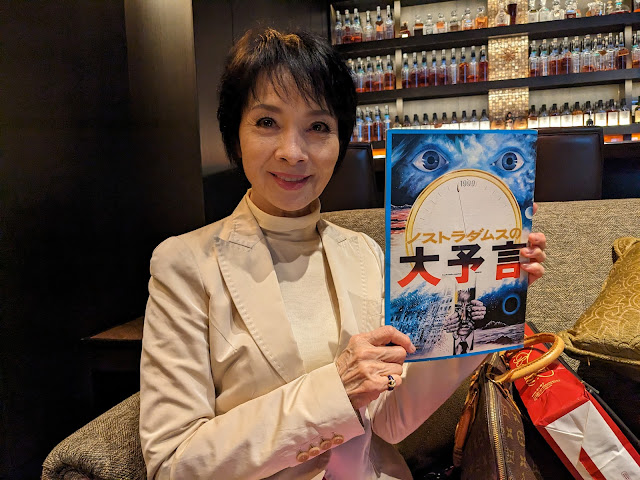
BH: How did you get cast in The Last Days of Planet Earth [a.k.a. Prophecies of Nostradamus (1974)]?
KY: I was in The Last Days of Planet Earth because Sakyo Komatsu requested me to be in it. Nostradamus had a prophecy about 1999. Although it didn’t come true, looking back on it now, the movie predicted a lot of things. I don’t think it’s sci-fi, but it does have elements of sci-fi. I think things are becoming like the movie predicted.
Being in that movie, I feel that things have been changing. There were quite a few difficult scenes, but they used CG in this movie.
BH: Please talk about working with director Masuda on this movie.
KY: He was very excited about this movie. At times, he was strict about the craftsmanship and could be quite demanding. I think he had strong intentions for this movie.
BH: The movie also starred Toshio Kurosawa. Could you share your memories of working with Mr. Kurosawa?
KY: Mr. Kurosawa . . . Normally, he was very charming and kind. His acting was very tight [precise, no mistakes]. I can’t remember if I had a love scene with Mr. Kurosawa. Was it at sea? Anyway, he gave me a lot of advice. His acting was very thorough. He had a very high sensibility and would really get into character.
BH: What was Tetsuro Tamba like to work with?
KY: Mr. Tamba was amazing. He put so much effort into everything. He had a very busy schedule, but he managed to do everything in a natural way.
Even though there were many different scenes in Nostradamus, his acting was very powerful. I think it was very hard for him because he was in so many different scenes. But his acting was amazing and very good.
BH: How about Yoko Tsukasa?
KY: She was the mother. She was very graceful. She interacted with me in a very natural way. And she played a very graceful, good mother. She dies at the end. Everyone’s acting was so impressive. They played such attractive characters.
Manager: How was it to have Tetsuro Tamba as your father and Ms. Yoko Tsukasa as your mother? Did you feel comfortable playing your role?
KY: Mr. Tamba had a lot of lines, so it was difficult for him. For the scene where we’re eating sukiyaki, we took the entire day to shoot it, which was quite difficult. When I saw that scene, I thought how amazing he had been. He persevered and never gave up. He has an amazing energy about him.
When I thought about how hard he worked, I was so impressed. I need to work harder, too.
BH: Do you remember the shoot at sea?
KY: Yes, I remember. It was very hard.
BH: Where was it shot?
KY: Shonan, I think. I’m sorry if I’m wrong. We shot the scene after the typhoon where I almost get swept away. I was scared. Oh, maybe I’m getting confused with Submersion of Japan (1974-75). The scenes were very similar.
BH: What can you tell us about the filming the scene on the beach with Mr. Kurosawa where you do a ballet dance? Where was the beach?
KY: Oh, that scene. I think we went to the sand dunes.
Manager: The sand dunes in Tottori.
KY: Yes. I was pregnant, and I expressed my joy on the sand. I was able to use dancing, which I’m good at, as an expression of love. I could have done it better, but that’s how I did it at the time.
BH: How long did filming last for The Last Days of Planet Earth?
KY: I may have had two shoots going on at the same time. I was shooting this movie along with another one. I think this shoot went on for a long time.
BH: One month?
KY: Yes, at least. Maybe two months. It went on for a long time.
BH: Yoshimitsu Banno worked on this movie as an assistant director and screenwriter. Did you work with Mr. Banno?
KY: Assistant director?
BH: Yes, and he also wrote the script with Mr. Masuda. Do you remember Mr. Banno?
KY: Mr. Banno . . . This was for the movie based on Sakyo Komatsu’s story, right?
BH: No, Sakyo Komatsu wasn’t involved with Nostradamus.
KY: He wasn’t involved? Even for the script?
BH: No, Tsutomu Goto wrote the original story. Mr. Komatsu wasn’t involved. Mr. Komatsu did Submersion of Japan (1973) and Espy (1974).
KY: He wasn’t involved with Nostradamus? Anyway, each take took a long time.
BH: Of course, Toho has never released The Last Days of Planet Earth on home video due to some controversy. What do you think about this?
KY: I think they had a lot of difficulties. But we, the general public, want to watch the movie on DVD, so we can watch each scene carefully. I hope they release the DVD. Because it was so difficult to make [this movie], it makes even more sense [to release the DVD] so people can see what an amazing movie it is.
Manager: I didn’t know about this at all, though! You really do a lot of research.
KY: I didn’t know, either. That’s why there aren’t any DVDs, and we can’t watch the movie.
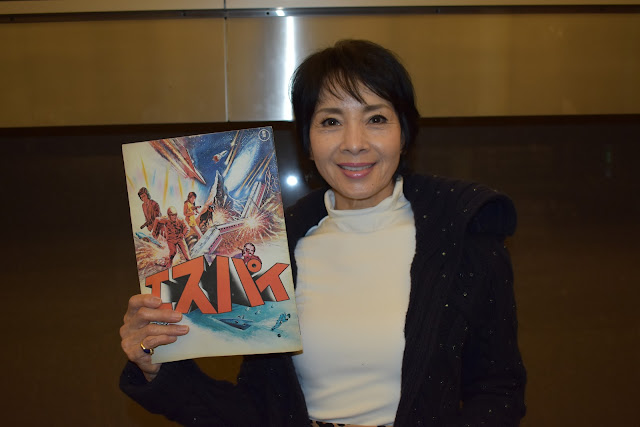
Manager: You really do a lot of research. You must really love movies. [On the topic of Espy], she said she felt resistance about the black guy’s taking off her clothes.
KY: Yes, I was a bit scared. Even now, I remember how shocked I was. I was really shocked.
This movie [Espy] may have been even more difficult than Living Together because a black man drugs me. We dance this sexual dance while I’m drugged, then he takes my underwear off. It was very intense. This kind of shock stays with you. Even though it was work, I became more mature after playing such a bold role. I hope I can play some more bold roles in the future.
BH: The director [of Espy] was Jun Fukuda.
KY: Mr. Fukuda was very particular with the shoots.
BH: How did director Fukuda direct [you in the scene]?
KY: He told me to be sexier. (laughs) That’s the kind of scene it was.
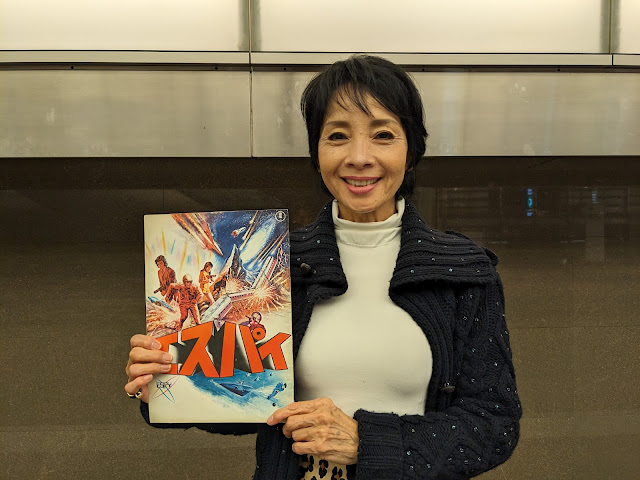
BH: How did you get cast in Espy?
KY: Until then, I had been the leading role in various movies. This was a Toho movie. Sakyo Komatsu was a big fan and asked me to be in Espy. That’s how I got cast. It was a sci-fi [movie] with a very interesting story. I read the script very carefully and thought about how I would play this role.
In Espy, my character gets drugged by a black man and loses herself while she dances because she is under a spell or the influence of a drug. I remember dancing a sexy dance. Mr. Komatsu’s movies pondered what the future would be like. The script was very good, very interesting. I thought it was very impressive.
BH: This movie also starred Hiroshi Fujioka. Please talk about working with Mr. Fujioka on this movie.
KY: Mr. Fujioka played the lead role, and I played alongside him. He is an amazing actor, very meticulous. He was confident about his work and took pride in it. I enjoyed working with him.
As the lead actors, we had a very hard job. But we all worked together and had fun. He is very thoughtful and a gentleman. He went through a lot of hardships but never showed it. I enjoyed working with him.
BH: What do you remember about working with [director Fukuda]?
KY: Mr. Fukuda was the director. There was a female script supervisor, and they always worked together. He was very efficient, and the woman [script supervisor] understood everything Mr. Fukuda was saying.
Even when difficult situations came up, they solved them. The director was of course impressive, but the female script supervisor worked very hard, and I think we made a very interesting movie in the end.
BH: What was Mr. Fukuda’s directing style?
KY: It’s hard to remember; it was so long ago. He accounted for everything. There were some very powerful scenes, and some scenes were nerve-wracking. This was a very large-scale movie. Thanks to the director, I think we were able to make a movie that was unprecedented. Sakyo Komatsu wrote the original story.
My costumes were designed by a designer, and some of them were very elegant. I enjoyed the fashion in this movie. Most of all, the story was very powerful and thrilling, so I think it was a very interesting movie.
BH: Masao Kusakari was also in this film. Please tell us about working with Mr. Kusakari.
KY: Mr. Kusakari’s face and appearance are not very Japanese. He was very handsome and had a stylish presence.
He wore his outfits very stylishly. He doesn’t look Japanese, so his appearance was unusual. Back then, if you didn’t look Japanese, you got bullied at school.
Mr. Kusakari was on the cutting edge. Even though he spoke Japanese, at the time, if you were different from everyone else in the slightest way, you were bullied. But Mr. Kusakari was very dignified and worked hard at his job. I don’t think he showed his weak side. As an actor, he was very resilient. I think he was bullied as a child because he’s only half-Japanese, but he was resolved in his will and dignified. He acted with style.
BH: How about Yuzo Kayama?
KY: I was 15 when I debuted. I was on many magazine covers, and I was often on these covers with Mr. Kayama. We worked together many times. He had a yacht, and we did an interview on this yacht. He was very masculine and said, “I normally don’t allow women onboard.” But it was for work, so he let me onboard his yacht. (laughs) He also sang. He was a big star, and he was very cool.
BH: Tomisaburo Wakayama was the bad guy in the movie. Do you have any memories of Mr. Wakayama?
KY: Mr. Wakayama was the older brother of Shintaro Katsu. I worked a few times with Mr. Katsu, and Mr. Wakayama was his older brother. He played the shamisen [Japanese lute], and he was in period dramas. He played the shamisen and did traditional dance. In Espy, he played the boss and was very cool. He was understated in a way and very masculine. He was very cool.
BH: How about Goro Mutsumi?
KY: I remember his name. He was a member, but I knew the other members very well, and this was the first time I worked with Goro. So I don’t know him well, but, if I saw a photo of him, I would probably recognize him.
He was very kind. We talked a lot. He was very masculine.
BH: [shows a photo of Mr. Mutsumi]
KY: Yes, I remember now. He was one of us. I spoke to him outside of work, and he was very nice. I wasn’t a newcomer, but he took care of me, so I thought he was very kind.
BH: There were many scenes with a foreigner named Jimmy Shaw. What do you remember about him?
KY: I don’t remember.
BH: Do you remember any of the filming locations? Did you go to any foreign countries?
KY: All of my scenes were in Japan. Because some of the scenes were shot overseas, it may seem like I went, as well, but I didn’t. All of my scenes were shot in Japan.
I had so much work at the time. It wasn’t just this movie. I was working on other projects, as well. I had multiple jobs at the same time.
Manager: She was supposed to go [to the overseas shoots], but they shot her scenes on set.
KY: I couldn’t go. All of my scenes were shot in Japan.
Manager: The first scene in Espy.
KY: Oh, was it Suzuka?
Manager: At the base of Mt. Fuji.
KY: Then it wasn’t Suzuka. If it was at Mt. Fuji, it must have been in Shizuoka Prefecture. Yes, I went there.
Manager: [Fuji] Speedway. There was a scene where Mr. Kusakari is driving, and he suddenly stops.
KY: Yes, that’s right. The scene with the car. That was shot on location.
BH: Were there any other locations?
KY: A lot of the scenes were shot on set. I’m sorry, I don’t remember.
BH: There is the scene where you are dancing with an African American actor. What [else] do you remember about filming this scene?
KY: Oh, yes. That’s the dancing scene with the black man I mentioned earlier where he drugs me, and I dance while I hallucinate. That was the first time I danced in my underwear, and my partner was black. It was a first for me, and I still remember when he ripped my underwear off. I still remember that scene very well.
Manager: It was traumatizing for her.
BH: Is that true?
KY: Yes. That kind of thing stays with you. Not in a bad sense, but I was a little shocked. It wasn’t dangerous, and I wasn’t afraid, but I still feel this emotion that I had never felt before. I still remember things like that very clearly in this movie. This scene was very memorable.
BH: How many takes [did you do]?
KY: Not that many. Maybe two takes, maybe one. To make the scene more shocking, we may have done another take. It was a very difficult scene. I still feel the emotion I felt then. It was a bit shocking.
Manager: How old were you?
KY: I think it was after Living Together, so…
BH: 23 years old or so?
KY: Perhaps. It was after Living Together, so I was 22 or 23. Maybe a bit later, but around there.
BH: Espy was based on a Sakyo Komatsu story. Please tell us about working with Mr. Komatsu.
KY: Mr. Komatsu always pursued perfection. He had a very high sensibility. He was a chain smoker, so he smoked a lot of cigarettes while he worked very hard.
BH: Do you have any other memories of Mr. Komatsu in this movie?
KY: He was very ambitious when it came to work and wanted to make good movies. He was full of energy.
BH: Did Mr. Komatsu come to the set for Espy?
KY: Yes, he did. He came to the press conference, the press announcement, after the movie was done. He was very shy and pure, like a boy. He had a cute side to him.
BH: There were many stunts and action scenes in this movie. Please tell me about them.
KY: I like to move a lot and had been doing ballet from a very young age. I wonder if I had a stunt man. I think there were some dangerous scenes, but I did all the action scenes myself.
Manager: You didn’t have a stunt man?
KY: There were some dangerous scenes. I don’t remember very clearly, but I think a stunt man did the dangerous scenes for me. I preferred to do the action scenes myself, and I enjoyed doing them. I did them carefully, so I didn’t injure myself.
BH: Were the action scenes dangerous?
KY: For example, jumping from a high place is dangerous, so they didn’t let me do those dangerous scenes to prevent me from injuring myself. So I didn’t do anything dangerous.
Manager: The fight scenes.
KY: I did the fight scenes myself.
BH: Could you share any other episodes from Espy?
KY: When we were shooting on location, we had to wait a long time. It must have been cold because I remember sitting around a stove and speaking to the other actors a lot. We told jokes to each other, and we got along very well.
BH: Which movie do you like more, The Last Days of Planet Earth or Espy?
KY: The Last Days of Planet Earth was a scary movie because it was based on a prophecy about the future. It wasn’t a very optimistic movie, but it was interesting to think about what the future would be like. Espy is a sci-fi movie and more fun. It was about foreign spies, but Espy had many scenes that were thrilling, so I like Espy more.
BH: How long did filming last on Espy?
KY: At least one month for me. It may have been longer for the others. I had other projects at the same time, so it may have been less than one month for me. Maybe three weeks.
Unlike overseas, Japanese shoots are quite short. That’s a difference between Japan and overseas. I was asked to do an overseas movie, but I was asked to spend time with the director for one month. But I was really busy in Japan and didn’t have time to spend time with the director, so I declined.
For overseas movies, they spend a lot of time together so that they open up to each other and become like a family. That’s how they make movies. But it’s completely different in Japan. So it may be more interesting to make movies overseas. In Japan, we show up [for the shoot], and that’s it. We don’t really get to know each other. Overseas, they spend time together and get to know each other very well. The way we make movies is completely different.
Manager: That’s why Japanese movies lack depth.
KY: Yes, in Japan, we make movies without knowing each other very well. It’s completely different from overseas. I secretly hope to be in an overseas movie someday. (laughs)
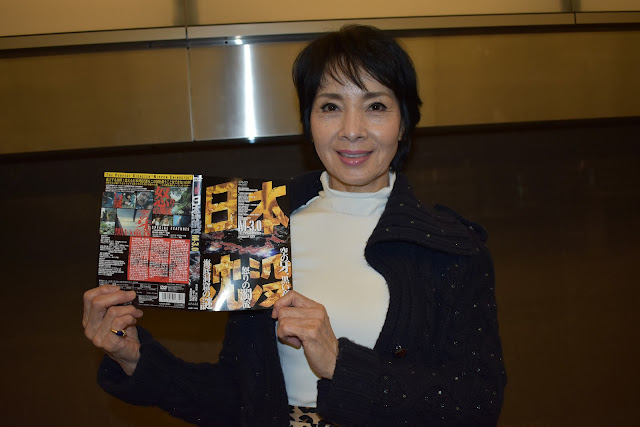
BH: How did you get cast in the Submersion of Japan TV series?
KY: For Submersion of Japan, I was first asked if I wanted to be in the movie [version]. But the president of my agency decided it would be better for me to be in the TV series rather than the movie. I was supposed to be in the movie, but I ended up being in the TV series instead. We did a shoot every week, and each shoot was very long. Just like the title, Submersion of Japan, Japan falls apart and sinks. We shot that every week, with earthquakes in different places each week. The shoots were difficult.
Being in the TV series of Submersion of Japan was very memorable. The staff had a very hard time. Things were constantly shaking, which was done by the staff actually shaking [the set]. To shatter a mirror, someone hit it from the other side. There was a scene of an earthquake while I looked into a mirror.
So I was looking into the mirror when an earthquake took place. The mirror shattered, and I got a shard in my eye. I had to keep my eye open while they took me see a doctor. I didn’t actually cut my eye, but, if I had closed my eye, I would have cut it. So it was a difficult shoot. But, because of these situations, I remember this [series] very well.
Nowadays, it seems like the whole world is shaking. But I hope that society and the world will become a happier place. At the time, I was in movies like Submersion of Japan, Nostradamus, and Espy, but I didn’t want the world to be like what those movies depicted. I wanted the world to be more peaceful, and I still think that today.
BH: You worked with director Fukuda on this TV series. Please share your memories.
KY: He had a strict side. But, if I said I wanted to do something a certain way, he would let me do it. So I didn’t think that he was a strict director. Working with him was fun.
BH: How about working with director Eizo Yamagiwa?
KY: For the TV series, I can’t remember exactly how it was, but there were different directors for different episodes. I think it was like Mito Komon (1969-2011). One director would direct two episodes, then another director would direct the next two episodes. I vaguely remember working with Mr. Yamagiwa, but I can’t remember what he looks like. I’m sorry.
BH: Please tell us about working with Takenori Murano.
KY: He was a fun person and was always joking. He made it fun for the staff. There were scenes where everyone was nervous, but he would say something funny and delight everyone. It was a lot of fun. If we were nervous about a scene, he would make everyone feel relaxed. We enjoyed working with him. He was a very nice man.
BH: How about Keiju Kobayashi?
KY: Mr. Kobayashi was middle-aged and very sturdy. He had a distinctive charm about him. He was quite gentle and ordinary.
BH: Do you have any memories of Mr. Kobayashi?
KY: He was very laid-back. He wasn’t talkative like Mr. Murano, but he had a presence. He was a wonderful actor.
BH: Did you work with Kenji Sahara?
KY: I don’t remember what he looks like.
BH: He was a Toho actor. [shows a photo of Mr. Sahara]
KY: I don’t think we spoke much. I was still very young. But, seeing his photo, he was so young. We may have talked a bit, but I don’t remember.
BH: How long did filming last for the Submersion of Japan TV series?
KY: The Submersion of Japan TV series was on for a long time, maybe one and a half to two years. To shoot one episode, I think it took one week. So, if we look up how long the series was on for, we can calculate how long the shoots were.
BH: [It was] from 1974 to 1975.
KY: One year? That means we were shooting for just under a year. Let’s calculate. If it took one week to shoot one episode, and we shot one episode after another. Then it didn’t take a full year.
BH: Which TV episode was your favorite of this series?
KY: I’m not sure. The one where I escape with Mr. Murano.
Was there a scene where the dam breaks? I think it was a nail-biting scene. Yes, I think we had to break the dam; otherwise, something was going to happen to the water. It was very memorable because everything fell apart with the earthquake. That scene was very memorable. We had to leave the area very quickly. We had to break the dam and change the flow of the water. It was a battle against nature.
I remember everyone being on the edge of his seat because of the suspense. And the father injures himself. Yes, that’s the scene. I remember it very well. We blow up the dam and have to escape very quickly, and it was a battle against nature. Danger was right before our eyes, but we escaped somehow. I don’t know if it was a good scene, but it was very memorable.
In the [episode], everything falls apart because of the earthquakes. The characters in the [episode] are all very worried, and I remember thinking it was a relief that this wasn’t actually happening. I wonder what it would be like if something like that actually happened. This is fiction, something that takes place on TV. But I hope that nothing like that will take place. Anyway, that’s the scene I remember the most.
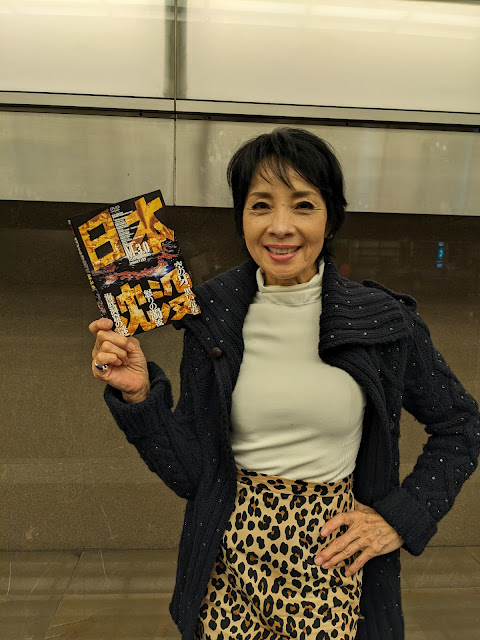
BH: What other memories do you have of making this TV series?
KY: There were so many staff members, beginning with the director, the assistant director, the people who made the props and sets – many people worked together to make a TV drama like this. There were some dangerous scenes, and some staff members were injured during the shoots. So many people came together and made this series. I’m very grateful that all the staff, including the director, brought their powerful energy together. I think Submersion of Japan is an expression of our not giving up and pouring our passion into making a good series.
BH: Please talk about Fashionable Operation (1976). What do you remember about director Kengo Furusawa?
KY: Fashionable Operation was mostly women. All the actors were so impressive. I think I was the leader and played the main role. Director Furusawa was an amazing director and was able to bring out the best in everyone.
BH: Some people say that director Furusawa is very loud. Was he a very loud director?
KY: Yes, he had a big voice. Everyone was surprised by it, but the surprise gave us energy and motivated us to do our best.
BH: Please talk about Skyscraper Murder Case (1976).
KY: This was with Masaomi Kondo. It was a two-hour TV drama, which was a first. Until then, there were hardly any two-hour dramas. As one of the first such dramas, Mr. Kondo and I did a suspense [story]. I don’t think my acting was very good at the time. With Mr. Kondo and the staff, we made a two-hour special drama. It was a murder case, so it was a scary story, but we had fun making it.
BH: Please talk about Truck Rascals in Fever Heat (1976).
KY: This was a Toei movie. I played the role of a Madonna who was on a pilgrimage to Takamatsu in the Shikoku region. We shot this on location. I escaped Tokyo and went to Takamatsu where the air was refreshing, the sea was beautiful, and the food was delicious. I had fun working with the two lead actors.
I was also very busy during this time. I remember arriving late at night and shooting from the early morning the next day. I wish I had more time to get to know the others because it would have been fun. But I only had two or three hours to sleep, so it was really challenging. I think it would have been fun to talk with the others about things other than work.
BH: How did you get cast in Phoenix (1978)?
KY: This was with Kon Ichikawa. I played a woman who makes herself really ugly, so she doesn’t get attacked. I put wads of cotton in my mouth to make my face look puffy, so I looked puffy and interesting. That was my idea. It was a lot of fun!
It was really fun to come up with ideas to disguise myself. Instead of someone’s telling me what to do, I came up with my own ideas. That was the role I played, so I remember it very well.
BH: Please talk about working with director Kon Ichikawa.
KY: Kon Ichikawa was a very heavy smoker. That’s how hard he worked. It was fun.
BH: This movie has an all-star cast. Please share your memories of working with the actors on this movie.
KY: We actually shot the scenes individually. It looks like we’re all there together, but we shot our scenes individually. So I didn’t see much of the other cast. They connected all the shots to create the story. So it’s an all-star cast, but I didn’t see many of the other cast.
BH: What other memories can you share about this movie?
KY: Phoenix had an impressive set, and the costumes were very unique. The preparations must have been difficult. But the scale of the movie was very big.
Manager: It was by Osamu Tezuka.
KY: Oh, that’s right, it was Osamu Tezuka. That’s why the movie was quite fantastical. One time, Osamu Tezuka drew an interesting picture of me. He drew a picture of my legs. I guess there was something distinctive about them. I can show you this picture sometime. It’s really interesting. I guess Osamu Tezuka was a fan of mine. That’s probably why he cast me in this movie.
BH: How did the film industry change from the late 1960s until the late 1970s?
KY: That was the best period! Japan was at the height of its economic growth. Many movies were being made, and everything was like a dream and very enjoyable. Everyone looked forward to the future.
All sorts of movies were being made, and everything was so much fun. It was like a dream. That’s the kind of period it was. People could spend a lot of money and time to make good movies.
The staff worked very hard and made many amazing movies. In the U.S., lots of great movies were being made. It was the same in Japan around this time – everyone dreamed of the future and strove to achieve these dreams of the future.
BH: What was your favorite movie to make?
KY: It was a Shochiku movie. I’m not sure if it’s my favorite, but the movie that I’m most known for is Living Together. The movie was based on Kazuo Kamimura’s graphic novel. Living with your partner became a social phenomenon. Japanese people didn’t live with their partners before that. Some people may have, but this movie shed light on the concept, and it became a social phenomenon.
It inspired young people to live how they really wanted to live. It was an amazing movie because it changed society. For young people, it inspired them to be brave, not just to think brave thoughts. So it changed society. The poster was a nude photo of me taken from the back. That also became a sensation.
Manager: There was an actor named Kanjuro Arashi, who was in an old movie, a period movie, called Kurama Tengu (1950). He was an old man. He got angry about the posters in Kyoto and tore them off. He was a really famous actor.
KY: Yes, Kanjuro Arashi was a huge star. These posters were plastered all over Kyoto, but he got very angry about them and tore all of them off. He said, “We can’t show these kind of posters in public!” That’s how much impact the posters had.
Kanjuro Arashi rode a bicycle with Kikuzo Hayashiya to tear off all the posters in Kyoto. That’s the movie I did when I was 22 or 23. So this movie helped me grow from a young girl into a more mature woman. A lot of people came to watch the movie. On opening day, people formed lines that wrapped around the movie theater to see the movie. That’s how sensational it was.
Manager: More people came to see this movie than Tora-san that day.
KY: That’s right. It broke records because more people came to see this movie than Tora-san.
Another one is Shinano River (1973), another Shochiku movie I did after Living Together. It was about a family with a gay father, and the mother is against it. She’s a very carefree woman and finds a lover. I played the daughter, who discovers that she’s a free spirit just like her mother and falls in love with her teacher and an apprentice.
The story was a based on a literary work and was rather dark. It expressed a side of us that people weren’t able to talk openly about, at least back then. Nowadays, there are gender-neutral people, in addition to men and women. But, back then, even if an actor played this kind of role in a movie, he was looked upon differently. If I did this role now, I’m sure I could show more charm than I did back then. But I did what I could at the time. This movie showed our inner emotions. I guess it was somewhat philosophical.
I hope I can be in a movie that will inspire people to be healthy and to have fun and to live in hope. Nowadays, there are all sorts of things like virtual [reality]. But I really like movies that show kindness, love for humanity, family love, love for animals – any kind of love. I’d love to be in a movie like that.
 Vantage Point Interviews