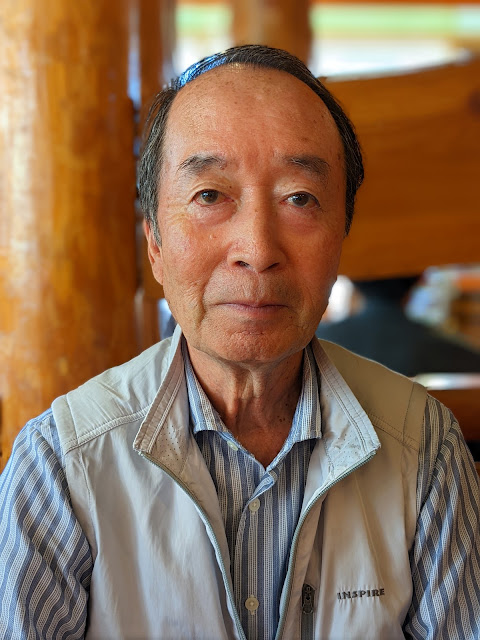
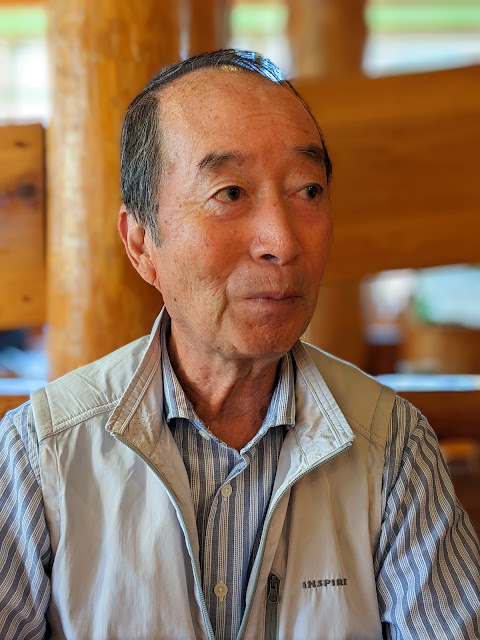
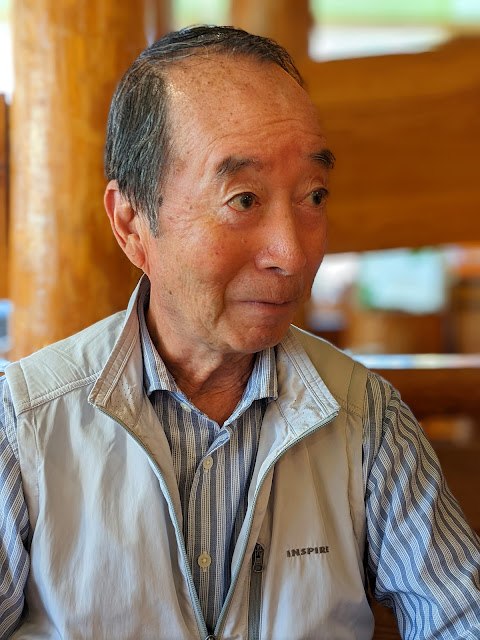
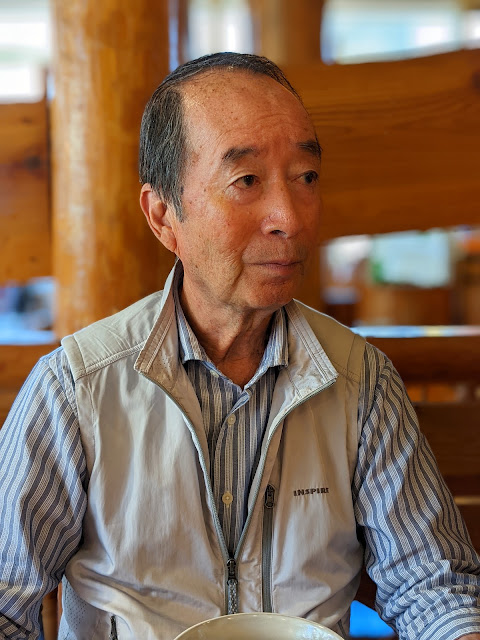
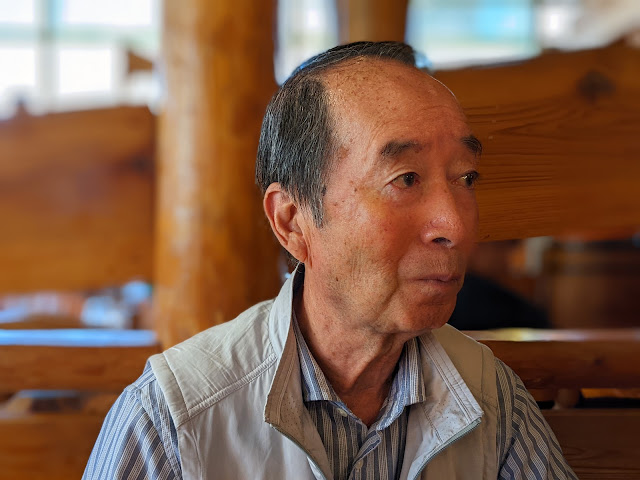
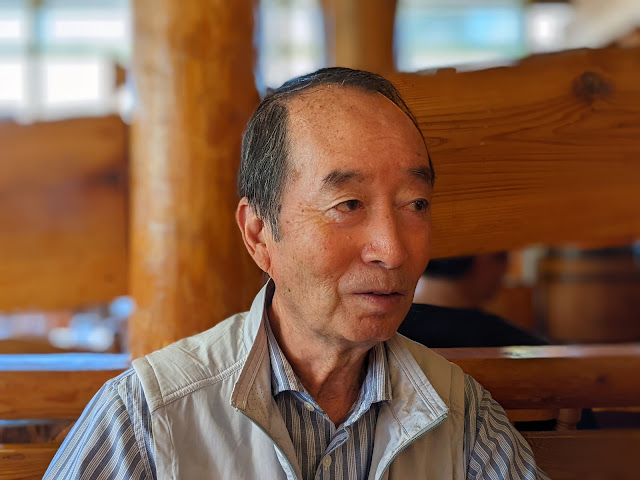
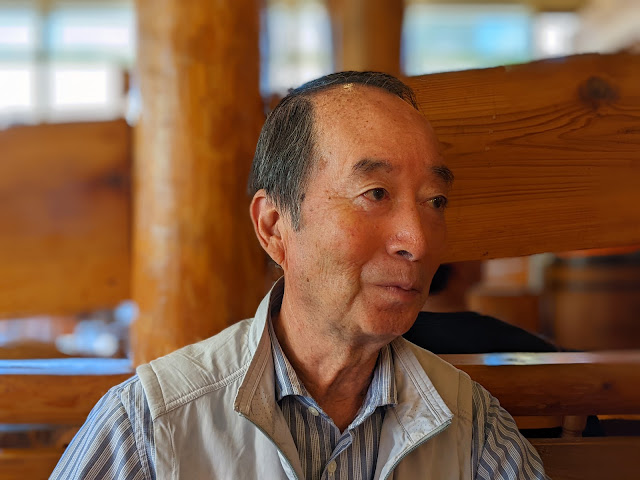
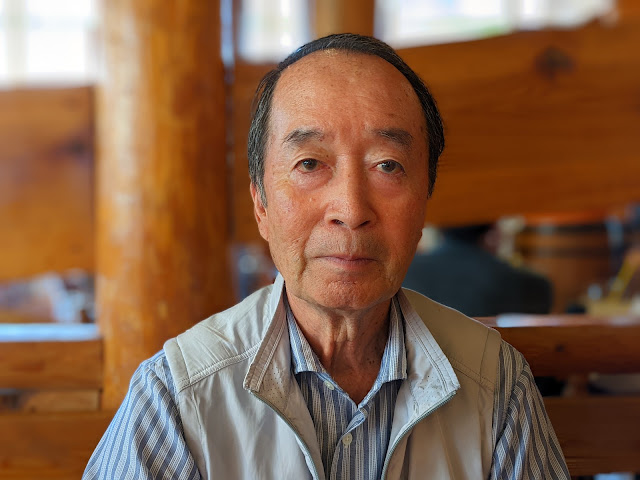
Takeshi Miyanishi was born in Tokyo in 1942 to a filmmaking family and began his career in movies with the Toho production Gorath (1962) as an assistant cameraman. He continued in that capacity on Toho kaiju films until 1968 with that year’s release of Destroy All Monsters. Afterward, Mr. Miyanishi moved up to optical photography and visual effects, working on a variety of films at the studio. His first onscreen credit for optical photography was Godzilla vs. Megalon (1973), and his final credited film is Godzilla vs. King Ghidorah (1991). His father, Ryotaro, was a cameraman, and his uncle Nobuo Aoyagi was the acting director for Princess Kaguya (1935), for which none other than Eiji Tsuburaya served as cinematographer. In this May 2022 interview, translated by Maho Harada, Mr. Miyanishi answered questions from Masahiko Shiraishi and Brett Homenick about his career in cinema.
Brett Homenick: Please talk about your early life.
Takeshi Miyanishi: My father was a cameraman, so I was interested in working in the movie industry. I joined Toho Studios because I wanted to be a cameraman. I was first hired as a part-timer.
Masahiko Shiraishi: What was your father’s name?
TM: Ryotaro Miyanishi.
MS: What movies did he do?
TM: PCL [Photo Chemical Laboratory, the precursor to Toho]. He didn’t start off as a cameraman. The last movie he did was a documentary about Hikawa Maru [a Japanese passenger liner], which is exhibited in Yokohama. It was a long documentary and his main work.
He worked as an assistant cameraman for movies and worked as a cameraman for TV [programs]. I forgot which movies he did.
MS: What year did you join Toho?
TM: I’m not sure.
BH: Your uncle was Nobuo Aoyagi.
TM: Yes, he was my uncle.
BH: He [was the acting coach for] Princess Kaguya (1935).
TM: Yes, he also directed Sazae-san [movies]. He was a budding Toho director at the time.
BH: Please talk about Mr. Aoyagi. Could you share any memories?
TM: He was my uncle, so he didn’t teach me anything. But I was interested in what he was doing. He lived in Seijo, and I went to visit him often, and we talked about movies. He had two sons, Tetsuro and Osamu Aoyagi. Tetsuro worked for Toho and worked as an assistant director. In the end, when Toho established a branch in Los Angeles, he went there with Mr. [Isao] Matsuoka [the former chairman of Toho].
MS: Did[n’t] he also work with Mr. [Akira] Kurosawa?
TM: Yes, Tetsuro worked with Mr. Kurosawa, too.
He [Nobuo Aoyagi] never talked about those things, and I never wrote anything down. This was ages ago. As for me, I started working at Toho in 1962 or 1963 for the tokusatsu movie Gorath (1962). I joined Toho because I wanted to be a cameraman. But they told me that there were no spots for a cameraman, and the only spots they had available were for tokusatsu.
So I worked with director [Eiji] Tsuburaya and cameramen like Mr. [Sadamasa] Arikawa, Mr. [Motoyoshi] Tomioka and Mr. [Yoichi] Manoda. I was the youngest.
I wanted to be a cameraman, but there were all these people who were my seniors already working as cameramen, so I was worried that I would never be able to become a cameraman. But at Toho, like other studios, assistants had different roles in tokusatsu, compared to drama. For tokusatsu, we would use miniatures and pools, whereas in drama there were actors with lines, so the assistants had different roles.
BH: What was Toho Studios like in the early 1960s?
TM: Back then, Toho Studios was on the rise and was making lots of movies, from drama to tokusatsu. Almost all their movies were huge hits at the box office. So they kept making lots of movies. No matter what kind of movie they made, people came to see them. TV wasn’t widespread back then, and the screen was small. The biggest ones were 36 inches, maybe 40 inches at the most. We didn’t have the giant screens we have today, like 50 or 100 inches.
MS: I think they were even smaller, like 20 or 22 inches. In a normal household, it was 14 inches.
TM: Right? Because movie screens were so much bigger, people who worked in the movie industry made fun of TV. When I worked in tokusatsu, people in the movie industry told me not to work on [programs] for TV. But times were changing, and TVs became more and more widespread, so people started thinking differently.
BH: Your first movie at Toho was Gorath. Please tell me about it.
TM: When I first started working as an assistant at Toho, the first movie I worked on was Gorath. I was actually the assistant of an assistant, helping out on the filming of Gorath.
BH: Can you tell me any memories from Gorath?
TM: I happen to have this. [shows a picture] I took this photo when I saw Taiko [Yasuyuki] Inoue. This was my first movie.
MS: They spent a lot of money to make that movie.
TM: Yes, but it didn’t matter to me whether they were spending money or not on this movie. It’s just that it was the first movie I worked on. At the time, it didn’t matter to me how much money they were spending on a movie. I just wanted to work in the industry, no matter what the budget was or whether it was going to be a big hit or not. I really enjoyed working. Actually, after I graduated from high school, I started studying photography in college. Then I got a part-time job at Toho.
At Toho, everyone told me, “You’re stupid. All you need to do is work here, and you’ll learn everything you need to know. You shouldn’t spend money on learning how to make movies.”
So I quit college. They told me to take the entrance exam in April to join Toho as an employee, so I took the test. Then [Koichi] Kawakita and I were called, and we were told that we didn’t pass the test. But, because we both worked hard, they were going to hire us as employees. (laughs) So that’s how I officially joined Toho.
MS: What year did you become an employee at Toho?
TM: [It was] 1964 or 1965. In 1965 or 1966, I became an employee at Toho. I always told them that I wanted to be a cameraman for drama. But, even when they were placing me in another department, they never gave me a position in drama. My boss, the section chief at the time, Mr. [Masami] Sueyasu, told me that I was excellent at my job, so he wanted me to continue working in tokusatsu.
BH: Next, please tell me about King Kong vs. Godzilla (1962). Do you remember it?
TM: Yes, I remember. I was totally absorbed in my work. Back then, I was the assistant of an assistant. If this were the sumo industry, I would have been carrying someone’s loincloth. There were so many people senior to me working as cameramen: Mr. Manoda, Mr. [Takeshi] Yamamoto, Mr. [Takao] Tsurumi, Mr. [Tokimaro] Karasawa, and Mr. [Kenya] Mukai. I was sixth in line. So I was worried that I’d never be able to work as a cameraman. That was the position I was in.
BH: Please talk about Atragon (1963).
TM: No matter what movie it was, I was totally absorbed in my work. The details didn’t matter. I just did what my seniors told me to do. At the time, I lived in Chuo-rinkan on the Odakyu Line. Work started at 9:00 a.m. at the studio. But I would start at 8:00 a.m., so they paid me for one hour of overtime. I would [begin work] at 8:00 a.m. and prepare for the shoot so that they could start at 9:00 a.m. I worked really hard. At the time, we all worked overtime in tokusatsu. Working 100 hours was not unusual.
I always took the last train to Chuo-rinkan, and there were three others who got off at the same station. I was always on the last train. Once, one of the station staff members asked me, “What kind of work do you do? You leave really early in the morning at 7:00 a.m. and come home on the last train at 12:30 or 1:00 a.m.” So I can’t tell you any details about each movie because I was working as hard as I could. It would be 10 to 15 years later that I could say what movie I enjoyed working on.
I worked with Mr. Kurosawa on High and Low (1963), which was a black-and-white movie. Although we were shooting in black and white, he requested to have red smoke. For that shot only, we used color film. But, if it suddenly switched from color to black and white, it [the continuity] would have been strange. So we shot the scene on color film, cut out the red smoke portion, and put it on black and white film.
In Kagemusha (1980), for the battle scene, they could only get 30 or 40 horses, whereas in a real battle back then there would have been 100 to 200. At the time, I had quit being a cameraman and was working as a composite technician because I thought, if I’m going to work in tokusatsu, I need to know all aspects of tokusatsu. So I became a compositor.
MS: When was this?
TM: That’s a tough question. (laughs) At the time, there were only three or four optical printers, and there were very few technicians who knew how to use them. It just happened that, when I became an optical technician, all my seniors quit because of some trouble. So I suddenly became a technician. That was really hard. When I was an assistant for the shoots, I was always being told what to do by my seniors.
For example, we had to shoot the wake of a boat. We had to take a boat from Takeshiba Ship Terminal to Oshima Island and shoot the wake of a boat. My boss, Mr. Tomioka, was the cameraman, so I went as his assistant. I never shot anything at a shoot as a cameraman. But, when I worked as an optical technician, I did everything myself.
BH: Please tell me about Motoyoshi Tomioka.
TM: Eiji Tsuburaya always had two cameras running, camera A and camera B. Mr. Tomioka and Mr. Arikawa were running the two cameras, and, when a third camera was needed, Mr. Manoda ran that camera. Mr. Tomioka would go to the shooting locations and shoot for the composite shots, like the wake of a boat or a mountain. In other words, he shot material for the composite shots. Mr. Arikawa worked closely with Eiji Tsuburaya and assisted him with everything. If they needed a third camera, Mr. Manoda would work with Mr. Arikawa.
MS: On the set, there would be a camera A and a camera B?
TM: Yes.
MS: So that means Mr. Manoda would be the chief [assistant cameraman]?
TM: Back then, there were many chiefs, like Mr. Karasawa and so on.
MS: Do you mean there would be camera A chief, camera B chief, and so on?
TM: Yes. Back then, that’s how it was. As I said before, there were Mr. Karasawa, Mr. Yamamoto, Mr. Tsurumi, Mr. Mukai, and there was someone else. I was junior to all these people.
MS: I saw on Wikipedia that, from Admiral Yamamoto (1968) onward, you worked on composite shots.
TM: Oh, right. I don’t know what year I worked on Admiral Yamamoto.
I shouldn’t say this, but at the time those of us working in the movie industry who were shooting on 35mm made fun of [the people working in] TV. They said that TV was just electronic images on small screens and said no one should work in TV. But I thought that TV would become mainstream, so I started working in TV, doing compositing work. Most of the commercials, which came through Dentsu, requested that I do the compositing work. There used to be lots of places like Den Film [that did compositing work].
Those places would be given work but subcontracted the work to people outside the company and didn’t do the actual work themselves. But I was a technician myself, so I would do the work, and, if it wasn’t good, I would keep working on it until it was good. So I had a good reputation at the time because my work was good.
People said, “Miyanishi’s images are solid. He only does good work.” But it’s obvious because I’m a technician myself. Of course I’m not going to hand in something that’s not good. But other production companies got contractors to do the work, so the sponsors would say, “What the hell is this?” when they saw the results. That happened often.
So, when I started working in TV, I worked on TV [programs]. I did Monkey (1978-80), starring Masaaki Sakai. The work was first done by Den Film, but I helped with the work, and they liked my work, so they started asking for me by name. So I did all of Monkey.
BH: Den Film [was owned by] Sadao Iizuka, right?
TM: Yes, Sadao Iizuka was in charge of sales at Den Film. Den Film knew that they had to do optical work and installed the equipment, but they folded before they were ready. They spent a lot of money, purchasing two condos in Seijo. One was for Mr. Iizuka. When Den Film folded, Mr. Iizuka was in a lot of debt. Now he lives alone in a housing complex.
MS: When you started working in the compositing section, who was your senior?
TM: Sachio [Yukio] Manoda. He had to quit the company because of this problem. [makes a hand gesture] So, as soon as I started working in the compositing section, they told me that I was the technician. I didn’t even know how to operate the optical printer but had to do the work somehow. So I studied really hard.
But there was someone who had joined before I did — Koichi Kawakita. But Mr. Kawakita had decided that he was going to work under Eiji Tsuburaya as a director. He wanted to be a director and didn’t consider himself an optical technician. So all the work came to me.
MS: Oh, right. Mr. Kawakita did the compositing work for Ultraman, didn’t he?
TM: Yes, he did tokusatsu. Koichi Kawakita loved tokusatsu. He was talented, and his technique kept evolving.
BH: The next Toho movie is Mothra vs. Godzilla (1964). Please tell me about this movie.
TM: Like I said, all I can say is that I worked really hard at my job. At the time, Miyanishi was the underling of underlings. As I’ve said, it was Mr. Arikawa, Mr. Tomioka, and Mr. Manoda who were the big shots. The only thing I can say I did is work as a focus man. I didn’t even make it as a chief [assistant cameraman] in tokusatsu. I only went as far as being a focus man.
Back then, you first became a chief, then you could be a cameraman. You first had to be a fourth [assistant], then third, second, chief, and then you could be a cameraman. I only made it as far as focus man. For Mothra vs. Godzilla, I worked really hard and assisted, but I don’t have any memories of the movie. The only thing I remember is working really hard. My work at the time was to do my job without getting yelled at by my bosses.
MS: So are there any movies on which something memorable happened during the shoots?
TM: For the tokusatsu shoots, what I remember are the Big Pool and the miniature shoots. What was memorable for me was Kon Ichikawa’s Princess from the Moon (1987) — doing the compositing work and being able to show off my skills.
MS: That’s your work in compositing. Is there anything you remember from the time you worked as a cameraman assistant?
TM: I remember my seniors being very good to me. That’s about all I can say. There’s not really anything else. I tried never to be late and to have everything ready so the shoot could start at 9:00 a.m. I would polish the cameras, load the film, check that the motor was running smoothly, polish the tripods, that sort of thing.
My job was to clean and prepare the equipment for everyone so that there wouldn’t be any problems. So I don’t remember any movies in particular. I think, when you’re actually working as a technician, you remember particular things like shooting with the wrong focus.
There was an episode like when I mis-set the focus, and they shot an explosion with the wrong focus, so they got an out-of-focus shot of the explosion. Mr. Tomioka got really mad at me. But that’s about it. I don’t remember any details about the shoots. My job was to prepare the camera equipment and film so that nothing would go wrong. I wasn’t the cameraman.
MS: What was Mr. Arikawa like?
TM: He was a director and considered himself second only to Eiji Tsuburaya for tokusatsu work. Mr. Tomioka was his subordinate [assistant].
He [Mr. Arikawa] was very nice. When Mr. Tsuburaya was unable to work, Mr. Arikawa did the directing.
MS: What was Mr. Tomioka like?
TM: He was very nice, too. Back then, Mr. Arikawa, Mr. Tomioka, and Mr. Manoda were the best out of everyone who worked under Eiji Tsuburaya. For optical work, it was [Yukio] Manoda, who was Mr. Manoda’s eldest son.
MS: What about Mr. [Hiroshi] Mukoyama? He did raw compositing?
TM: Yes, Mr. Mukoyama did raw compositing. For raw compositing, it was Mr. Mukoyama, Mr. [Kazunobu] Sampei, and Mr. [Hiroshi] Matsuda. Mr. Sampei did Princess from the Moon. Back then, I was young. People were like, “Miyanishi? He did the compositing work?” But I came to be recognized for my work. So I started getting work like Kamen Rider, and they started asking for me by name.
MS: You did Kamen Rider?
TM: A little bit. I worked with Nobuo Yajima. It was a Toho movie. I went to Kyoto with Mr. Yajima, and he took very good care of me. What I remember the most was Toshio Masuda. I think I did all of Toshio Masuda’s movies. He always said, “Miyanishi, come. Miyanishi, come.”
MS: From The Battle of Port Arthur (1980) onward?
TM: Yes, from The Battle of Port Arthur onward — all his tokusatsu movies. I accompanied him from Okinawa to overseas countries for his tokusatsu scenes.
MS: The Battle of Port Arthur, The Imperial Japanese Empire (1982), Battle Anthem (1983), Doten (1991)…
TM: You know your stuff!
MS: Of course, that’s my work. I also worked on Doten.
TM: My name is on all those movies. Mr. Yajima always had composite shots, so he always asked for me by name. He said, “Miyanishi, you always do good work. You always continue until you’re satisfied.”
For the battle scene [in Kagemusha], Mr. Kurosawa said, “We can only get 30 horses. Your job is to make it look like there’s 100 to 150 of them.” He said, “I’m going to Hokkaido to shoot the battle scene. I want you to do the compositing work.”
Mr. Kurosawa was all about using telephoto lenses. But, in those days, they were using film, so you couldn’t use the film if the image was moving. So I couldn’t do the compositing. But he said, “I took 10 shots. Make something good out of them.”
But there were only three shots where the image wasn’t moving. In the other seven, the image was moving. So I took those three shots and used the front side, the back side, pulled back, and did all sorts of stuff. I think the cameraman was [Asakazu] Nakai.
MS: I think it was Mr. Nakai and Mr. [Masaharu] Ueda.
TM: Mr. Ueda was younger. I think he did Kagemusha. Mr. Ueda was assisting, but the main [cameraman] was Mr. Nakai. Anyway, I showed Mr. Kurosawa what I did in the projection room. He said, “Oh, that’s good.” I only had three out of the 10 shots that I could use, so I used the front side, the back side, pulled back, etc., and showed Mr. Kurosawa.
You know, he hated composite shots. He watched it five times, over and over. After the fifth time, he said, “The horse on the right is the same one that’s on the left. It’s the same horse. I can’t use this. Are you trying to deceive me?” He got mad at me.
At the time, he told the production chief to tell me not to come to the editing room. The production chief said, “Don’t come to the editing room. Mr. Kurosawa will punch you. He’s saying you’re trying to deceive him.” I thought, “Of course! That’s what composite shots are all about — deceiving people. If someone watches the same scene five times, of course he’s going to figure out how I did it.” (laughs)
Kon Ichikawa’s Princess from the Moon was the same. Mr. [Teruyoshi] Nakano was the [tokusatsu] director, but he didn’t get along with Mr. Ichikawa.
MS: I was on the production team, so I know that very well.
TM: Right? Mr. Nakano stepped down, and everyone said I should do it [direct]. I said, “I’m not a director,” and refused. But everyone said I should take Mr. Nakano’s place and direct. So I directed the scenes where Princess Kaguya goes up to heaven and when she radiates light.
MS: If I remember correctly, you hung a black backdrop, blew smoke with a fan, and used light from above, correct?
TM: Yes, yes.
MS: I remember watching that. When Princess Kaguya goes into the light, Mr. Ichikawa wanted the smoke to swirl, so I remember your working to make that happen. So the smoke really moved in a swirl.
TM: Yes, that’s right.
BH: Do you remember the Toho movie, Dogora the Space Monster (1964)?
TM: I remember the movie, but I really don’t remember anything other than working really hard. The only thing I really did was working as an optical technician using the optical printer. From the time that my name appeared in the credits, I had to build my reputation. But the work I did before that was only about assisting my seniors so that they wouldn’t get mad at me.
For the raw compositing, at the time it was Mr. Sampei, Mr. Mukoyama, and Mr. Matsuda. If I thought something was not good enough, I fixed it by redoing the composite. If the continuity between the images wasn’t good, I would redo the composite myself. That’s how adamant I was, because my seniors would say, “What the hell is that?”
Of the compositing work I did, the worst job I did was a movie with Mr. [Nobuhiko] Obayashi. I think it was for House (1977). Mr. Obayashi was shooting with a blue background. Normally, you have a clean wall that you paint blue. But Mr. Obayashi used a wall that looked like someone poured blue paint on it. Because the blue was uneven, it was impossible to take it out [in the composite].
But he said, “Mr. Miyanishi, that’s what I’m aiming for. When someone sees the shot, they’ll think, ‘That’s a bad composite job.’ But that’s my signature.” Mr. Obayashi used to direct commercials, so he didn’t want something realistic. He wanted something different. So that’s why Mr. Obayashi also asked for me by name. I worked a lot with Mr. Obayashi and went drinking with him.
And Kinji Fukasaku, who was at Toei. Normally, you would shoot from 9:00 a.m. and go till 5:00 p.m. But he would shoot at night, from 5:00 p.m. till 5:00 a.m.
MS: He could only get his engine going at night.
TM: Exactly. He could only work at night. So I went all the way to Kyoto to go to Toei, but it was tiring. But that’s when Mr. Yajima took good care of me.
MS: Was it a period piece?
TM: Yes. Well, there were two or three movies.
MS: Were they Legend of the Eight Samurai (1983) and Samurai Reincarnation (1981)?
TM: Yes, yes. I don’t remember them all, but there were several. Mr. Fukasaku lived in Seijo Gakuen, and his wife was a Nikkatsu actress – Sanae Nakahara. Ms. Nakahara was really nice. She loved pachinko [a Japanese-style pinball game] and would go after dropping her children off at school. I also lived in Seijo and sometimes bumped into her at lunchtime. She said she won at pachinko and treated me to a beer a few times.
Back then [in the 1960s], I wasn’t a technician. All I could do was prepare the camera equipment and film so the technicians could do their work smoothly. It was the same for all these movies, including Submersion of Japan (1973). Oh, maybe for Submersion of Japan I was already doing compositing.
MS: Yes, I think you did the compositing for Submersion of Japan. From Admiral Yamamoto on, you started doing compositing.
TM: Yes, that was 1968. From around this time, my name started appearing in the credits.
BH: So you don’t remember any of these movies?
TM: Yes, because I was an assistant and was working really hard.
MS: So you don’t remember specific details about each movie?
TM: That’s right; I don’t remember details about each movie. But, after I started doing the compositing, I had to find the right balance visually, so I fixed whatever I needed to fix.
BH: Do you have any memories of Eiji Tsuburaya during this time?
TM: I never learned from Eiji Tsuburaya, but I can tell you about his personality. He was such a nice man. He was hard-working and serious. Back then, it was a big deal to become a tokusatsu director for Toho. Everything he did, he did with great care. He worked very closely with Ishiro Honda to find the right balance for the screen.
At the time, the shoots were separated into tokusatsu and drama, but it had to be seamless between the two; otherwise it would be unnatural. So they worked very hard to make it seamless, and Mr. Arikawa and Mr. Tomioka worked under Mr. Tsuburaya to ensure this continuity.
BH: Please talk about Admiral Yamamoto.
TM: So, once I started doing compositing, I went to the shoots because I had to make sure the conditions were the same. If a shoot was done during the day and then again in the evening, I would have to make the sky darker or lighter. I thought about this kind of thing a lot. I would see [the conditions for] a certain shot and remembered [what the conditions were for] the previous shot and would think about what I needed to do.
Den Film was Sadao Iizuka’s company, which specialized in compositing. Compared to Toho, it was a tiny, little company. But at the time it was very special. I think Mr. Iizuka first worked at Tsuburaya Productions, and then he started Den Film.
MS: Mr. Iizuka didn’t work for Tsuburaya Productions. He had an annual contract at Toho but worked in secret for Tsuburaya Productions. Minoru Nakano worked for Tsuburaya Productions.
TM: Yes, Minoru Nakano worked for Tsuburaya Productions. But, the way I see things, neither of them had experience on set or knew what happened during the shoots. Well, maybe Mr. Iizuka had some experience, but he drew laser beams and things like that.
MS: Mr. Iizuka first worked for [Toho’s] art department. Then he started doing the drawings for the beams. But he started out as a painter.
TM: That’s right; he was a painter. And he met his wife because they worked together, Mrs. Sadako Iizuka.
MS: Mr. Iizuka quit after Eiji [Tsuburaya] died. He said, “I’m quitting because the Old Man died.”
TM: Oh, that’s right. He’s much older than I am.
MS: I think, when you started, Mr. Iizuka was still working in the compositing department.
TM: That’s right. Mr. [Yoshiyuki] Tokumasa was still there, too. I didn’t interact with him very much because I was out shooting and then worked indoors in the compositing room. But do you know why I ended up working in the compositing room?
MS: Please tell us.
TM: It was because they wouldn’t let me work on the drama side. The section chief at the time, Mr. Sueyasu, said, “Mr. Miyanishi, we are going to place you in another department. I know you want to work on the drama side, but Mr. Arikawa and Mr. Tomioka told me that you should be in tokusatsu.” So, instead of me, Mr. [Tadashi] Furuyama joined the drama side. I think he eventually worked freelance and became a cameraman. Anyway, they wouldn’t let me join the drama side. So I thought I should study all different aspects of tokusatsu and decided to work indoors as an optical technician.
That’s when [Yukio Manoda] and the others quit because of various circumstances, as I mentioned earlier. [Yukio] was Yoichi Manoda’s older brother and an optical printer technician. At the time, Mr. Iizuka and others were working in optical effects. But, when I joined the optical department, it started getting complicated [for Mr. Iizuka], so he decided to quit and started Den Film with Minoru Nakano after Eiji [Tsuburaya] died.
MS: Things at Tsuburaya Productions became unsustainable around 1969, and they let go of their employees. That’s when [Mr. Iizuka] started Den Film. After Eiji [Tsuburaya] died, Tsuburaya Productions became unsustainable, so Mr. Iizuka quit Toho and started Den Film. Mr. Nakano also quit Tsuburaya Productions and joined Den Film. With Mr. Sagawa…
TM: Yes, Mr. Sagawa … and Kiyoshi Suzuki. Kiyoshi Suzuki married Keiko Hisamatsu, who was Eiji Tsuburaya’s scripter [script supervisor] – she’s now known as Keiko Suzuki.
BH: [Do you have any memories of] Yog Monster from Space (1970)?
TM: I don’t remember much, just that I did my best to do the compositing. If I didn’t think it was good enough, I did the compositing over and over and continued until I was satisfied. I had just become a technician and worked very hard, doing them over and over again.
I did each one two or three times and showed Mr. Arikawa the best one. I didn’t have the skills yet, so I couldn’t instruct the people on the set to shoot it this way or that way. Later on, I could give instructions on how to do the shooting. But, around this time, I did the composite two or three times and showed the best one.
As I said before, places like Den Film don’t do the compositing themselves; they contract the work out. So they would take whatever they received and show the director, but the director would say, “What the hell is this?” I heard those kinds of stories.
BH: At Den Film, you worked on Ultraman Ace (1972-73) and Jumborg Ace (1973).
MS: Did you do Jumborg Ace? Did Mr. [Michihisa] Miyashige take over partway?
TM: No, I did both. [referring to Mr. Miyanishi’s list of credits] This is Monkey, right?
BH: Yes, it’s Monkey. And Megaloman (1979)?
TM: Yes, I did Megaloman. For these TV series, it was a competition between Den Film and me. But I was told by the company not to do too much TV. So I had to do the work in secret.
MS: The tokusatsu for Ultraman Ace was contracted out to Toho Eizo. So you were able to do it?
TM: Yes. If it was Toho Eizo, I didn’t have to hide the fact that I was doing the work. But, for the others, I had to work in secret. Well, I didn’t really hide the fact that I was doing the work, but I couldn’t openly say that I was doing it. All the money goes to the company, anyway, and my salary was paid from that money, so it didn’t really matter.
BH: At Toho, you did Godzilla vs. Megalon (1973). But please explain [your work on the title sequence].
TM: Honestly, at the time, I had to do everything, from the title and everything. As I said before, I left early in the morning and came back on the last train every day, to the point that the station staff asked me what I did for a living.
MS: You also did the compositing work for the title [sequence].
TM: Yes, I did. We shot the title [sequence] separately from the rest. I did the compositing work. The drawings were done for the title [sequence], and I would do the compositing work.
BH: Do you remember director Jun Fukuda? What was he like?
TM: He was a very nice man, but I don’t remember much about him. What movie did I work on with Mr. Fukuda?
BH: Godzilla vs. Megalon, Espy (1974), and The War in Space (1977).
TM: Right. I don’t remember anything specific about the directors. The only one I do is Mr. Kurosawa. That doesn’t mean that the other directors were bad people or anything. It’s just that Mr. Kurosawa watched the same thing five times and got mad at me because he noticed that the same horse was on the left side and the right side, so that was a memorable episode with Mr. Kurosawa. Everyone else knew that I only had three shots out of 10 that I could use and that it was difficult to do that composite.
MS: What camera did they use for the opening [of Kagemusha]? Was it a Mitchell?
TM: At the time, they usually used a Mark II. On locations, if they needed to use a handheld, they used an Arriflex. But otherwise they used a Mark II. I wanted to use a Mitchell. I wanted them to do a proper blur test and make sure the camera didn’t move. But, in those days, even if there was a bit of a blur, it was tolerated.
MS: It’s the longest composite shot in the world. It was about seven or eight minutes, I think.
TM: That’s right. That’s right.
MS: So it wasn’t a Mitchell. I noticed a bit of a blur in the composite shot.
TM: Yes, that’s why I wanted them to shoot with a Mitchell for all the shots. But Mitchell [cameras] went out of fashion, and cameras like Mark II came out that were easy to film with.
To be honest, the reason I stopped doing optical effects is because, with the third or fourth Star Wars [Episode I: The Phantom Menace (1999)], CG started coming out. So I thought, “My time is over.” From now on, CG is going to be used in the U.S.
I hear that now film lasts 100 years, but digital images don’t last 10 years. They have to keep making copies; otherwise it will disappear.
MS: Did you do the composite of the horses in Kagemusha with a hand-drawn mask?
TM: No, I made a composite using horses that were filmed.
MS: Yes, so did you do that with a hand-drawn mask?
TM: Yes, by hand.
MS: That must have been so much work.
TM: It was! That’s why the cameraman at the time said, “Miyanishi, this is amazing! You have to show this to the director.” I told him, “You went through the trouble of filming it.” If I had been at the shoot, I would have asked them to use a 50mm or 70mm lens instead of a telephoto. But Mr. Kurosawa always used a telephoto lens, no matter what, even if he was shooting two people.
Normally, you would use a 50mm or 70mm, but he would use a 100mm and move the camera back. If you use a 100mm lens, it would be too close, so you have to move the camera back. That was the Kurosawa style. That’s how he shot. Every director has a different style.
BH: The director of Submersion of Japan was Shiro Moritani. Please talk about Submersion of Japan and director Moritani.
TM: My impression of Mr. Moritani in Submersion of Japan — we were in a place called House or something like that, a small restaurant or bar on the second floor of a building in Seijo. Mr. Moritani was Mr. Kurosawa’s first assistant.
BH: Chief assistant director?
TM: Yes, he became a director after that. He was a very good director and spoke very clearly. I had a very good impression of him. He asked me to work with him on this movie.
MS: Didn’t you take material that was shot on 16mm and make a composite with it?
TM: Yes, I did. I converted it from 16mm to 35mm and made the composite.
MS: Yes, because when you shoot on 16mm there’s a blur.
TM: Yes, because they’re shooting with a hand-held camera.
MS: The cameraman, who died while shooting the famous eruption of the volcano Mount Unzen, shot eruptions of underwater volcanoes and overflowing lava. He shot them with 16mm and 35mm, and you [Mr. Miyanishi] did the compositing with those shots. He was shooting with 16mm; that’s why there’s a blur. It couldn’t be helped.
TM: At the time, Eiji Tsuburaya went to Oshima Island after the eruption and even went all the way to Mount Asama to shoot lava. They didn’t do any tokusatsu because they wanted it to be as realistic as possible. People like Mr. Tomioka went to shoot this material, and I went as an assistant.
When I was an assistant, I didn’t work for Mr. Arikawa. People like Mr. Manoda and Mr. Karasawa assisted Mr. Arikawa. Mostly, I worked as an assistant [to shoot] material for tokusatsu. So I went to Oshima and Mount Asama and places like that. If a volcano erupted, I would go there to shoot some material.
MS: So you didn’t necessarily go to shoot material for a particular movie; you would go to shoot stock footage?
TM: Yes, we would go to shoot stock footage. That’s the kind of work I did when I was an assistant.
MS: For Submersion of Japan, the composite shot of the falling water was done with a hand-drawn mask.
TM: Is that so? I can’t remember.
MS: I thought it was really interesting how it was done. I think it was the first time to do a composite shot of falling water with a hand-drawn mask.
TM: I was still young back then. I was like Mr. Iizuka and Mr. Mukoyama, who later became veteran optical technicians. They did raw compositing. I gradually improved my technique. Mr. Sampei and Mr. Matsuda did raw compositing, which became the trend.
Scenes that are shot live on set are much more impressive than composite shots. Nowadays, they use CG, so all you need to do is shoot the people, and you can insert them anywhere you like. But, back then, we couldn’t do that kind of thing because we were shooting on film.
BH: Next, do you remember Godzilla vs. Mechagodzilla (1974)?
TM: I just remember working really hard. But, unless I see the actual movie, I can’t remember. It was decades ago.
BH: [What about] Conflagration (1975)?
TM: Yes, Conflagration and The Human Revolution (1973). We went to shoot at Soka Gakkai.
BH: How about The Last Days of Planet Earth (1974) [with] director Toshio Masuda?
TM: For Mr. Masuda’s movies, he asked me to do composite shots of specific scenes. Toshio Masuda really liked me and kept asking me to do stuff. He came from Nikkatsu. He happened to do a movie for Toho, and it became a huge hit. Although he was a director at Nikkatsu, he directed a major Toho movie. Maybe Yuko [Tomoyuki] Tanaka fell in love with his work.
MS: [At Toho,] they said, “The only director who can make a major movie is Mr. Moritani.” So the only thing they could do was invite a director from Nikkatsu.
TM: That’s right. There used to be directors like Akira Kurosawa and Kon Ichikawa who could make major movies, but at the time Mr. Moritani was the only director [at Toho] who could make a major movie. So Toshio Masuda was the only person. There was Mr. Fukasaku, but maybe he wasn’t a good fit [for Toho].
Like we were saying before, he did whatever he wanted to do at Toei, shooting only at night, starting at 5:00 p.m. and finishing at 5:00 a.m. Because I was doing the compositing, I had to go to the shoots at night, as well. I couldn’t be sleeping at home while they were shooting! (laughs) There was also Daisaku Kimura at Toei.
BH: He is an amazing cameraman.
TM: Yes, he even had his own parking spot at Toei.
BH: Mr. Kimura did Submersion of Japan.
TM: Yes, that’s right; he was the cameraman. There was also Mr. Furuyama, whom we talked about earlier, who was a camera assistant. [Tomoyuki] Tanaka fell in love with his work. He filmed [behind-the-scenes footage] on 8mm, which no one else did at the time because it was expensive.
[Tomoyuki] Tanaka kept these for years, and before he died he gave them to Mr. Furuyama, saying that they were his treasure. Mr. Furuyama thought he couldn’t do anything with them, so he donated them to the Japan Film Preservation Society. Once in a while, they’re aired on TV, like NHK. So you see shots of people’s shooting these movies.
MS: Until when did you keep the [optical printer]? You sold it in the end, didn’t you?
TM: I left before that. At the time, retirement was at 60. When CG started coming out with Star Wars, I retired from optical work and worked for theme parks. The first one I did was Spain Village, then the one in Kinugawa, Nikko. I did the optical work for the videos. I also worked for the Ramen Museum in Yokohama, which they’re still using. The director, Mr. [Yoji] Iwaoka, said, “Mr. Miyanishi, it’s thanks to you that the Ramen Museum still exists.”
MS: Did you have the optical printer until the 1984 Godzilla?
TM: I think so.
MS: The compositing for the 1984 Godzilla was done at Tokyo Laboratory.
TM: Maybe I still had the optical printer then. I can’t remember why, but I didn’t take on that job. It wasn’t because I’d sold the optical printer because I did the work for the theme parks. I also shot a documentary for Asahi beer. It covered the history of beer, so I even went to Egypt for the shoot.
MS: So maybe it was after that that you sold the optical printer. Was it around the time of Yoshikazu, the third son of the Manoda brothers?
TM: I might have handed things over to Yoshikazu Manoda.
MS: As I said before, there were Yukio, Yoichi, and Yoshikazu.
TM: Yes, the three Manoda brothers. All three of them were in the movie industry.
Anyway, I started doing work for theme parks and the Ramen Museum. Because I had worked for Toho, I did movie promotion. For example, I made a video about the history of ramen, but I had no idea about the history of ramen. I think instant noodles were invented in in 1962 or 1963, so I created the museum to be like the atmosphere of the cities at that time, like the alley near the West Exit of Shinjuku.
MS: The atmosphere is from around 1957 because there’s a sign for The Mysterians (1957).
TM: At the time, I was working for Toei and places like that, so I could use signs from The Mysterians and Mr. [Toshiro] Mifune without worrying about Toho’s complaining. Toei was [actors like] Chiezo Kataoka and Chiyonosuke Azuma, and Shochiku was … I can’t remember.
Anyway, at the time, movies were still major because TV wasn’t that big yet, and I received good reviews for my work. That’s why the Ramen Museum still exists. All the other theme parks have closed. Mr. Iwaoka, the director of the Ramen Museum, still tells me that he’s grateful because the museum still exists.
MS: Other than the Kurosawa movies, are there any movies for which you did optical effects that were memorable?
TM: The work I did with Kon Ichikawa and Toshio Masuda.
MS: What kinds of scenes were they?
TM: I forget. What was Mr. Masuda’s movie about again?
BH: Last Days?
TM: I’ve done too many movies; I can’t remember. (laughs)
MS: Can you tell us about any scenes that you remember [from any of Mr. Masuda’s movies]?
TM: I can’t remember.
BH: Do you remember these movies — Espy, Conflagration, The War in Space?
TM: Yes, I remember them. But what I think I did best was adjusting the continuity with the shots before and after the composite. I don’t think the other technicians did that. They just did the compositing work and submitted that part. I would read through the script and attend the preparatory meetings to grasp the sense of the overall movies. That helped a lot. It was rewarding to be able to do everything myself.
BH: Do you remember director [Katsumune] Ishida from Conflagration?
TM: Not really.
BH: [What about] Pulgasari (1985)?
TM: Yes. [I was] there for three months. The crew was there for about one and a half months. I stayed for another month and a half. They bought me an optical printer there for me.
MS: They bought an optical printer for you? Wow!
TM: They planned for me to learn how to use it and use it to do the compositing, then return to Japan.
MS: What country was the optical printer made in?
TM: At the time, there were lots of different optical printers.
MS: I heard they used cameras made in Russia.
TM: I was surprised when they brought me a proper optical printer.
MS: But I’m sure the company name was written on the optical printer.
TM: I didn’t go see it.
MS: Oh, you didn’t see the actual printer?
TM: No, I didn’t see the actual printer because I made everything in Japan and brought it over. I went to the North [Korea] about 10 times. If I had a seat in business class on China Airlines, they would upgrade me to first class. That’s how often I went there. Nothing weird happened; they let me visit places. The crew went back to Japan after about two months, but I was there for three months.
There was a person who asked me every day what I wanted to eat or drink, and they would bring me what I requested. That was fine, but I told them that I wanted to stay in a hotel in Pyongyang. They said that could be arranged but warned me that it would be troublesome to stay at a hotel in Pyongyang because no one spoke Japanese. But I wanted to see the atmosphere in the North, so I went and stayed for about one month.
If people from the North go to work in Japan, China, or [South] Korea, they’re not allowed to go back to their hometowns. They have to stay in a hotel. Their families would visit them at the hotel, and they would hand the money they earned abroad to their families. You’d think that they would go back to their hometowns, but they stay at a hotel and go back to Japan, or wherever they were working. This person came to Japan a few times, and we went to an izakaya [Japanese inn] in front of Seibu-Shinjuku and ate and drank there.
So I did compositing work and also worked as a producer. The first person who requested me to work with him was Mr. Shin [Sang-ok] from Korea.
BH: He was the director, right?
TM: Yes, he was a director at a large studio like Toho. At the time, director Shin didn’t get along with the [South] Korean president. So he intentionally got kidnapped. The media made a big fuss, saying, “He was kidnapped! He was kidnapped!” But he wanted to defect.
So we shot at Peking Studios and had money sent to Toho Studios from the North Korean embassy in China. Toho was satisfied because they had received the money. I decided the budget as however billion yen and asked to have half paid in advance. They sent 60 million yen or something like that as an advance to Toho Eizo Bijutsu. The higher-ups said, “Miyanishi, what are you doing? What kind of work are you doing?” I told them that we were going to shoot a movie about a Chinese folktale and that we had to go to China.
MS: So the movie was shot at Peking Studios and in North Korea, right?
TM: Yes, we went to North Korea to shoot on location.
MS: But you shot most of it on sets in the studio?
TM: Yes, we shot miniatures in the studio.
MS: So you shot both at Peking Studios and on location?
TM: Yes, but most of the shooting was done at Peking Studios. North Korea was a bonus. I told the crew that this was actually a folktale from North Korea and that we had to go to North Korea for the location shoots.
MS: So everyone was there for about one and a half months?
TM: Yes.
MS: And Peking Studios was one and a half months?
TM: Yes.
BH: When was this?
TM: I’m not sure.
MS: It was after [the 1984] Godzilla.
TM: Anyway, people talked about the movie in Japan. I got so many calls from newspapers; it was such a hassle. I pretended not to know anything and said, “I don’t know; I don’t know.” Asahi, Yomiuri — they all called.
After that is when the [North Korean] kidnappings started. This was before the kidnappings. They wanted me to make a second movie. We even did the location hunt for the second movie.
But, because the media started talking about the [North Korean] kidnappings, I thought it was getting risky, so I told Mr. Shin, “I don’t speak the language, and all these problems are starting to come out, so I want to pull out.” He understood. The movie was popular in Japan and in North Korea, too.
BH: What do you think about Pulgasari? Is it a good movie?
TM: Yes, it’s a good movie. Ordinary people are arrested by the North Korean military and put into prison. They make a doll out of clay, which gets bigger and bigger, and they eventually defeat the military, like Godzilla. It’s a good movie.
BH: Do you remember Sayonara Jupiter (1984)?
TM: Yes, it was a movie I made toward the end.
MS: The whole story takes place in outer space, right?
TM: Yes.
MS: You did a lot of masking, didn’t you?
TM: Yes, of outer space.
BH: Was it a lot of work?
TM: Yes, it was because Sakyo Komatsu was very particular about everything. Space movies had a lot of animation-like images, so that helped. More realistic movies like Mr. Kurosawa’s movies were much more difficult. But people like Mr. Obayashi and Sakyo Komatsu didn’t understand why I had to work so hard.
MS: The planet Jupiter was added as a composite later, wasn’t it?
TM: Yes.
MS: They probably used a blue backdrop. Did they also use a black backdrop?
TM: Yes, they used a black backdrop.
MS: They shot with a black backdrop, and you made masks for each shot? They shot in high contrast, and you added whatever was missing by hand?
TM: Yes, a bit.
MS: So you made the masks and added in the stars?
TM: That’s right. You understand very well. It was one of those movies where my name wasn’t in the credits. River of Fireflies (1987) was another a movie that I did as a part-timer. I just earned petty cash. They didn’t have a budget for tokusatsu for this movie.
But they wanted to have tens of thousands of fireflies, so they said, “Miyanishi, help us! We don’t know what to do.” I asked Mr. Kawakita for advice. We came up with the idea of crushing kapok and turning it into powder.
MS: They didn’t sell kapok in granular form back then?
TM: No, no! So we had to make it ourselves.
MS: The granules?
TM: Yes. We put light on them and then shot them in high contrast.
MS: So you used a black backdrop, shot in high contrast, and then added color afterward?
TM: Yes, we shot it in high contrast so you get the granules. I then used an optical printer to do this [makes a motion] with the light and added them in as a composite.
MS: So you sprinkled them [the kapok granules] from above [like snow], added some wind, and added light.
TM: Yes, we sprinkled them very slowly so they would spread to make it look like a river of fireflies.
MS: It’s the same as [Godzilla vs.] Biollante (1989)! At the end of Biollante, you see these lights flashing.
BH: Exactly, like fireflies.
TM: This movie was nominated for the Academy Awards. Some people said, “You did the compositing work for this movie. Why isn’t your name in the credits?” People were wondering who did the compositing work, and eventually they found out! (laughs) My name wasn’t even in the credits, and I only got paid as a part-timer. They paid me some petty cash.
But it was because they didn’t have any budget for tokusatsu for that movie. So the director, Mr. [Eizo] Sugawa, asked me to do the compositing work. That’s how I ended up working on that movie. It was a lot of work.
BH: What about Godzilla (1984) with director Nakano and director [Koji] Hashimoto?
TM: The recent one? I didn’t do the 1984 one.
MS: Yes, you did.
TM: I did?
BH: This one. [shows a photo]
TM: Oh, I don’t remember.
BH: What about Godzilla vs. King Ghidorah (1991)?
MS: You weren’t at the shoots for King Ghidorah. Maybe they just put your name in the credits.
TM: Yes, I just did the compositing work.
MS: You supervised.
BH: Yes, you were the optical supervisor.
TM: Yes.
MS: Someone else from the production team, like from Tokyo Laboratory, was at the shoots. So you weren’t at the shoots.
TM: Oh, that’s why. I just provided the ideas.
MS: They just put your name in the credits?
TM: That’s right.
BH: I see. Are there any other movies that you have any memories?
TM: The only one I remember is Princess from the Moon. I don’t remember much about Sayonara Jupiter, either. The Battle of Port Arthur was a war movie.
MS: The Phoenix (1978)?
TM: Oh, yes, The Phoenix. I worked on that movie.
MS: I saw it because it was recently released on Blu-ray.
TM: Right.
MS: You did compositing with animation.
TM: Yes, that’s right. I did compositing with animation. I remember Kagemusha, too. Looking at this list [of credits], I realize I did so many movies! (laughs)
BH: Which one is your favorite?
TM: My favorite?
BH: Or which one was the best?
TM: I worked really hard on The Phoenix. I worked really hard on Princess from the Moon, as well. I worked really hard on all of them! (laughs) But, when it comes down to individual movies…
The Battle of Port Arthur is a war movie, right? I had to create an atmosphere of wartime with the compositing, so that was really difficult.
Oh, Pulgasari is on this list, too.
MS: Movies like Lake of Illusions (1982) were very rare. The director was Shinobu Hashimoto.
BH: That’s right.
TM: Oh, that’s right! It was the first movie that Shinobu Hashimoto directed.
MS: It was his third.
TM: It was his third? Really?
MS: The first one was I Want to Be a Shellfish (1959).
TM: I remember that movie.
MS: It [Lake of Illusions] was a strange movie with a flying space shuttle at the end. It starts with a soap [lady] and ends with a space shuttle.
TM: That’s right; there was a space shuttle. Looking at this list [of credits] makes me feel nostalgic. I did so many things with so many people.
 Vantage Point Interviews