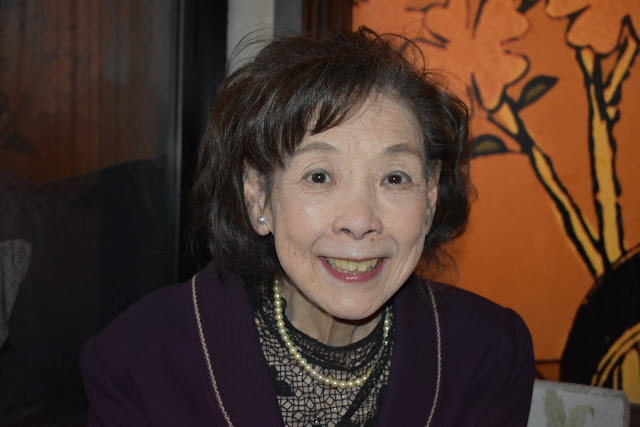
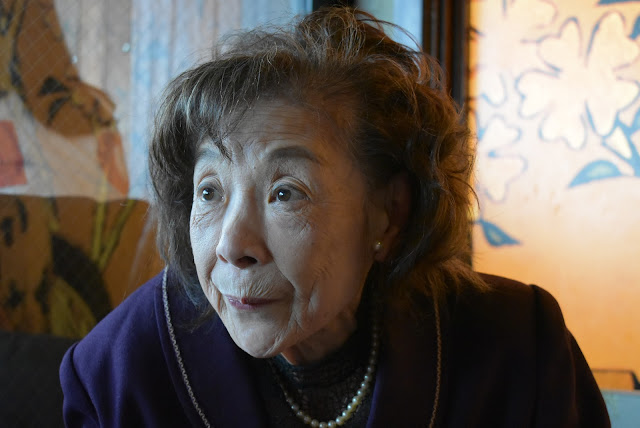
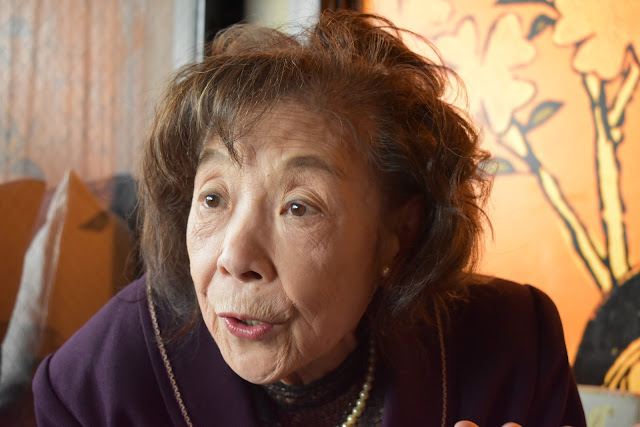
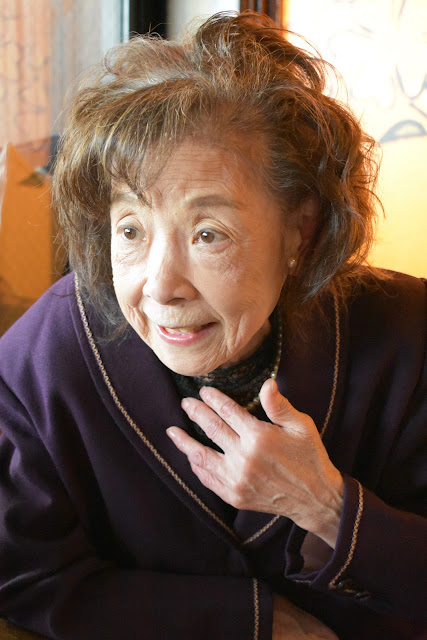
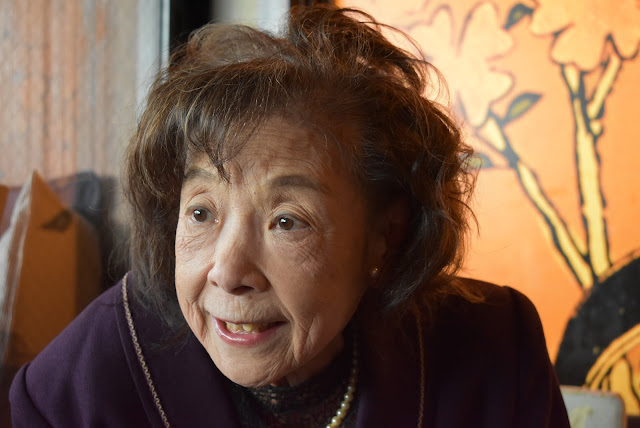
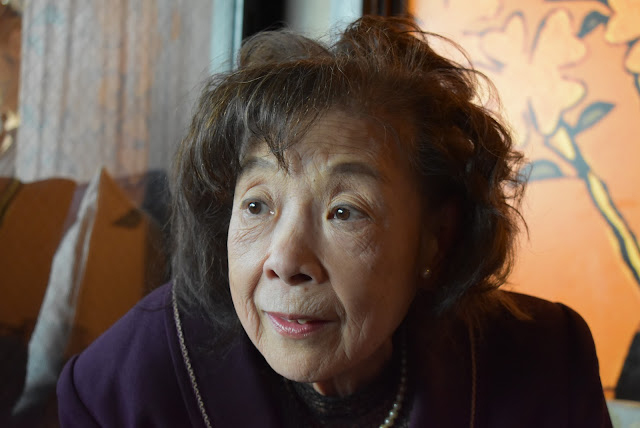
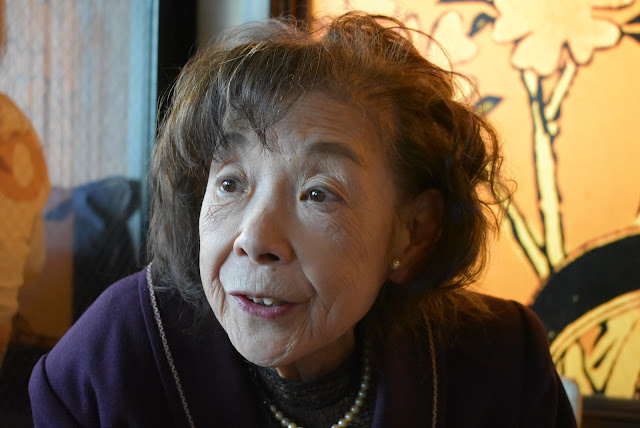
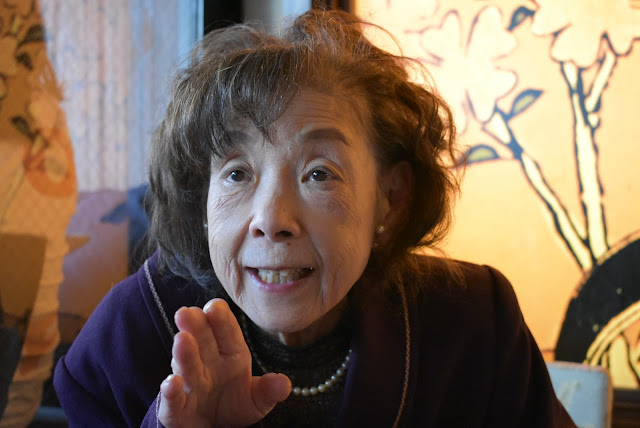
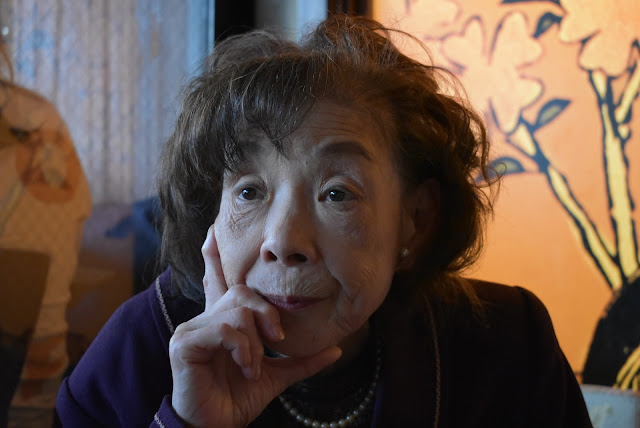
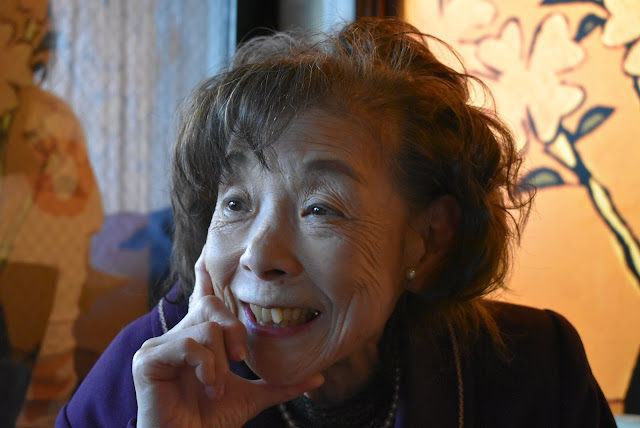
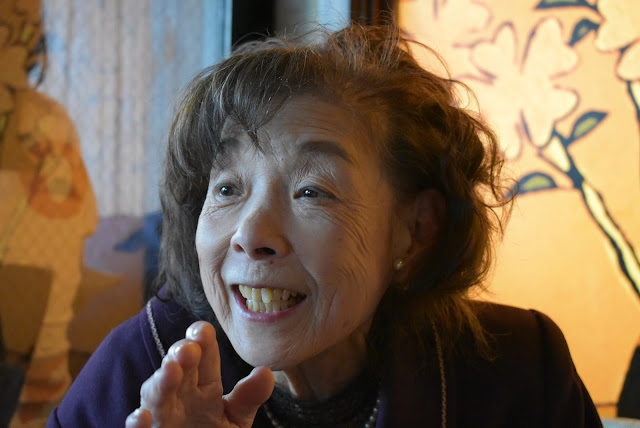
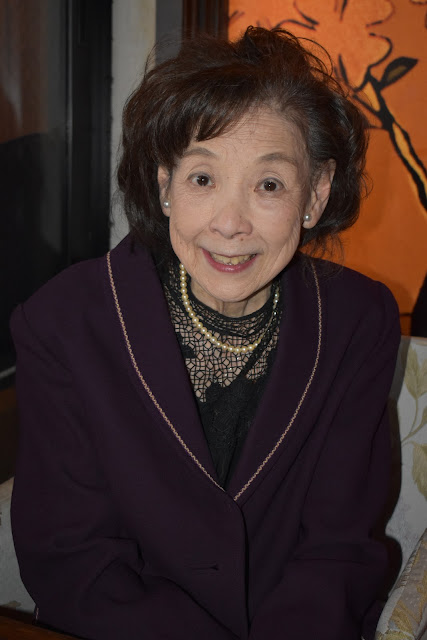
Machiko Naka (October 12, 1936 – March 4, 2023) was an accomplished actress who appeared in many Toho films throughout the years. She was a regular actress in the popular Young Guy series and appeared in such movies as the Crazy Cats romp Las Vegas Free-for-All (1967) and Kihachi Okamoto’s war epic Battle of Okinawa (1971). Godzilla fans would know Ms. Naka as the actress who played Ichiro’s mother in Godzilla’s Revenge (1969), but her SFX credits also include appearances in episode 22 of Ultra Q (1966) and episode 2 of Ultra Seven (1967-68) for Tsuburaya Productions. In October 2021, Ms. Naka spoke to Brett Homenick about her acting career in an interview translated by Maho Harada and Mao Watanabe.
Brett Homenick: Please tell us where you were born, and tell us about your early life, growing up.
Machiko Naka: I was born in Dalian, Manchuria. After World War II, my family and I returned to Japan in 1947. We came back to an area in Hiroshima City called Koi, where my mother’s family was from. I started elementary school in Hiroshima when I was in the fifth grade. This area of Hiroshima was very rural.
BH: What memories do you have of living in Manchuria?
MN: After the war ended, the Soviet soldiers came. Women and children were in danger, so we had to hide in our yard. My father worked in food production and made tsukudani [preserved food made by cooking seafood and vegetables in sweetened soy sauce] and pickles for soldiers. So there were many barrels in our yard. My sisters and I would hide in these barrels from the Soviet soldiers, who were wearing lots of watches. We were very frightened and had to hide all the time.
Because my father worked for the military, we weren’t allowed to come back to Japan for a while. Many soldiers were going back to Japan, but we weren’t allowed to go back. So my father negotiated a deal: He would provide the house, and, in exchange, we could return to Japan. So we finally were able to return in 1947. We arrived at Sasebo in Kyushu. Luckily, my mother’s home was still standing in Koi, Hiroshima, so my family and I went there to live.

BH: Tell us about your sisters. What memories do you have of [them], especially growing up at that time?
MN: I have five siblings. My oldest sister was married to the chief priest of a temple in Hiroshima. My second oldest sister was a dressmaker. The third sibling is my older brother, who went to Brazil with my father. After living in Manchuria for so many years, my father didn’t feel comfortable in Japan. So, after my sisters and I started working, my father went to Brazil with my brother and worked very hard there. The fourth sibling is the sister who was in Takarazuka.
I’m the fifth sibling, and I have one younger brother. So there were six of us, but all my siblings have passed away; I’m the only one who’s left. My younger brother died quite young. I was very lonely, but luckily I have this kind of work. It’s been a while since I retired. I developed back pain and have to be treated, so I stopped working.
I was also in Takarazuka. My sister who was in Takarazuka was three years older than me. She was my senior, and I always accompanied her to the exams. One day, someone asked me, “Why don’t you join Takarazuka, too?” But I said, “No, I don’t want to.” But, before I knew it, I was also in Takarazuka. Back then, you would study for one year and then perform onstage. Nowadays, they study for two years. So I studied for one year, and then I performed onstage.
But I only stayed for a year or so. I was told that, because I’m short, I was better suited for films than for the stage. So I was with Takarazuka Eiga [Takarazuka Films] for several years, and then I was invited by some executives from Toho to an interview. I was interviewed along with a few of my colleagues from Takarazuka and was asked to join Toho. Soon after I joined Toho, I got the role in the Young Guy series [as Teruko Tanuma].
BH: Let’s go back to Manchuria. Do you have any other memories? For world history purposes, [do you have] any other stories about the Soviet soldiers?
MN: It was very scary. But I was with my family, so we would hide together. So it wasn’t so bad.
BH: Next, please talk about the transition to life in Japan after Manchuria. What was that like, and what did you do immediately after coming back to Japan?
MN: When I came back to Japan, I was in elementary school, so I don’t remember much about the transition. My parents were in good health, and my father had many business partners from Manchuria, so his business was going well after we returned. But I was a little girl back then, so I didn’t pay attention to how my parents were making a living. Now that I have experience making a living, I understand these things. But, at the time, I didn’t pay much attention.
BH: Where did you go to school? Talk a little bit about your school life and your hobbies at that time.
MN: We lived in the countryside, and the school was very close to my house. I started attending this school in the fourth grade and then did the fifth and sixth grades at the same school. I went to a girls’ [junior high] school in Hiroshima for one year. Then my father moved his business to Kobe, so I started attending a junior high school in Kobe from the eighth grade. I then attended high school in Kobe for three years.
After five years in Kobe, I joined Takarazuka. I lived in Kagekiryo [Opera Dormitory], which is a dorm near Takarazuka-Minamiguchi Station. My sister was living in Kagekiryo, and I started living there, too. Then I was invited to join Toho, so I went to Tokyo on my own. I found a small house in Seijo, near Toho Studios. But it wasn’t a good idea for me to live alone, so my mother came to live with me. Around the same time, my father went to Brazil, so my mother came and lived with me.
BH: Prior to Toho and Takarazuka, did you have any particular hobbies or interests? Other than becoming an actress, did you think you might do something else?
MN: Since I was small, I did traditional Japanese dance. My mother loved lessons like shamisen, koto, and piano, so all my siblings took lessons. Both my sister who was in Takarazuka and I took Japanese dance lessons for a long time. We also took piano and koto lessons. All my siblings could play the koto. There were many of us, but my mother allowed all of us to take lessons. We also took tea ceremony lessons, and the teacher would come to our home.
BH: I know you’ve already talked about going to Takarazuka, but is there anything else you would like to share about how you joined Takarazuka and some of your early years there?
MN: Before joining Takarazuka, one of my sisters saw an ad in a magazine called Shufu to Seikatsu [“Housewife and Life”] that was casting for Girls’ School (1955), which starred Chikage Ogi and many others. They invited applications from female students from the general public. My second-oldest sister thought I should apply, so she sent in my photo, and my application was approved. I had an interview and got the role of a female student. This was before I joined Takarazuka. I had just graduated from high school and was very lucky.
I never thought of going into the entertainment business or joining Takarazuka, but I was a Takarazuka fan. All my siblings loved Takarazuka, and my sister who went to Takarazuka had always dreamed of being a Takarazuka star since she was a child. I had never thought about going into the entertainment business, but I was lucky to be cast in Girls’ School. I guess it was fate — I became an actress and eventually joined Takarazuka and Toho. But it wasn’t something that I proactively worked toward.
BH: I understand that your real name is Machiko Nakabayashi. So how did your name get shortened to just Naka?
MN: When I entered Toho, they told me I needed a stage name. People at Toho gave me this name. My last name is Nakabayashi, so they shortened it to Machiko Naka. My first name is Machiko, but they changed the kanji [Chinese characters] for chi. My real name uses the character that symbolizes wisdom, but this character has a lot of strokes, so they thought it wasn’t well balanced with my new last name, which had very few strokes. So they changed it to the character for “one thousand,” which uses very few strokes. Toho gave me this stage name when I first started working there, which was around the time of the Young Guy series.
I can’t remember when it was, but they took me to Cairo [Egypt] for a film festival called Nihon Eiga Mihonichi [Japanese Film Market]. It was the last time they had this film festival. On my way back from Egypt, I went to Rome, Spain, and Paris. That was the only time I went abroad, but I have such wonderful memories from this trip. I was very lucky because Toho took me to this film festival.
BH: Around what year was that?
MN: I think it was around 1966. Around that time, there was a TV show called Freezing Point (1966), which starred Michiyo Aratama, who was my senior at Takarazuka, who was also at Toho. I was also in this show, and Iwao Mori, who was the vice president of Toho, thought that my acting was very good in this show. When it was decided that Toho was going to participate in the film market in Cairo, I was told to go see him. When I did, he told me that my performance in Freezing Point was very good, and he told me that I could go to Cairo. So the trip was a reward for my performance.
BH: Do you have any other stories about Iwao Mori?
MN: He was the vice president. He was a very important person, so I didn’t have many chances to see him. The only time I saw him was when I went to see him at his office at the Toho headquarters.
BH: Let’s go back to Girls’ School. Do you have any memories of making this movie?
MN: In Girls’ School, I played the role of a female student and just enjoyed acting with my friends. I just applied to be in one movie, so that was it. I had just graduated from high school and didn’t have any intention of becoming an actress, but by chance I got a role in this movie and then joined Takarazuka.
I had never taken any lessons or prepared to become a professional actress, so, after I joined Takarazuka, I had to work very hard to keep up with everyone. Everyone had worked very hard for one or two years to get into Takarazuka. It’s still the case now, but it’s always been very hard to get into Takarazuka.
My sister had studied very hard before getting into Takarazuka, but I hadn’t studied at all and had just applied for that movie. I had taken Japanese dance lessons for a long time, but I didn’t have experience with singing, ballet, or any of that. That’s why I thought I wouldn’t get accepted. So I was very lucky to get into Takarazuka on my first try. Everyone usually has to try two or three times before getting accepted.
Back then, we only had one year of training, but nowadays you have to train for two years. I took singing and ballet lessons after class [at Takarazuka] so I could keep up with the others. After one year of training, I was able to perform onstage at Takarazuka.
BH: Let’s talk about joining Toho. You did talk about it a little bit before, but could you tell us more about joining Toho?
MN: After my first performance on the Takarazuka stage, I was also in some TV commercials. Around that time, Mr. Nakamura, the director of entertainment at Toho, came to Takarazuka and interviewed several of us in my cohort. I hadn’t heard about the Young Guy series then.
I had the interview with Mr. Nakamura. I don’t remember the details because it was such a long time ago, but I think he invited me to Toho Studios, and my father was in Tokyo at the time. I didn’t intend to go because I was in Takarazuka. But, yes, I think Mr. Nakamura invited me to Toho. I can’t remember exactly what happened after that, but I thought, if the manager of Takarazuka Eiga, Mr. Nakamura, was offering me to visit Toho, I should go.
[Yoshizumi] Takai, who was my teacher, said that, because of my short height, I was better suited for movies, and suggested that I go to Toho. Around the same time, Mr. Takai said they were looking for someone to play the part of Mr. [Yuzo] Kayama’s younger sister in the Young Guy series. Maybe he heard this from Mr. Nakamura. So I began to think that maybe I should go to Tokyo. My sister was in Takarazuka, so maybe I should go to Tokyo and be in movies.
Mr. Takai thought it was a good idea for me to go to Toho. He said that Mr. Nakamura had invited me, so I didn’t need to worry about anything, that everything would be all right. So I joined Toho. I thought about living in a boarding house in Tokyo. But my father had just left for Brazil, so my mother decided to come live with me in Tokyo. We looked for a place near Toho Studios and decided to live in Seijo, which was the closest.
At first, I did some small jobs. Then I got the role of Teruko, the younger sister in the Young Guy series, which ran for a long time. I didn’t expect it to run so long! I don’t know how many films there were in that series, but I was in it from the beginning to the end. The Young Guy series lasted about 10 years, and I played the role of Teruko, the younger sister, alongside Mr. Kayama for the entire series, from when the Young Guy is a student [in Sir Galahad in Campus (1961)], all the way to the end in Return of the Champ (1981).
Recently, Mr. Kayama was ill, but I was relieved to see him on TV the other day and to see that he’s doing better. Mr. Kayama also lived in Seijo, but I heard that he and his wife moved away from Seijo and now live in a condominium. I think he had a brain infarction and wasn’t in good health, but he’s been in rehabilitation for a while now. I’m glad he’s doing better and is able to go on walks.
BH: You also mentioned that your mother came to live with you in Seijo. How long did she live with you at the time?
MN: We lived together until she died of a brain infarction. When my father died in Brazil in 1977, my mother was in Seijo. Before he died, my mother went to Brazil to look after him. My brother was also there and had married, so his wife was there, but my mother wanted to go to Brazil to look after my father. My father wanted her to stay with him in Brazil and told her not to talk about Japan so much. But she really wanted to come back and talked about Japan often.
My brother understood this, so, after the first anniversary of my father’s death, she came back to Japan and lived with me again in Seijo. In the end, she had a brain infarction and passed away in December 1991. I took care of her for a long time, making her meals and that sort of thing. I wanted to bring her home, but my mother knew that I hadn’t married and lived alone, so she said she would stay at the hospital, where she passed away. Since then, I’ve lived alone in Seijo.
BH: Why did your father move to Brazil?
MN: My father moved to Brazil with my brother. They ran a chicken farm. I don’t think he did much work over there; it was mostly my brother who was running the farm. That’s why, after my father died, my brother couldn’t come back to Japan. My mother stayed in Brazil until the first anniversary of my father’s death, and then she came back to live with me. She passed away in the hospital in December 1991.
I was living alone in Seijo then, and I was in my 50s. I was a member of the Japan Screen Actors Association and paid their annual fee, which was 6,000 yen. I was part of a small agency, which got me a lot of work. So I was still very busy in my 50s.
BH: Let’s talk about the contracts at Toho. How were the contracts done? Could you talk about getting signed to a contract at Toho, and did it change over time?
MN: No, in my case, the contract didn’t change much. I was at Toho from 1960 for about 10 or 11 years. It was a long time ago, so I don’t remember very well, but my performance fee was divided into 12 months. They paid me this amount every month and transferred the money into my account. I paid for my living expenses with it.
So, if I were in a movie, my performance fee would be 200,000 yen or 300,000 yen, but I wasn’t paid a lump sum. If I did five movies in a year, they would take the total amount and divide it by 12, and then they paid me this amount every month. There’s no such thing as a fixed salary in the entertainment industry.
I was with Toho for 10 or 11 years from 1960. Then the movie industry went into recession. They told us they couldn’t keep people under contract anymore, so I switched to an agency. All the Toho directors and actors, everyone got laid off because the TV industry was thriving, and the movie industry was in a slump because fewer people were going to the cinema.
Nowadays, the film industry is much better, but, at that time, it wasn’t very good. After I was laid off from Toho, people suggested that I join an agency. I went to a few agencies, some of which were very small. In the end, I joined an agency called Toei Actors Center, even though I had been at Toho. Toei did a lot of TV, so I did a lot of TV work. I did all kinds of work. Once, with eight other actors, we toured elementary schools and junior high schools by bus and performed plays.
I’ve been an actress all my life. I’ve never worked any other jobs, not even part-time jobs. People suggested that I do some part-time work, but I’ve been fortunate to have only worked as an actress.
BH: How would you describe the difference between Toho and the Toei Actors Center? How were they different?
MN: With Toho, the work was mainly in films. I did have a lot of TV work, like Freezing Point. But the Toei Actors Center is an agency, so the format was completely different. There weren’t any contracts for the salary. If I had a job for a TV show, they would pay me the entertainment fee directly. I didn’t do any movies with Toei, just TV. But I had a lot of TV work, ranging from small to big projects. So the fee was very low for each job. Even if I had a few TV jobs in a month, I wasn’t paid very much. I wasn’t in any Toei movies.
BH: Let’s actually talk about some of the movies you did at Toho. The first movie I’ll ask about is Romance Express (1961), with Frankie Sakai and Reiko Dan, directed by Yuzo Kawashima. What do you remember about Romance Express?
MN: I remember director Yuzo Kawashima’s being physically disabled. He had bad legs — I think he had polio as a child. The actor Tatsuya Mihashi held a dinner on the anniversary of director Kawashima’s death every year in Shinjuku. Mr. Mihashi was also at Toho and invited me to these dinners, and I went every year. I was in many of director Kawashima’s films.
BH: Do you have any [memories of] Frankie Sakai?
MN: Frankie was such a nice man. We were in this movie together, but we weren’t in the same scenes. In the Company President series, most of Frankie’s scenes took place in the office with Mr. [Hisaya] Morishige, whereas I played Mr. Morishige’s daughter, so most of my scenes took place in the home. We rehearsed our lines together.
I worked with him in a play in Nagoya, and he was so good to me. He was so kind, so I respect him so much. I was nervous about making mistakes, about not appearing onstage at the right time. If you don’t appear onstage at the right time, it’s the end of your career as an actor. Frankie would often accompany me on the walkway to the stage. He was so good to me. I have many good memories with Frankie.
BH: Let’s talk about the Company President series. These were directed by Shue Matsubayashi.
MN: Director Matsubayashi was the son of a temple priest in Shimane. I was in a lot of his films. He was so interesting. His brother is now a priest at the temple. Director Matsubayashi went to Brazil. My oldest sister was also married to a temple priest [but not at this temple]. The head temple in Kyoto told her husband to go to a temple in Brazil to teach Buddhism, so my sister and her family all went to Brazil. They invited my father to move to Brazil, which is why he ended up living there. Director Matsubayashi told me that he went to Sao Paolo, Brazil, and visited my brother-in-law. That was after he stopped making movies.
I met director Matsubayashi through Mr. [Sanezumi] Fujimoto, a famous producer at Toho, who produced the Young Guy and Company President series. Mr. Matsubayashi visited Mr. Fujimoto’s grave in Tokyo on the anniversary of his death every year to offer prayers because he’s a Buddhist priest. He went with seven or eight others from Toho, like Yoko Tsukasa and Ms. [Yuriko] Hoshi. Director Matsubayashi invited me, as well, so I went every year. Mie Hama didn’t come because she lives in Hakone or something.
All of us gathered at Mr. Fujimoto’s grave every year, which was at a large temple in Tokyo. We all cleaned Mr. Fujimoto’s grave, and Mr. [Yasuo] Tanami’s wife brought flowers. Director Matsubayashi was a temple priest, so he would recite the sutras. After the ceremony, we had lunch at a Chinese restaurant in the Imperial Hotel and then went our separate ways. We did that every year. I think the anniversary of Mr. Fujimoto’s death was in May.
After the 33rd anniversary, we stop offering ceremonies. Director Matsubayashi told me that, for the last ceremony, Mr. Fujimoto’s younger sister offered to pay 100,000 yen for the lunch at the Chinese restaurant in the Imperial Hotel. But all that ended with the 33rd anniversary.
BH: What memories do you have of Mr. Morishige?
MN: You’ve probably heard about the sexual harassment accusations against Mr. Morishige, but he never did anything like that to me. I played the role of his daughter, so he was very strict with me. I always tried to leave as soon as I could after the shoot. Mr. Morishige didn’t say anything, but I could feel that he thought I should stay a bit longer after the shoot was over.
I joined the Toei Actors Center thanks to Mr. Morishige. His daughter Akiko knew someone at Toei and made the introduction. That’s how I was able to join Toei Actors Center. His daughter’s husband had his own agency called Izumi Productions, which still exists today. Mr. Morishige did a play at the Imperial Theatre for many years. But there was no suitable role for me, so his daughter suggested that I join the Toei Actors Center. That’s why I did a lot of TV work.
I’m so grateful to Mr. Morishige, and to Akiko, who’s passed away. I think her son now runs the company.
BH: Another one of Mr. Morishige’s daughters was played by a young Hiroko Sakurai. Do you remember working with Ms. Sakurai as one of the daughters of Mr. Morishige?
MN: Ms. Sakurai is now with Tsuburaya Productions, doing kaiju films. She’s no longer acting and now works as a producer. I don’t see her much anymore because we don’t work together anymore. In the Company President series, she played the role of my younger sister. We were both Mr. Morishige’s daughters, with my being the older daughter. She’s with Tsuburaya Productions, so she has a lot of work. She joined Toho about half a year after I did, so I’m her senior. She’s much younger than I am. I think she’s also been abroad for the kaiju films.
BH: But, on the set, do you remember anything about her?
MN: We were working during shoots, so I don’t have any memories of her. I’m the type of person who concentrates and stays quite focused because I need to focus on my work. She married young and had a family, I think. To be honest, I didn’t really socialize with her.
We worked together, but all of us actors were busy trying to do our job well. We played sisters in the movie, but we didn’t eat together or anything. That’s how it was in the movie industry. In TV, people would go out together. But I wanted to go home as soon as the work was done.
BH: During the Toho years, were you friends with any other actors or crew members?
MN: I didn’t become close with other actors. At work, we would rehearse lines together, but, otherwise, we didn’t spend time together. People didn’t get that close to each other. We were busy trying to do our jobs well. It depends on the person, but I didn’t become close with any actors. I worked a lot with [Tatsuyoshi] Ehara in the Young Guy series because we had a lot of scenes together, but there weren’t many people who became friends among the crew or actors.
BH: You made many of the Company President series. Do you have, generally speaking, any memories about any of the Company President series?
MN: I don’t have any memories in particular. I was busy trying to do my job well. But I really enjoyed the shoots and really loved my work. So I was happy that the Company President series continued for a long time. But I don’t have any memories.
BH: Generally, when you were shooting, what was the shooting schedule like? How difficult was it?
MN: For Toho movies, we usually started at 9:00 a.m., so I would arrive an hour early to have my hair done. I did my own makeup. Immediately after entering the Toho gate, I would go to the hair and makeup room. The hair stylist would do my hair while I did my own makeup. So I would arrive an hour or so before the shoot. But, for TV, there is no fixed time. We might start at noon, or at 10:00, so there is no fixed schedule for TV.
BH: Let’s go back to director Matsubayashi. On set, how would he direct actors? How would he direct you? How would he work?
MN: Director Matsubayashi never said anything. He let us act freely and never told us what to do. He let us do what we wanted to do. He was that kind of director.
BH: Now let’s move on to the Young Guy series. First of all, you worked with Yuzo Kayama in many of these films. What was his personality like?
MN: He could do anything; I was always impressed. He played the piano well, he played the shamisen — he was so nimble. I was always so impressed by him. He loved to sing. After his birthday, he invited me and some others to his home, like Mr. Ehara and Kunie Tanaka. He ordered sushi and then sang all night. He didn’t let anyone else sing, but he sang all night. I was impressed with how much he loved to sing. I think he loves singing more than saying lines or acting. He’s so nimble; he can do anything and learns very quickly.
BH: Was he very sociable on the set, or was he very serious?
MN: He definitely wasn’t serious. If he wasn’t in a scene, he would lie down and fall asleep. He was very frank. He wasn’t very brisk but had his own leisurely pace.
BH: Next, let’s talk about director Jun Fukuda. He worked on the Young Guy series, many of them. What was his personality like, and how would he direct?
MN: I remember his love of coffee. He lived in Setagaya and opened up a coffee shop near his house. That’s how much he loved coffee. He died very young from cancer. I went to his memorial at a hotel.
He also let us act however we wanted in the Young Guy series. The character I played, Teruko, wasn’t a difficult role, so he let me act freely without telling me what I should do. Teruko lived with her grandmother, so the role wasn’t very stuffy. The work was very free, so I really enjoyed it.
I worked with Ms. [Choko] Iida and Mr. [Ichiro] Arishima, who played my father. Mr. Arishima also lived in Seijo. His daughter was also in Takarazuka, so I remember him well. When he passed away, his funeral was held at his home. But he never said much. When he wasn’t in a scene, he would be writing or doing something else. We didn’t talk that much because we were all working. I remember him being very free, not a difficult person.
BH: Of course, there are many Young Guy movies. Does anything stand out — any shooting memories?
MN: The last one, Return of the Champ, was the most memorable because I was in a lot of scenes. I also had a lot of scenes in Sir Galahad in Campus, but, for the ones in between, I didn’t have that many scenes because Mr. Kayama and Ms. Hoshi went abroad and things like that, so the shoots were often overseas. For me, I had the most scenes in Return of the Champ.
There was a 10-year gap between Return of the Champ and the previous Young Guy movie. In the last film, my character was married to Tatchan’s [Mr. Ehara’s nickname] character, so I played the role of a wife. I ran a shop, so I was always in a kimono. I played the role of Teruko throughout the series, but the last one was the most memorable one for me because I had the most scenes.
BH: How did things change? At first, it was Yuriko Hoshi as his love interest, then it changed to Wakako Sakai. So did it change anything?
MN: No, not really. That role changed from Ms. Hoshi to Ms. Sakai. But I wasn’t in many scenes. I was only in the scene with the tanuki [Japanese racoon dog] and went to the shop a few times, so it didn’t affect me at all.
BH: What about Tatsuyoshi Ehara? Do you have any memories about him or his personality?
MN: We played opposite each other, so, of all the actors, I spoke to him the most and felt the closest to him. There’s a Toho reunion party called Kinuta Doyukai [Friends of Kinuta], which is a reunion of all the people who worked together at Toho Studios — actors, crew members, directors, producers, the people who did the lighting and stage sets – all of us who worked together. This reunion is held every other year in autumn, usually in October.
Tatchan and I are the presenters, even though I’m not very good at speaking. I let Mr. Ehara do most of the talking. It was canceled last year and this year because of COVID. Everyone is optimistic about next year, but who knows. My body is in pain, so I’m thinking of not going. Anyway, we have it every other year, and everyone pays a participation fee, which is about 8,000 yen.
There’s a space like a conference room next to the set at Kinuta, and the cafeteria served sushi and things like that. We get together there and catch up with each other at this reunion. I think we’ll be able to hold the reunion next year. But the directors, Mr. Ehara, and most of the crew members have already passed away, so I don’t know. I got a postcard saying that the reunion was canceled for this year.
BH: You also worked a lot with the Crazy Cats, a comedy team, and also director Kengo Furusawa.
MN: Director Furusawa died young. He did the Young Guy series was with Takarazuka Eiga. He was such an interesting person, so nice and kind. His voice was very loud, so he sounded scary, but deep down he was very kind.
BH: How would he direct you or other actors in scenes?
MN: For the Young Guy series, I played Teruko for years, which was a supporting role. None of the directors ever said anything to me. They always let me act however I wanted.
BH: But he would give directions very loudly?
MN: His voice was very loud, like a soldier. All the directors for the Young Guy series had loud voices, but they were all very kind.
BH: Do you have any general memories of the Crazy Cats, like Hitoshi Ueki or Kei Tani?
MN: Mr. Ueki was the son of a temple priest. I worked with him many times, but we didn’t really socialize. He came to the Kinuta Doyukai reunion once. People like Ms. [Yoko] Tsukasa and Mr. [Akira] Takarada always came. And Izumi Yukimura, who was also in a lot of Takarazuka films, always came to the reunion, as well.
BH: Also, around this time, you did Ultra Q (1966) for Tsuburaya Productions.
MN: I was in many TV programs, but I don’t remember that one.
BH: This was [for] TV around 1964. Did you have any feeling about working on television at that time?
MN: I prefer film. TV projects are usually much smaller in scale, and the screen is much smaller, as well. So I preferred to be in movies. But, at the time, movies were in decline, so we couldn’t stay in the film industry. All the actors were being laid off. It wasn’t just the actors. The directors and producers were also getting their contracts annulled. So we had no choice but to work for TV productions.
In Ultra Q, I remember doing transformation scenes. They were called TV dramas, but the scale was much smaller than film, and we would shoot on location, not in the studio. But I don’t remember much. I was in so many TV dramas!
BH: Is it also the same for Ultra Seven (1967-68)?
MN: I don’t remember. I did a lot of TV work.
BH: Let’s talk about Godzilla’s Revenge (1969). Please talk about this movie and what you remember about this.
MN: Director [Ishiro] Honda was also very kind. In the later years of his life, he would go for walks with his wife and pass in front of our house, and I would speak to him when I saw him.
BH: You worked with a little boy named Tomonori Yazaki. What do you remember about working with the little child actor?
MN: I only saw him during the shoot and never saw him after that. I have no idea how he’s doing now, but he must be a young man by now. I may have some photographs with him here when we were in the tatami room after lunch. Please take a look later.
BH: Do you remember how long you worked on Godzilla’s Revenge?
MN: I was only in the scenes inside the house, so it was just a few days. Oh, I also had a scene where I’m on the phone, so I had two different shoots. But the shoot didn’t last very long.
BH: In the scene, there was Yoshibumi Tajima, another actor. I’ve heard other actors describe him as being a very nervous actor. On any movie, did you ever see that about him?
MN: Yes, I worked with him. He was more of a supporting actor. I was onstage with him in a production by the [Japan] Operetta Association, which was an operetta. But I didn’t socialize with him. I didn’t socialize much with the other actors. We would go our own ways after the shoot was over.
He had a heavy build. He was a supporting actor and was very experienced. I didn’t socialize with him outside of work. We were onstage together, but we were in separate dressing rooms, of course, so we didn’t really talk.
BH: In this movie, your husband is played by Kenji Sahara. Obviously, you didn’t have any scenes together, but, just generally, do you have any memories of Kenji Sahara?
MN: Ken-chan and I were very close, but I haven’t heard about him recently. He might have already passed because he was much older than me. I don’t think we worked much together. In that film, he played my husband, but we didn’t have any scenes together. We were very close, and he was very good to me. He always invited me to his events. He was also in a lot of Takarazuka movies.
BH: The next movie is Battle of Okinawa (1971). It’s a war movie directed by Kihachi Okamoto. What do you remember about Battle of Okinawa and director Kihachi Okamoto?
MN: I was only in one scene. I was in this movie because I owed money to Toho, and it was a way to pay them back because Toho was making fewer films. I was only in one scene in Battle of Okinawa, but I didn’t get paid. Toho considered this to be payment and canceled my loan. That’s why I was only in one scene.
With my contract, I received a monthly salary from Toho instead of being paid per movie. But, because Toho was making fewer films, I had been paid but hadn’t been in many films. So being in this one scene in this movie made up for the monthly salary I had received.
I didn’t socialize with director Okamoto outside of work. Director Okamoto’s wife is doing well — she’s directing these days. I think she met director Okamoto at Waseda [University], where the director was her senior.
Keiju Kobayashi was in the Company President series and the Young Guy series. He was also in Battle of Okinawa. He took very good care of me. He arranged for me to be in a radio drama. It aired for 15 minutes at 8:15 a.m. every morning, from Monday to Friday. Choko Iida played my mother, and Mr. Kobayashi played my brother. The salary was very good.
Mr. Kobayashi got me this role, and he took very good care of me. It was a radio drama for TBS, and we would record the episodes for the whole week in one evening. It was such a good experience. I really loved that radio drama.
BH: Let’s talk about the end of the contracts at Toho. Around 1970 or so, Toho ended its contract system. What do you remember about that process, and what was it like when Toho ended its contract system?
MN: I was 31 or 32 years old when my contract ended. The person in charge at Toho said, “Maybe this is your unlucky year.” [In Buddhism, there is a year when you are said to be cursed.] The film industry was in decline, and Toho couldn’t keep its actors under contract anymore. So we actors had to join agencies. There was nothing we could do.
People were let go at the end of their contract. Everyone had a one-year contract, which was renewed every year, but Toho could no longer renew the contract and keep their actors because the film industry was in decline. So they told us to find an agency. I don’t have a husband, so I had to find another way to make a living, so I joined an agency.
BH: After they said that they couldn’t renew the contract, what happened next?
MN: I went to an agency. It was all TV and theater. For theater work, I performed in a comedy at the Koma Theaters in Osaka and Shinjuku. I didn’t perform at places like the Meijiza theater. It was Toho, so I performed at the Koma Theaters, which were in Tokyo and Osaka. I also performed at Meitetsu Hall and Chunichi Hall in Nagoya. So I did a lot of TV and theater work, but I had very little work in film.
BH: At Toho, what would you say was your favorite movie that you worked on?
MN: The Young Guy series was my favorite. It’s like a treasure to me to have played Mr. Kayama’s sister. Sometimes, Mr. Kayama’s fans call me to ask me how I’m doing. The other work I did were just one-offs. The Company President series also spanned a long period, but no one is left from that series, like Mr. Morishige. Mr. Kayama is still alive and well, so the Young Guy series is like a treasure to me.
BH: Who would you say was the best actor at Toho that you worked with?
MN: Mr. Ehara and Mr. Kayama. For the Young Guy series, we shot two movies every year. There was one at New Year’s and one in the summer. There were also movies with Takarazuka Eiga, so I would go there every month and stay in a ryokan [a traditional Japanese inn]. I’m most nostalgic about the Young Guy series.
I was in a few of the Company President series, in both the first half and second half. Sometimes, people tell me that they saw one of the Company President series on BS [broadcast satellite] TV. But most of the cast and crew, like Mr. Morishige, have passed away, so it feels like it’s in the past.
BH: Who would you say was the best director at Toho that you worked with?
MN: It’s hard to say. I sometimes ran into director [Akira] Kurosawa on the street, but I never had the opportunity to work with him. I only worked with directors who did comedy, not with directors who were strict. None of the directors I worked complained very much and always let me act freely, so it’s hard to say.
 Vantage Point Interviews
A wonderful interview with an amazing lady! I’m sad to learn that she has passed away.
LikeLike